Hungary was on the verge of an exchange rate crisis - central bank chief


We have already reported extensively about Finance Minister Mihály Varga’s most important statements.
Matolcsy does not mince words
György Matolcsy kicked off by saying he will talk about the truth because this is no time for smoke screens. He said his speech aims to deter the political elite of the future from once again going on such an “inflation adventure” that was “committed and lived through” in Hungary.
Matolcsy describes it as a "mass casualty incident" of economic policy. Although, we are already on the way out of this, inflation could be around 7% by December, we have an experience behind us, an economic policy failure.
We are at the end of a "brief but vicious" inflationary period, but it was not the first one, as the 2020s show similarities with the 1970s, said Matolcsy. "Global central banks want to avoid a return to the '70s," he said, adding that more and more people are aware that
it's not inflation or growth, because inflation eats growth.
They know this in more and more places, but not everybody has realised it in Hungary yet, he added.
Slamming the government
Matolcsy recalled that the MNB had already indicated in spring 2021 that inflation would be persistent, and that the MNB was the first in the EU to take action against inflation.
But we found that we were alone,
he said, because the government did not introduce the measures in 2022 that it finally did in 2023, a year and a half late. According to the central bank governor, the MNB stepped on the brakes while the government stepped on the gas.
In 2021-2022, the government took measures that increased inflation substantially,
he said, mentioning deficit-boosting measures and the food price freeze.
The government may have been trying to put out a fire, but with fuel,
he said and recalled that in October 2022
WE WERE on the verge of AN EXCHANGE RATE CRISIS.
Finally, in 2023 the government launched the fight against inflation, and there is a high probability that inflation will fall to single digits by December.
The proximity of the exchange rate crisis and sovereign default last year was also discussed in a panel discussion:
The country came very close to an unmanageable crisis at the end of last summer, when at the peak of energy prices it was not clear how the economy could cope with external imbalances and high foreign exchange demand. However, as the year drew to a close, these tensions eased considerably, mainly as a result of the fall in gas prices and the central bank's emergency interest rate hike.
Price caps caused some of Hungary's excess inflation compared to regional peers
We are witnessing the inflationary adventure of an adventurist policy,
said the central bank governor. He presented the MNB's calculation which showed that GDP contraction in the second quarter (-2.3% yr/yr) could have been avoided (+0.3%) with inflation close to the regional average.
Dependence of Hungary has increased
Our competitiveness has deteriorated thanks to the "inflationary adventure", said György Matolcsy. At the bottom of this lies the economic-financial dependence that also causes low productivity. The economy's external dependence has grown significantly, while "the solution is always inside", he said.
This year, the country's current account balance has already been improving, largely driven by a decline in imports and lower consumption. "No competitiveness reform plays a role in this improvement, according to our measures," he said.
It should be clear that Hungary's risk perception is not good,
he said.
WE ARE AMONG THE five MOST FINANCIALLY VULNERABLE COUNTRIES," HE ADDED.
Responding to Varga's criticism
György Matolcsy responded to Mihály Varga's criticism of the developments in autumn 2022, when the MNB stopped raising interest rates, which lead to forint depreciation. Matolcsy said that there was a huge speculative wave against Hungary, negotiations on blocked EU funds were yielding no results, there were twin deficits, and the highest inflation of the EU was in Hungary, he recalls.
Not only sharks, but also other marine animals will move in on such an economy to see if they can get a bite out of it, Matolcsy said, and commenting on the halt in interest rate hikes, he said that
we made the best possible decision,
otherwise we would have had to raise interest rates further.
He also stressed that the central bank was not to blame for record high inflation.
Could the inflation target change?
In the mid-1980s, the world's leading economic policymakers agreed on inflation targeting, with only small differences between countries. Most recently, in Jackson Hole, the Federal Reserve chair called for no discussion on raising the inflation target, pointed out György Matolcsy. "It is not worth thinking about changing inflation targeting any further," he said.
If the Hungarian central bank were to consider such a change without any global consultation, it would be financial suicide.
commented Matolcsy on whether the Hungarian inflation targeting system could change. Such speculation would lead to an unintended fall in the exchange rate.
Mihály Varga said that the government has no exchange rate target and no inflation target, nor can it have any, these are rather theoretical issues, Varga concluded.
"The Hungarian economy carries a high level of public debt"
Ákos Péter Bod, university professor and former governor of the central bank, said that the high level of public debt, which is lower than in Austria or other countries, is a serious problem, but the bigger problem is that it is not someone else but the Hungarian economy that caused it.
"The average interest cost in Hungary is high, and it will continue to rise," said Ákos Bod Péter, citing as an example the foreign currency bond issue two weeks ago, which carried a 5.5% bond yield.
At the mercy of external factors
He pointed out that before the latest Moody's decision, the Ministry of Finance must have given a very good presentation, that they had not changed either Hungary's credit rating or the outlook. He then mentioned that it is still problematic that most credit rating agencies have Hungary's rating close to junk grade.
We are exposed to factors over which the government has no control
said Péter Ákos Bod.
He cited the interest rate environment in the neighbouring countries and the performance of the eurozone as examples. And because of this, the economist said, there is a
risk that Hungary will be stuck in a state close to recession.
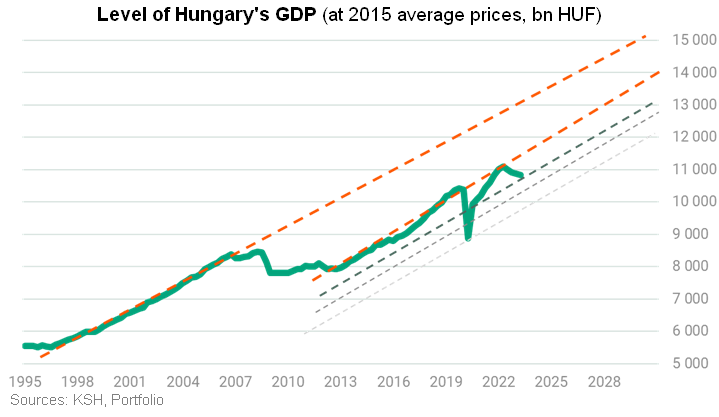
It is not known whether we will return to the growth trend or continue with a lower trend. The third option is that we will get stuck in a near-recessionary situation, said Ákos Bod Péter. He recalled that the MNB has stabilised the forint exchange rate, but this has come at a cost in terms of rising borrowing costs, which is hurting the economy.
He illustrated the above with a Portfolio graph:
Péter Ákos Bod also disagrees with the rewriting of the inflation target
It is debatable how good the inflation targeting system is in a world of rapid changes in the macroeconomic environment, said Ákos Péter Bod. He added it is more appropriate to look at the size of the inflation differential. The economist believes that Hungary should follow the example of the euro area in this respect.
Nor do I agree that a government minister should throw in a number for which it is not clear what the purpose is,
said the former central bank governor, referring to an opinion piece by Economic Development Minister Márton Nagy in late spring, in which he suggested that the inflation target should be set higher than the current one, as this would send a more realistic message to markets.
Varga says the main reasons for inflation were the following:
Finance Minister Mihály Varga said one of the key factors behind Hungary's high inflation was soaring energy prices, as Hungary has no great own capacities in electricity generation or gas production. The second key factor was booming food prices, fuelled by an unprecedented drought in Europe in 2022. The third factor was marked wage increases.
He added that the rapid reduction in the debt-to-GDP ratio (from around 80% before the coronavirus pandemic to around 60%) was thwarted by the pandemic, which turned the preservation of jobs into the key priority. Fiscal loosening was triggered by the new post-pandemic situation, he said.
Varga said that monetary policy is the main driver of inflation.
"I think that the central bank did the right thing by starting to raise interest rates, whether it did so in time or not is debatable," said Varga, adding that when the MNB raised interest rates, it was still buying government and corporate bonds.
You cannot blow hot and cold at the same time in any economy.
He also said that there were interest rate hike cycles were still in full swing globally when the MNB ended its own rate hike cycle.
The substantial forint weakening in autumn 2022 did not happen by chance, he said.
Responsibilities are divided," he said. "A stable and balanced exchange rate is important for the economy, it can contribute to growth, it can help preserve jobs."
International credit rating agencies also have a positive view on Hungary
The domestic banking system is strong, the labour market is tight, debt is falling, monetary and fiscal policy is tightening simultaneously, FDI inflows are massive, inflation is falling, energy dependence is declining, and the current account deficit is declining and is expected to be around zero this year, Mihály Varga cited the rating agencies' comments on Hungary.
I'm not saying everything is perfect, but we are on the right track,
he added.
The rating agencies highlight three risks for Hungary:
- One is that the war could shut off the energy taps, Varga said, adding that anything could happen. Therefore, energy dependence must be further reduced.
- The second risk is that the war will escalate. We cannot know and influence this, but we are close to war physically.
- The third risk is our dispute with the EU, Varga said. We have been having disputes with the EU for over a year, which are mainly political, not economic disputes, he said. The minister also noted that
nothing will happen in this regard until 15 October.
The EU wants to wait for the result of the Polish elections, and this will determine whether the negotiations speed up or slow down, he said. "It is not up to Hungary, we have met the conditions."
Deficit target revision ongoing
Varga said the central bank's loss will be reimbursed by the budget over a longer period which improves the country's fiscal position, adding that fiscal rigour will be maintained and the shortfall will be lowered.
The deficit target, which is currently 3.9% of GDP for this year, is being revised, he said.
He noted that the decrease in real wages resulted in weaker consumption which led to the the need of reviewing fiscal processes.
We are committed to lower the deficit this year,
he said, noting that the gap was around 6% last year. He added that the cabinet insists that the budget deficit will not exceed 2.9% next year.
He said that we could even stop ongoing investments if the fiscal situation so requires. Alternatively, the government could consider postponing defence investments.
Comments about a higher bank tax and a possible revision of interest-subsidised loans
Although the government is reluctant to use such a tool, it may consider raising taxes on banks if they make significant profits (which could exceed HUF 1,000 billion this year - editor's note), in order to improve the situation of public finances, said Finance Minister Mihály Varga in his presentation.
He also said that interest-subsidised loan schemes may also be reviewed, citing the significant gap between market and subsidised interest rates.
Asked by Portfolio after the event whether he had consulted with Minister of Economic Development Márton Nagy, Varga said that he had summarized in his presentation the fiscal measures available to the government "to intervene in the processes if necessary."
"One element of this could be a review of interest-subsidised loans. Obviously the government is considering here whether such steps are needed, either at housing subsidies or at energy efficiency subsidies.
I don't think it's necessary now, but it's certainly in the fiscal toolbox.
stated Varga.
Asked by journalists about the bank tax, he said that it is far from certain that the bank tax will be increased or that existing burdens will be extended.
My speech was not so much directed at the banks, just that this could be a fiscal tool, that we are also considering tax revenue to help correct the deficit, but that was not the basic point,
the Finance Minister added. He explained that, in his view, "monetary policy has had a significant impact on bank profits, and a positive one at that, as the high interest rate of the central bank has caused the banking system's profits to increase.
The government will not change interest-subsidised loans and will not raise bank taxes either, the leader of PM Viktor Orbán's ruling party said at a press conference held during the break of the Esztergom meeting of the Fidesz and KDNP parliamentary groups.
Varga speaks about battery factories
Mihály Varga said that there are decisions even within a family that we do not agree with. Varga would not put the dilemma in terms of "inflation and growth", but "balance and growth", he said, because until there is balance, there will be no sustainable growth. The external balance is already improving and the country is getting back on track for high growth.
In recent years, Hungary has become an integral part of the European automotive industry, Varga said, adding that 120,000 people work in the automotive industry alone. In this industry, a decision was taken to produce only electric cars, and the customer trend is also pointing in the direction of increasing the share [of EVs]. According to Mihály Varga, it is possible to stay out of this, but he believes
IN THE LONG TERM, THE AUTOMOTIVE INDUSTRY WILL CONTINUE TO BE THE LEADING INDUSTRY IN THE ECONOMY, WHICH IS WORTH GETTING INTO.
It's not all the same which part of EVs will Hungary manufacture!
There is no doubt that there is a technological revolution, but it is not just that the car is electric, because the Hungarian Post Office already had an electric car in 1926. The question is which part of this computer on four wheels will we make?
responded Ákos Péter Bod to Varga's remark that Hungary cannot allow itself to stay out of the technological transition.
According to the economics professor, it would be more important for Hungary to develop the IT part of the business rather than the water-intensive and low value-added assembly.
He pointed out that Hungarian industrial policy had been moving towards energy-intensive production over the past decade, but that we are slowly reaching the energy threshold. The former central bank governor sees it as a positive development that our energy networks are already interconnected with all neighbouring countries, or will be in the near future.
Cover photo: Getty Images





