EU report reveals that Hungarian children are in big trouble


Eurofound, the European Union's research agency, recently published a comprehensive study on the quality of child welfare and social services. The survey looked at child poverty, early childhood education and care (ECEC), education and school-based activities, health care, housing and nutrition, and does not paint a good picture of the situation in either the EU or Hungary.
The study shows that child poverty in the EU has fluctuated between 2015 and 2022, but typically the proportion of marginalised people has decreased, fewer families have been at risk of poverty each year, and access to health, education and social care has improved in most Member States.
the situation has changed, however, during the coronavirus pandemic, and by 2022 over one-quarter of children in the eu were at risk of poverty or social exclusion.
There are major differences, though, between urban and rural areas. In 2022, 7,860,000 children living in cities in the EU were at risk of poverty or social exclusion. This means that over one-quarter (25.5%) of children living in urban areas experienced that risk. This was the case for 6,806,000 children living in towns and suburbs (23.8% of children living in those areas) and 5,273,000 in rural areas (24.7%).
Hungary's performance in this respect is remarkable. While child poverty rates have barely decreased in the EU as a whole, the situation in Hungary has improved significantly since 2020 and is below the EU average, with only 18.1% of children at risk.
However, an analysis of some segments shows that there are serious problems in many areas in Hungary. For example, in 2021, 5% of low-income households with children aged under 16 in the EU had unmet medical needs. In Hungary, the percentage was nearly three times the EU average (14.6%). In terms of urbanisation, the highest percentages of households with unmet medical needs were in towns and suburbs in Romania (24.5%), Hungary (24.2%) and Latvia (23.8%).
Hungary is either a top-performer or a bottom-scraper
The 2022 Council Recommendation on early childhood education and care asks the Member States to ensure that by 2030 at least 45% of children under the age of three participate in ECEC for at least one hour per week. In 2022, only nine member states, including Hungary, achieved this goal.
For children between the age of three and the starting age for compulsory primary education, the target set in the 2022 Recommendation is the same as the benchmark set in the EU strategic framework for a European Education Area: at least 96% of children in that age group should use these services by 2030. In 2022, 87.1% of children in that age group in the EU participated in ECEC services for at least one hour per week. Only Belgium, Hungary, Spain and Sweden achieved the 2030 target.
The AROPE rate for children differs according to the degree of urbanisation – that is, according to whether they live in cities, towns and suburbs, or rural areas. In Hungary and Poland, the percentage was approximately one-tenth. In Hungary, the share decreased from 28% in 2015 to 10% in 2022. This points to significant progress and effective policies to reduce child poverty in urban settings, according to the authors of the Eurofound study.
The research also looked at ECEC participation of children at risk of poverty and found that participation rates improved between 2015 and 2022, indicating an upward convergence.
The participation rates in ECEC of children aged between three and compulsory schooling age and classified as at risk of poverty or social exclusion in 2022 are displayed in the graph below. In 2022, 93.7% of children in that age group at risk of poverty or social exclusion used ECEC for at least one hour per week. Hungary (100%) and Luxembourg (94.3%) had the highest participation rates that year.

In 2022, the EU average early school-leaving rate was 9.6% (Figure 7). Breaking down this group by where they lived in terms of degree of urbanisation, 8.6% of early school-leavers in the EU lived in cities, 10.6% in towns and suburbs, and 10% in rural areas. Romania (15.6%), Spain (13.9%) and Hungary (cc. 13%) had the highest rates of early school-leaving in 2022, while Croatia (2.3%; note, however, that data reliability is low) and Ireland (3.7%) had the lowest rates. The EU average decreased from 14.7% in 2007 to the 2022 rate of 9.6%.

It's important to note that the indicator that monitors early school-leaving (which is included in the Social Scoreboard as well as the Education and Training Monitor) measures the share of the population aged 18 to 24 with at most lower secondary education who were not in any form of education or training in the four weeks before they were surveyed. So this is a retrospective look at those who dropped out of the education system as children and did not go on to obtain a school leaving certificate or any kind of vocational qualification.
Early school-leaving increased in only four countries between 2007 and 2022 (Czechia, Hungary, Slovakia and Sweden). These increases were small, with the biggest increases being around 1% in Czechia and Hungary.
According to the Eurofound study, this could be helped if much more budget resources were allocated to education. Fifteen Member States increased their share of expenditure on education, while the share decreased in twelve. In 2021, total general government expenditure on pre-primary, primary and secondary education was 2.3% of GDP in Hungary, compared to the 3.5% EU average.
moreover, government spending on pre-primary and primary education even dropped by 2021 (to 0.8% of GDP), placing hungary among those five countries (also denmark, ireland, portugal and romania) that reduced expenditure in this area.
The study notes that the biggest decrease took place in Hungary, whereas Czechia had the highest increase. The data indicate that the highest percentages of unmet needs in low-income households with children were in towns and suburbs in Romania (24.5%), Hungary (24.2%) and Latvia (23.8%).
More and more Hungarian families in trouble
Low-income households with children aged under 16 in Hungary had unmet medical needs.
the percentage was nearly three times the eu average at 14.6% in 2021.
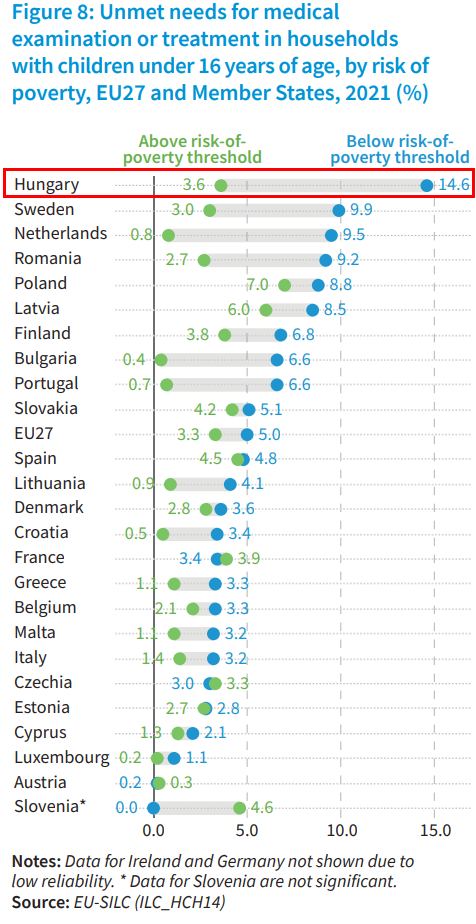
Hungary also had one of the highest proportions of families with children facing problems paying housing costs in the EU, with 14.6% of all households facing this situation, compared to the EU average of 3.6%. But for the sake of comparability, it is important to note that in Greece and Luxembourg, nearly 10% of those affected are at risk.
In addition, the Hungarian figure is alarming because in most EU countries the proportion of people with payment difficulties and difficulties in meeting housing costs who do not own their own property was high, but among homeowners Hungary had the highest proportion of people with severe deprivation, at over 28% (in 2020).
As the graph below shows, the highest severe deprivation rate for homeowners could be found in Hungary. The highest rates of severe deprivation for children at risk of poverty or social exclusion in households with tenant status could be found in Latvia and Portugal.

Another depressing domestic statistic is that Hungarian households with children most at risk of poverty are way down at the bottom of the EU rankings in terms of daily access to fruit and vegetables. The 58.6% share is the worst across the EU, and compares with 99.2% in neighbouring Austria, the EU leader.
On the positive side, in 2014, just over 50% of families with children at risk of poverty had daily access to fruit and vegetables, so there has been a significant improvement in the country by 2021.

While the study highlights that effective policy steps have been taken to reduce child poverty in Hungary, they argue that for further improvement, the government needs to prioritise investment in education, preventing early school leaving challenges, ensuring the unmet medical needs of the most vulnerable and reducing housing costs.
Cover photo: Getty Images.





