Hungary Central Bank Act to be modified to disarm budget time bomb


A draft law amending the Central Bank Act has been added to the pending bills on the Parliament's website. The amendment will almost certainly be adopted by the governing majority in Parliament in the coming weeks.
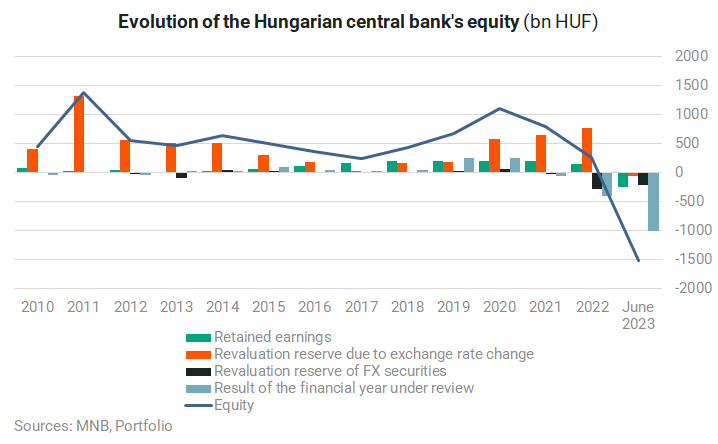
Until 2022, the rule was that the MNB's negative equity had to be immediately reimbursed by the budget, but this was not a problem as the MNB's equity was never negative. This year, the law has already been amended once to require the central bank to be recapitalised in equal instalments over five years, but even this seems to be too much of a burden on the already strained budget. Therefore, the new proposal is that the MNB's capital can be temporarily negative. It is not specified how long the transitional period will last.
Instead of a rigid rule on the MNB's capital injection, a more flexible rule from an economic policy point of view is justified, says the explanatory memorandum to the bill. The new rule allows for a flexible approach and is more efficient, as it does not aim at a specific way of recapitalisation, but at the desired state of affairs set by the European Central Bank.
The amendments will also increase the role of the Fiscal Council in the budget process, the authors add. In the future, the Fiscal Council will give its opinion on the central bank's expected capital position and possible budget commitments. The necessary forecasts will be provided to the FC by 1 December this year, and it have until 8 December to give its opinion. Subsequently, they will receive a forecast of the capital position by the end of April.
The amendment became necessary because by the end of June the MNB's equity was minus HUF 1,500 billion, which alone would put a burden of HUF 300 billion on the 2024 budget under the five-year rule. In addition, further capital losses are expected in the second half of the year, as the central bank may continue to make losses, albeit smaller ones. And the sustainability of next year's deficit target of 2.9% is already in question without an extra burden of around 0.5% of GDP.
Cover photo: ©2018 Lingxiao Xie via Getty Images





