How much zing can be added to consumption in Hungary?


The frequently voiced view that the Hungarian budget is heavily reliant on consumption-linked revenues is indeed true. The weight of VAT receipts in 2022 was 10% of gross domestic product in Hungary, with only Croatia's share even higher in the EU (above 13%), while the EU average was 7.5%.
It is also worth adding that according to the latest available data for 2020, the VAT gap (the difference between the theoretical maximum possible VAT collection and the actual VAT collected) in Hungary has fallen to 5.1%, compared to the EU average of 9.1%. In addition, the overall VAT rate in Hungary is 27%, the highest in the EU.
This makes it immediately clear
why the underperformance of consumption volumes and the possible greying of the economy are causing such significant problems on the revenue side of the budget this year.
In such a situation, stimulating consumption seems the obvious choice. The question is how this can be achieved while keeping risks and side-effects to a minimum. There is good news and bad news in this respect.
The good news is that the country's external position has improved dramatically from what was a disastrous situation at the end of last year. The current account balance has already swung into surplus in the second quarter as the energy bill took a plunge (notably due to the fall in natural gas prices) and because domestic demand has weakened sharply. So it is not a question of trying to stimulate consumption when the external imbalance is showing a significant deficit.
Some additional imports generated by consumption would not be an unbearable burden in the current situation.
The "how" is a more complex issue. Increasing the volume of consumption can be achieved
- at the expense of savings,
- by raising wages, or
- by boosting lending.
As for the latter, banks have already lowered their lending rates in response to the government's expectations, which may indeed improve the dynamics of lending. However, the extent of the improvement is uncertain. You can lead a horse to water, but making it drink is another matter: after the energy shock of 2022 and the current consumption shock, it will probably take time for lending to start expanding at a higher pace, given prudence considerations.
On the other hand, raising wages is the only available solution to the increase in disposable income. Note that no increase in social transfers can be expected (as it would worsen the budgetary situation), while unemployment is still very low, so there is not much room for manoeuvre in this area.
But wage growth must not be permanently disconnected from the economy's capacity to perform, as this could generate inflation.
This brings us to perhaps the biggest challenge: inflation remains very high, and although the speedy decline seen in recent months is likely to continue in the coming months, I expect the average rate of inflation to remain well above the central bank's target of 3% next year.
In such a situation, a major pick-up in consumption could make it more difficult to achieve the inflation target. Moreover, given that inflation has been high for some time (above the central bank target for several years), the risk of it getting stuck at high levels is not negligible. This in turn could lead the MNB to keep interest rates high, cooling the very economy it is trying to stimulate.
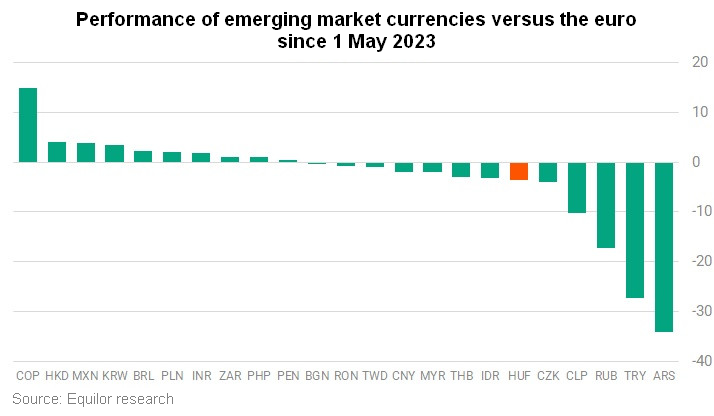
This raises the possibility of raising the inflation target, since with a higher inflation target interest rates should not be kept so high. However, this move, however attractive it may seem at first sight, carries considerable risks. First of all, there is the forint: while in the first four months of the year the national currency was the best performing emerging market currency in the world, this has been reversed since the beginning of the summer and the forint has been much weaker since then.
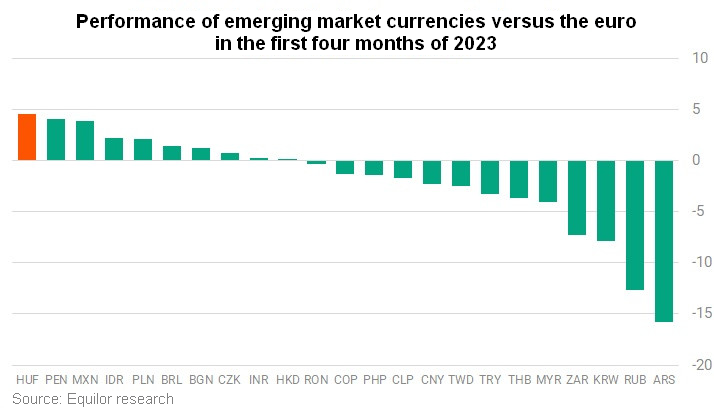
All that has happened is that the MNB has started its widely anticipated cycle of interest rate cuts at the pace expected. It is not difficult to imagine what the impact on the forint could be if the MNB suddenly started cutting interest rates much faster than the market projected.
It's also worth noting that hungary's current inflation target is relatively high in regional terms.
The target (i.e. the middle of the inflation target range) is 2% in Czechia, 2.5% in Poland and Romania and 3% in Serbia.
Of course, everyone is still waiting for Hungary to finally receive the suspended EU funds, which would give a further boost to economic growth and would obviously have a very positive impact on the budget, not to mention the risk perception. Uncertainty about this remains for the moment, although there have been rumours in recent weeks that a deal may now be close.
The receding but still high inflation, the expected continuation of the rate cut cycle and the government's efforts to boost consumption point to a period of considerable uncertainty for the forint. In such an environment, there are also question marks surrounding the expected pace of interest rate cuts by the MNB: the weak economic situation justifies lower interest rates, while inflation is not yet beaten.
It is possible that in the months to come the market will either view the central bank's actions as too soft or too harsh, which could translate into increased HUF volatility, especially in the periods following interest rate decisions.
THIS IS 'ON THE OTHER HAND', PORTFOLIO'S OPINION COLUMN
This article reflects the views of the author, which do not necessarily reflect those of the Portfolio editorial team.
Cover photo: Getty Images





