Hungarian central bank faces another challenge - Life after the merging of interest rates


Convergence is done. How to proceed?
The MNB had to carry out a dramatic raise to the benchmark rate a year ago to protect the forint, and in May this year it started to gradually lower the rate in 100 basis points steps per month. So by September, the 13% base rate became the benchmark rate again, and we were back where we started a year earlier.

However, in its last interest rate decision a month ago, it struck a cautious tone and indicated that it would prepare the market for future decisions through continuous communication, but in recent weeks it has not sent any new message to the market.
However, the MNB has repeatedly referred to the retrospective real interest rate as a benchmark. And in September, when the real interest rate turned positive after seven years, it indicated that it intended to maintain this status. The difference between the 12.2% inflation figure and the 13% base rate means that
it may cut interest rates by less than 80 basis points to maintain a positive real interest rate.
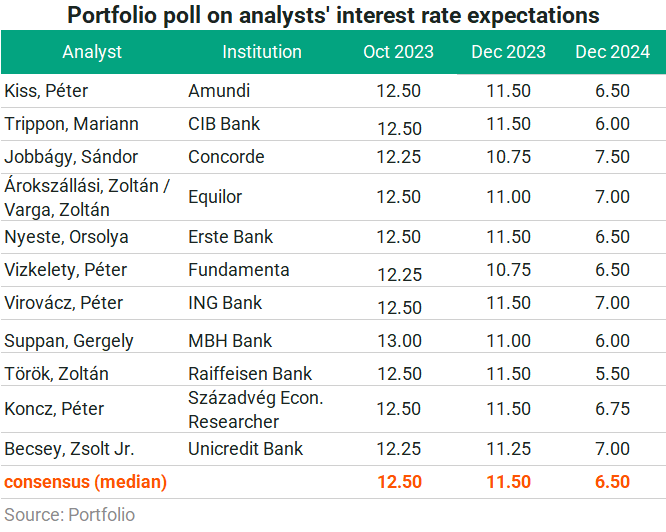
Portfolio's usual survey shows that the market has resonated with the central bank's message, as all analysts believe that the central bank will not continue to cut interest rates at a pace of 100. Respondents are divided into three major and minor groups:
- Those who think the MNB will be brave expect a 75-basis-point cut, which would still leave the retrospective real interest rate marginally positive.
- Those who think the central bank will be more cautious expect a 50bp cut.
- There is one analyst who does not expect a rate cut for the time being, expecting the base rate to be kept on hold at 13%.
With some exaggeration I'd say any move from a 100bp cut to an on-hold decision is on the cards,
noted Zoltán Árokszállási, analyst at Equilor. He thinks a 100bp cut would take the markets by surprise and this outcome is the least likely of all.
However, given that inflation could fall to around 6% by the first half of next year, a base rate of 13% seems very high. So, based on macroeconomic fundamentals alone, it could be cut by up to 100 basis points, but the central bank is unlikely to risk this for the sake of market calm.
The MNB has repeatedly stressed its cautious and gradual stance, inflation eased significantly in September but is still in double digits, and the volatility of global investor sentiment may also be in favour of a wait-and-see approach, said Gergely Suppan, who is the only one who expects no change in rates today. At the same time, the analyst at MBH Bank believes that the significantly improving external balance could also provide an opportunity for a small rate cut.
The most likely outcome is that the central bank will try to strike a balance between the current favourable situation and the risky external environment, which may eventually result in a 50 basis point cut, Péter Virovácz said. According to the ING Bank analyst, the combination of longer-term inflation risks and short-term geopolitical risks is not showing a clear improvement, and in the case of the latter, the Israeli-Palestinian war is only adding to the pressure.
After the September policy meeting, the central bank drew attention to the fact that its decisions are not made on autopilot, but in a data-driven manner, so it is expected that after the predictable 100 basis point cut in the benchmark rate in previous months, the central bank will slow down the pace of monetary easing, said Péter Koncz, junior analyst at Századvég economic researcher.
It may be worth considering that it is advisable to choose a pace that is sustainable over a relatively long period. In our view, the most likely scenario is a continuation of 50 basis points this week, which is likely to be followed by a move in November and December, said Orsolya Nyeste, analyst at Erste Bank.
The paths ahead
Analysts say the current decision could also set the pace of interest rate cuts in the coming months. It is expected that after Tuesday's meeting, the Monetary Council will reiterate that monetary policy is not on autopilot, and that the MNB can remain data-driven, i.e. it can make decisions on a month-by-month basis depending on the statistics it receives. At the same time, today's rate change may tell us a lot even about the end-year interest rate level.
Analysts now expect interest rates to be between 10.75% and 11.5% in December.
As the central bank tends to emphasise both agility and gradualness, the October rate cut is likely to be indicative at least for the rest of the year, unless we see a material change in the inflation path and risk perception, Péter Virovácz stressed.
He thinks there are several paths ahead for the central bank: (1) taking more gradual and sustained steps to create a markedly high positive real interest rate environment in the short term, as inflation falls rapidly in the coming months, and thereby strengthen the forint in a meaningful way. (2) The bank could adapt more flexibly to changes in inflation and use the real interest rate as an anchor, leading to a steeper reduction in the short term and then a sustained hold.
For the remaining two interest rate decisions of the year, we believe that the central bank should reduce the pace of the cut, primarily because of the fiscal developments if they show an overshoot of even the increased deficit target. A further risk is if the European Commission does not give a clear positive signal on the disbursement of EU funds, as this could be a precursor to a possible rating downgrade at the end of the year, said Zsolt Becsey, analyst at UniCredit Bank.
What about the forint?
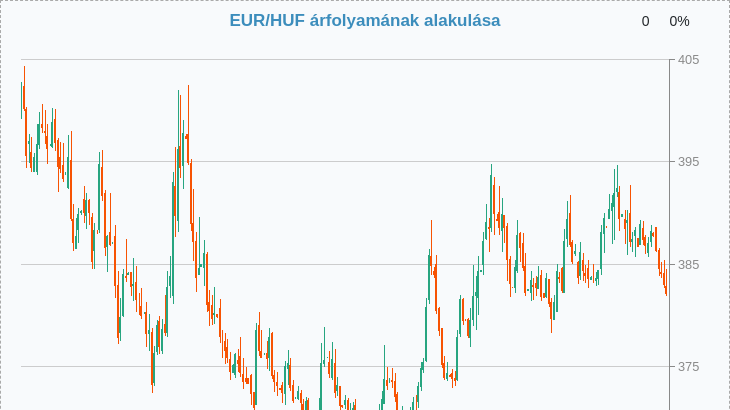
There is always the question of how the central bank's actions affect the forint exchange rate. According to Zsolt Becsey, the international environment could be generally supportive for the forint in the coming months, and he does not expect further hikes by the Fed, which could provide support for emerging market currencies, including the forint. If U.S. real economic data show waning economic activity, a strengthening below the 380 level is possible, but a sustained strength of the forint above this level would certainly be uncomfortable for the central bank, so the 380 level is seen as the lower support level at the moment.
However, the outlook for next year has deteriorated, according to UniCredit. The product return fee announced in October will be factored into the consumer price index, raising it by at least half a percentage point, while new risks have emerged over gas supplies via the Turkish Stream. Next year, annual average inflation is likely to be in the lower half of the 7 to 8% range, consistent with a similar level of the base rate at the end of the year.
The Hungarian government adopted a law on a new mandatory return system for products with a return fee marketed domestically. This means that the customer pays a return fee of HUF 50 (EUR 0.13) per bottle for all glass, metal, and plastic bottled beverage products. The money will be paid back after the bottle has been returned. Mol Group, which had won a 35-year wage management concession from the state, stresed that the aim is to recycle 90% of plastic and glass bottles and metal beverage cans within three years.
The ebbing HUF interest rate advantage and real valuation will lead to a faster forint depreciation in 2024, he added.
For the remainder of the year, EUR/HUF could hover between 375 and 395, with a weakening trend driven by deteriorating external sentiment and rising geopolitical risks, while an EU agreement could temporarily push the cross towards 375, said Mariann Trippon, analyst at CIB Bank, on the short-term outlook for the forint.
The unpredictable geopolitical environment and the uncertainties surrounding EU funding could easily put the forint under downward pressure, which would jeopardise the central bank's inflation target, Péter Koncz said.
Cover photo: Lázár Todoroff /Portfolio





