Wage increase to be rushed in Hungary


The minimum wage could rise by 15% and the wage minimum for skilled workers by 10%. In the case of the latter, employers want a smaller increase, while workers want a bigger one, Sándor Czomba, state secretary at the Ministry of Economic Development, told M1 television recently.
However, the government did not support the third element of the agreement, which would have been a one-off wage compensation of HUF 100,000. Instead, the new plan was to bring forward (to December) the increase in the minimum wage from January 2024.
István Hollik, Fidesz-KDNP's communications director, has now confirmed that the minimum wage could rise by 15% "this year". This indicates that the government has accepted the idea of rushing the wage increase by a month.
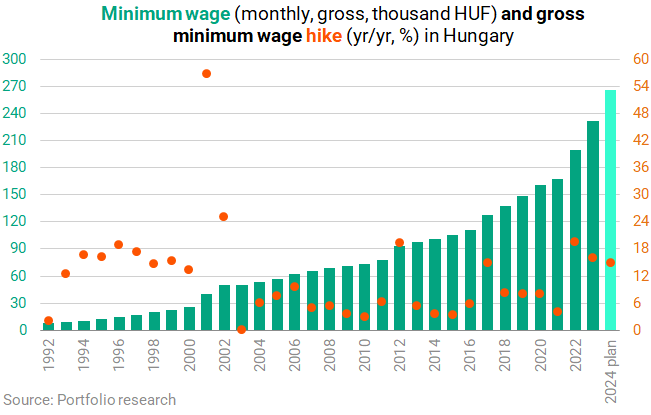
Economists surveyed by Portfolio expect wages in Hungary to rise by around 10% on average next year, a slower pace than this year's 15% increase. While workers are obviously unhappy about the lower wage rise, the good news is that inflation in 2024 could be a third of this year's, which could lead to a resumption of real earnings growth. But analysts say there are serious risks, so an (upside) inflation surprise is on the cards.
Employees have asked for next year's wage increase to be brought forward - if the government would not concede to the HUF 100,000 one-off compensation - because of high inflation in 2023. However, it is worth noting that this will only amount to just over HUF 20,000, which is one fifth of the original proposal.
Sándor Czomba said that the problem with the HUF 100,000 one-off payment was that it would not have been a mandatory benefit. Therefore, it is by no means certain that those earning minimum wage or the wage minimum would have received it.
However, the interest representative bodies argue that it is not certain that public employees and workers in state-owned companies can be paid a similar level of wage compensation in the current fiscal situation (e.g. this year's deficit target raised to 5.2% of GDP from 3.9%, risks about the attainability of next year's unchanged 2.9% goal).
Cover photo: Getty Images