Single-digit inflation finally arrives in Hungary


Inflation in Hungary shrank further from the September rate of 12.2% to 9.9% in October, the lowest since May last year. This means that
the government has achieved its target of single-digit inflation, which it has been vocally aiming at for months.

The fresh data came as a surprise, as analysts were expecting an average price increase of 10.3%, and no one was expecting a single-digit increase in October. However, experts were confident that the rate of increase would fall below 10% in November, so all that happened was that it was brought forward by a month.
As in recent months, the main factor behind the fall in inflation continued to be the base effect, as a year ago it was the energy and food shocks that were pushing up prices. In recent months, repricing activity in Hungary has been spectacularly mild, with inflationary pressures subdued even by European standards. The main reasons for this are the fall in real wages, weak consumer demand and the long recessionary period. The October data further reinforce the picture of subdued inflation. The short-base core inflation indicator fell further, suggesting an annual inflation environment now around 2%. In other words, if the inflationary developments of the past three months were to be a persistent feature of the Hungarian economy, we could in fact be talking about price stability.

However, this picture is deceptive in that in the second half of the year, a large number of economic actors do not make any pricing decisions at all (unless they are hit by a very extreme shock, as was the case last year). Therefore, the path of inflation will become clearer early next year, when more one-off upward price pressures and the pricing behaviour of market agents will become visible.
Looking at the individual product groups, on an annual basis, the price increase was highest for miscellaneous articles and fuels at 16.5%, services at 13.2% and spirits and tobacco at 11.6%. For the first time in a long time, food inflation of 10.4% was no longer on the imaginary podium. On a monthly basis, the fall in prices was mainly due to cheaper household energy, fuels and food. The sudden 3.2% price rise in clothing was largely due to seasonality.
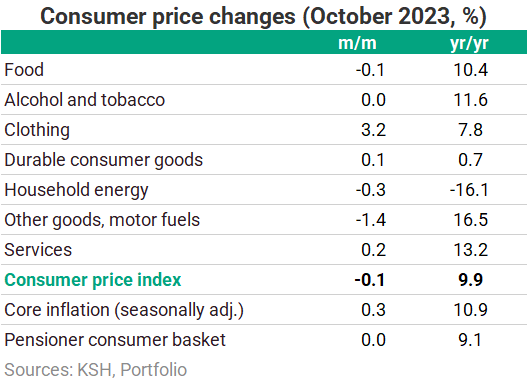
Inflation data are also relevant for monetary policy, as the central bank's decisions are strongly influenced by price developments. In October, the National Bank of Hungary's (MNB) Monetary Council cut the base rate by 75 basis points to 12.25%, and now
the lower-than-expected figure could mean that this pace could be maintained in the coming months.

Food prices rose by 10.4% in annual terms, with the biggest increases recorded at:
- sugar (+54.4%),
- chocolate and cocoa (+23.8%),
- non-alcoholic beverages (+23.8%),
- and snacks (+22%).
Within the product group we had the following price decreases
- eggs (-16.9)
- flour (-15.4)
- cheese (-6.4)
- margarine (-4.2%).
Household energy became 16.1% cheaper, with 33.5% less paid for piped gas, 3.4% less for electricity, 5.4% more for firewood and 4.7% more for cylinder gas. Motor fuel prices increased by 30.2%.
The price of services went up by 13.2%, including:
- motorway use, car rental and parking +21.3,
- holiday services +17.8,
- vehicle repair and maintenance +16.3,
- sports and museum admissions +14.7%,
- travel to work and school -21.7%.
Alcoholic beverages and tobacco prices were up by 11.6%, within which the price of alcoholic beverages rose by 13.7%. Consumers paid 0.7% more for consumer durables, including 10.4% more for kitchen and other furniture, 5.9% more for heating and cooking appliances, 4.7% more for new passenger cars and 4.4% more for living and dining room furniture and 9.1% less for second-hand passenger cars. Pet food prices jumped 29.3%, the price of detergents rose 20.0%, that of toilet articles 9.9% and dwelling repair and maintenance goods prices edged up 4.3%.
Compared to September, consumer prices decreased by 0.1% on average. Food prices decreased by 0.1% on average, within which margarine cost 2.5%, cheese 1.2%, sugar 1.1% and flour 1.0% less and chocolate and cocoa 2.2% and non-alcoholic beverages 0.7% more for consumers. Motor fuel prices were cut by 3.8%. Clothing and footwear became 3.2% more expensive owing to seasonal changes. Consumers paid 0.3% less for electricity, gas and other fuels, within which firewood prices went down by 1.2% and the price of natural and manufactured gas was unchanged.
Cover photo: Ákos Stiller/Bloomberg via Getty Images





