Devastating labour shortages: the EU could be flooded with immigrants


In 2022, the employment rate in the European Union rose to a record high of 74.6%, while the EU unemployment rate receded to 6.2%, the lowest ever recorded. Unsurprisingly, the job vacancy rate rose to 2.9%, the highest rate ever recorded, with labour shortage indicators showing increasing tightness in the labour market.
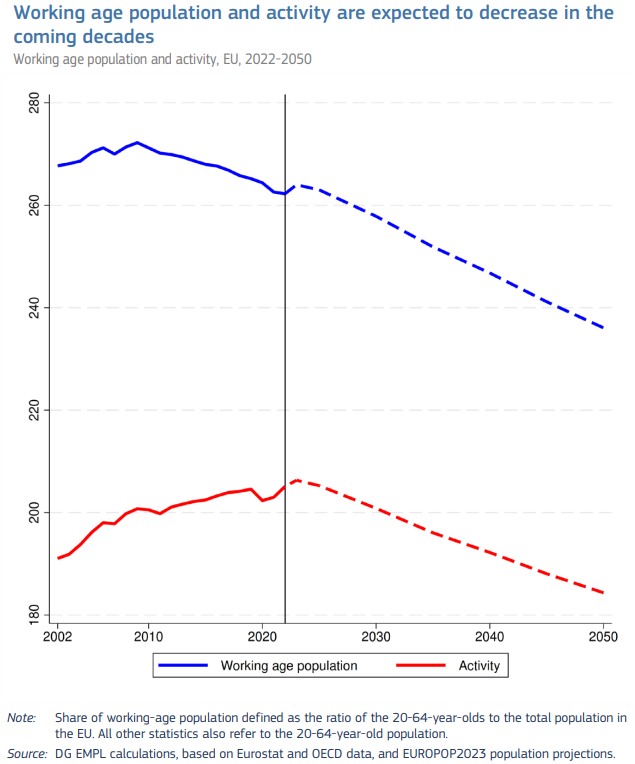
The number of people in working age (blue line) is expected to decrease in the coming decades. While the working-age population (20-64-year-olds) reached a record of 272 million people in 2009, it declined to 265 million by 2022 and is expected to fall further, to 258 million by 2030, 247 million by 2040, and 236 million by 2050. Mitigating the problem definitely requires steps to be made.
The Commission has on Wednesday presented a series of new initiatives in a Skills and Talent Mobility package to make the EU more attractive to talent from outside EU, and to facilitate mobility within. "Today's measures include a new EU Talent Pool to match employers in the EU with jobseekers in third countries as well as measures to promote the recognition of qualifications and learner's mobility. They come as key deliverables of the European Year of Skills."
Skills shortages persist across the EU, in a range of sectors, and at various skills' levels, the EU executive said.
"The EU's drive to fill labour shortages in the EU starts at home: with relentless efforts to upskill, reskill and use the untapped potential of the EU's domestic workforce to the benefit of the single market.
But to address the shortages the Member States are facing, the EU will also need to attract skills and talent from all around the world. For this approach to be successful, the EU must be able to attract talent and retain the needed talent.
"Developing labour migration cooperation with third country partners can also be a mutual gain, that feeds expertise and financial support back in the economy of the country of origin," the EC added.
A previous Commission report shows that immigrants (non-EU-born workers) are more likely to work in occupations where there are persistent labour shortages. This is particularly visible in low-skilled occupations.
The highest job vacancy rates at the end of 2022 were observed in the Netherlands (4.9%), Belgium, Austria (4.8% for both) and Czechia (4.7%), with the lowest in Romania, Bulgaria, and Spain (0.9% for all three). With a rate of 2.6% (0.2ppt lower than the EU average), Hungary is in the mid-range of the rankings.
However, it is very likely that many foreign workers will still be needed. In fact, the Hungarian government has just today unveiled a new draft law on the entry and residence of third-country nationals. The draft would introduce various new residence permits and visa categories, with a new category of investment residence rights being highlighted. The most surprising part of the plan is that the government would create a permit that would apply specifically to guest investors, effectively giving investors from outside the EU a buy-in to take residence in the country.
Cover photo: Getty Images





