There is one indicator where the forint is among the world's top currencies


Here is the positive real interest rate for Hungary
In September, the retrospective real interest rate, the difference between the current policy rate and the last known inflation data in Hungary, rose into positive territory for the first time in more than seven years, with inflation falling to 12.2%. This was not surprising, of course, as the trend had already indicated that a turnaround would happen sooner or later, and the National Bank of Hungary (MNB) has repeatedly indicated that it aims to achieve a positive real interest rate.
In recent months, the Hungarian real interest rate has continued to rise, with inflation falling to 9.9% in October, while the central bank cut the base rate to 12.25%, leaving the key indicator at 2.4%. This could change again just this afternoon, as the Monetary Council is expected to cut rates by another 75 basis points to 11.5%. However, this does not threaten the positive retrospective figure.
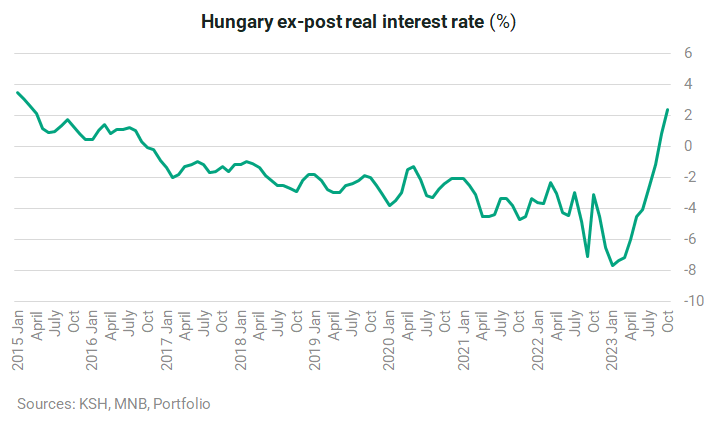
But what exactly is ex-post real interest rate and why is it important that it is retrospective? Investors usually consider two types of real rates, the so-called forward-looking real rate is more relevant from a market perspective than the retrospective rate mentioned above, but it is much more difficult to estimate. If we simply look at the prospects for interest rates and inflation over, say, a 12-month horizon, this forward-looking real interest rate has been positive for some time. However, the MNB does not, for example, consider the outlook for the policy rate in its usual set of monthly charts, but compares the zero coupon yield curve of the Government Debt Management Agency (ÁKK) with inflation expectations. The latest central bank chart also shows that the turning point for the forward real interest rate has just come.

In the region, only the Hungarian ex-post real interest rate is currently positive, with the Czech Republic at minus 1.5%, Romania at minus 1.1% and Poland at minus 0.85%. In all three countries, real interest rates have risen in recent months as interest rate cuts have not kept pace with the fall in inflation.
Positive real interest rates are not a feature of emerging countries, but rather a consequence. In the United States, inflation is currently running at 3.2% and the policy rate at 5.25%-5.5%, while in the eurozone the ECB's interest rate is 4.75%, with recent inflation at 2.9%. So these days,
anyone who doesn't want their currency to depreciate has to keep up.
In the low-inflation environment prior to the Covid, there were only a few countries with positive real interest rates. Most of them were in or on the verge of a currency crisis and wanted to stabilise their currencies. Today, however, times are clearly different, as more than half of the countries we have studied have positive retrospective real interest rates.

Of course, there are also unique stories now, such as Ukraine and Russia trying to stabilise their currencies by maintaining positive real interest rates in a war that has been going on for more than a year and a half. But the graph shows that Hungary's example is not unique,
the country is in the middle of the pack in terms of retrospective real interest rates.
Why is positive real interest rate important?
The importance of real interest rates is reflected in the foreign exchange market, as in the so-called carry trade, investors look for countries with high interest rates to profit from, but price stability is also important. If we look at the performance of individual currencies over the first nine months of 2023 and compare it with the real interest rate graph above, the correlation between the two is clear.

Apart from the individual stories mentioned above, it is clear that this year,
- the Mexican and Brazilian currencies have been the best performers against the dollar, while these two countries have the highest real interest rates,
- and the Argentine, Turkish, and Egyptian currencies have been among the worst performers, which is not a coincidence given their real interest rates.
The forint also fits this pattern, which has been the fourth best-performing currency in the world since the beginning of the year, thanks to exceptionally high nominal interest rates and a now positive real interest rate. In other words, leaving aside individual factors,
the currency with the highest real interest rate is the one that can strengthen the most today.
It might stay with us for years
Moreover, the inflation and interest rate trajectories that seem most likely at the moment suggest that the rise in real interest rates in this country is not over yet. Speaking at a conference last week, MNB Deputy Governor Barnabás Virág said that
higher-than-inflation interest rates could be with us for months or even years.
We have already mentioned that this afternoon the Monetary Council will almost certainly cut the base rate by another 75 basis points to 11.5%, which will temporarily lower Hungary's real interest rate. But only temporarily, because then inflation in November will fall further, and probably by more than 75 basis points.
Based on the inflation and interest rate polls regularly produced by Portfolio, inflation could fall to around 7% in December this year, which could mean a positive real interest rate of almost 4% at the expected base rate of 10.75%, and by the end of 2024, inflation of 5.1% could still be lower than the expected 6.25%.

Looking at the expected real interest rate of almost 4% in December this year, the last time we saw a higher rate was in the summer of 2009, after the financial crisis.
In other words, the real interest rate turning positive seems to be a long-term trend, and presumably it will be the interest rate conditions abroad that will determine how long this will last. As long as the aforementioned large developed central banks stick to above zero, most emerging market countries will have no choice but to keep their currencies from depreciating significantly.
This also means that
the Hungarian real interest rate may support the forint on a long-term basis, so from this point of view, there is no need to expect a serious weakening of the domestic currency.
The question is, of course, how determined the Hungarian economic policy leadership will be to maintain positive real interest rates. At present, the central bank is clearly counting on this in the long term, in order to achieve its own mandate of price stability. At the same time, the more growth-sensitive government has repeatedly indicated that it is not a big fan of a positive real interest rate that would reduce economic dynamism.
Cover photo: Jozsef Zoltan Varga via Getty Images





