Hungary needs to restructure system of household energy support - OECD


GDP to grow after 2023 contraction
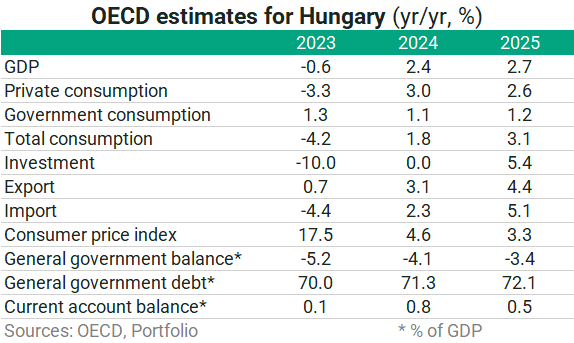
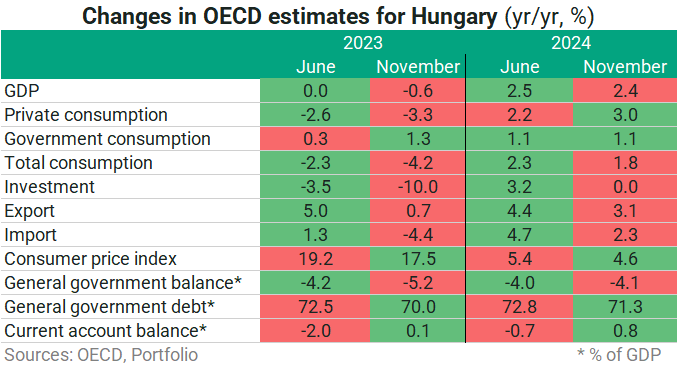
Economic activity is projected to rise by 2.4% in 2024 and 2.7% in 2025, after a decline of 0.6% in 2023. Lower inflation, mainly driven by energy and food prices, is expected to support a gradual pick-up in investment and private consumption. The main risks around the outlook are related to the pace of the decline in core inflation and the outcome of negotiations with the EU regarding the delivery of EU funds, the OECD said in its country analysis.
"Public consumption and investment will provide less support to growth in 2024 and 2025, in line with the government’s objective of reducing the fiscal deficit. Exports are expected to pick up in 2024-25 as growth in Hungary’s main trading partners, including Germany, regains momentum."
Budget deficit targets to be missed
"Reducing the budget deficit as planned will be key to rebuilding fiscal space in view of upcoming spending needs related to ageing and the green transition," it added. Contrary to the general view, the OECD does think that this year's 5.2% of GDP deficit target (revised upwardly from 3.9%) will be met. However, it also projects that the 2024 and 2025 goals will be missed, forecasting 4.1% and 3.4% budget gap for these years, respectively, which compare with the government's targets of 2.9% (revised upwardly from 2.5% in May), and 1.9% (vs. 1.5% previously).
Descending debt trajectory at risk
As a consequence, government gross debt* is expected to rise to 71.3% of GDP in 2024 and to 72.1% in 2025 from 70.0% this year. (*Under the Maastricht definition of general government debt, which includes only loans, debt securities, and currency and deposits, with debt at face value rather than market value.)
Overheads reduction scheme needs overhaul
Restructuring energy support by moving from price caps to targeted cash transfers to support vulnerable households would increase incentives for energy savings and improvements in the energy efficiency of dwellings, reduce the exposure of public finances to fluctuations in global energy prices, and lower Hungary’s dependence on energy imports,
the OECD said.
Monetary policy is tight and fiscal consolidation is underway
The OECD reminded that the central bank (MNB) started to lower its effective policy rate in the spring of 2023, but noted that monetary policy remains tight.
Considering the uncertainty related to the evolution of core inflation and the exchange rate, and the need to firmly anchor inflation expectations, further monetary easing is expected to proceed in a gradual manner.
Fiscal policy is being tightened substantially, with a projected deficit reduction of around 3 percentage points of GDP between 2022 and 2025 but public debt is expected to remain higher in 2025 than prior to the pandemic, the OECD said.
The main consolidation measures in 2023 include the non-repetition of past gas reserve purchases and an increase in temporary windfall taxes. In 2024-25, the main measures include lower government consumption and investment. However, in cyclically-adjusted terms, the bulk of fiscal consolidation has taken place in 2023. The energy price support provided to households is expected to remain in place in 2024 and 2025.
If core inflation proves more entrenched than expected, the central bank will need to keep rates higher for longer, affecting consumption and investment.
The OECD warned that a new surge in energy prices would have similar effects, while also straining public finances, given the utility price cap in place.
Another risk is related to the delivery of EU funds.
Failing to reach an agreement on the complete delivery of those funds may curb investor confidence, increase the cost of capital, and put renewed pressure on the exchange rate.
How to boost productivity growth?
"Productivity growth could be bolstered by strengthening competition in the transport, professional services and telecommunication sectors. Lower telecommunication prices and a wider diffusion of digital skills would accelerate the digitalisation of firms and help Hungarian firms, especially SMEs, to bridge the digital gap with peer countries," it added.
Cover photo: Getty Images





