Hungarian banks' profits surpass HUF 1 trillion mark, but where is the money coming from?


We have also recently written about the performance of the insurance sector:
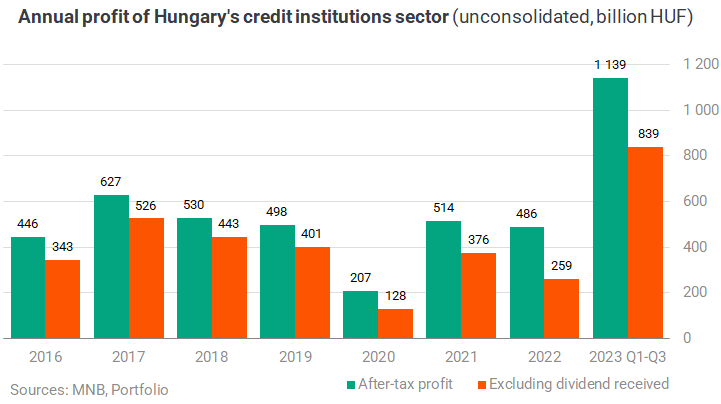
The National Bank of Hungary (MNB) has on Tuesday published the results and balance sheet figures for the Hungarian banking sector for the first three quarters of 2023, and we looked at the unconsolidated figures excluding OTP Bank's foreign subsidiaries. We see that the banking sector's nominal profits have never been so on an annual basis, let alone in the first three quarters. Including dividend income, credit institutions' after-tax profits were EUR 1,139 billion, and excluding it, EUR 839 billion.
Consolidated (!) profit figures for the largest market players so far suggest that more than three quarters of the sector's profits came from the seven banks shown in the chart below. Behind OTP and MBH, Erste Bank has moved up to third place.

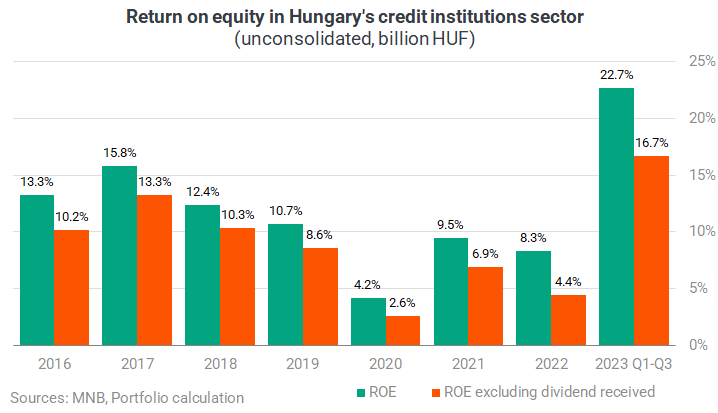
Not only in absolute terms, but also in nominal terms, the performance of the credit institutions sector is outstanding this year, as Portfolio calculates that
the sector's return on equity (ROE) is 22.7%, which would have been 16.7% even without dividend income, which is largely generated from foreign and non-banking activities.
These figures are already reminiscent of the banking 'heyday' before the 2008 financial crisis.
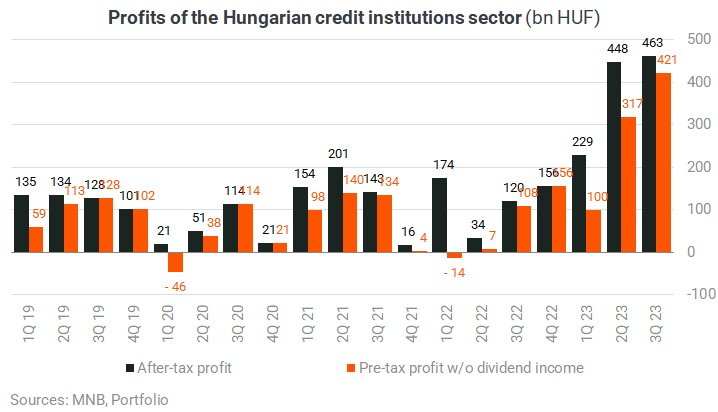
The biggest absolute gains in the history of the banking sector came in the second and third quarters of this year, even though the central bank started cutting interest rates in May, which might lead us to suspect that
it is not just high interest income from the MNB that is driving the outperformance, especially in the third quarter.
Of course, the impact of interest payments by the MNB is not negligible: we have reported several times that in the first half of the year alone, banks received HUF 627 billion more in interest income from central banks than a year earlier. In the first three quarters of the year, credit institutions' interest result (i.e. the difference between interest income and interest expense) totalled HUF 1,635 billion, compared with HUF 1,193 billion a year earlier and HUF 794 billion two years earlier.

In the now declining interest rate environment, other factors are increasingly coming to the fore, so we looked at what else has boosted pre-tax profit compared to last year. There are three main items worth highlighting:
- interest income rose by EUR 442 billion;
- other operating profit increased by HUF 432 billion;
- risk costs (impairment and provisions) improved by HUF 372 billion.
(The exchange rate spread and the trading result, which usually move in opposite directions and hectically, are of less interest now).
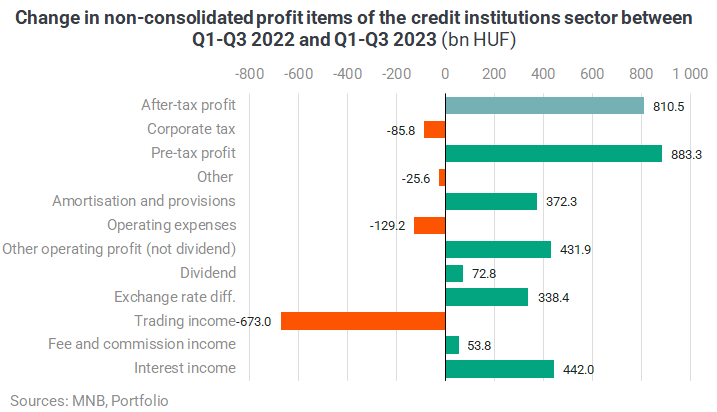
The reasons behind the rise in interest income have already been mentioned, but the rise in other operating income is worth mentioning. Looking behind the figures, we see that one item in particular has boosted this line:
A kamateredmény emelkedése mögött álló okokat már említettük, említést érdemel azonban az egyéb működési eredmény ekkora emelkedése. A számok mögé tekintve azt látjuk, hogy egy eredménytétel dobta meg különösen ezt a sort:
the result from "non-trading financial assets mandatorily at fair value through profit or loss" improved from HUF -76 billion to HUF 212 billion, or HUF 288 billion.
Underlying this item are assets that banks, unlike most loans, do not carry at amortised cost, but must always revalue at fair value through profit or loss. Typically, this includes loans whose interest rate subsidies are linked by the legislator to government security yields by a multiplier, most notably baby loans and CSOK (family housing allowance) loans. Their value in the books rises as the yield curve falls and falls as the yield curve rises. We see the accounting effect of this revaluation in the bank profit and loss figures.

It is also worth mentioning the change in risk costs, as shown in the graph above. Based on the reports published by banks so far, it is no surprise that in the third quarter banks wrote down more provisions than they created,
resulting in a net risk costs reversal of HUF 9 billion by end-September this year, compared to a net write-back of HUF 363 billion last year, partly due to the war and the energy crisis.
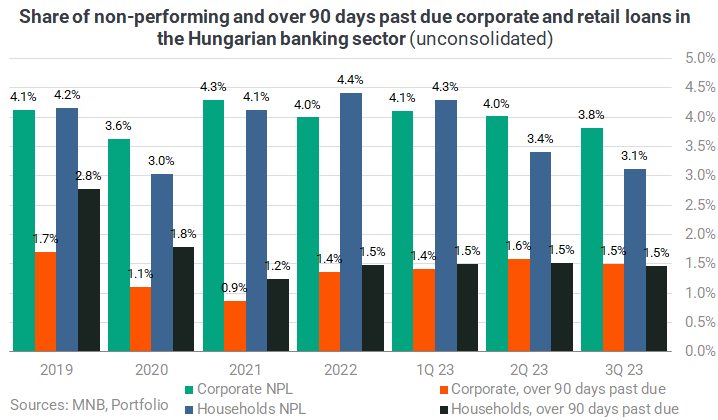
A significant part of the reversals are presumably linked to the improvement in the economic outlook and the "recovery" of loans previously in the repayment moratorium, i.e. their turning into performing loans again and getting reclassified accordingly. This is also evidenced by the non-performing loan (NPL) ratio, which has fallen to 3.8% from 4.0% for corporate customers and to 3.1% (!) from 4.3% for household customers this year. Within this, the share of customer loans that are effectively over 90 days past due has essentially stagnated at 1.5%.
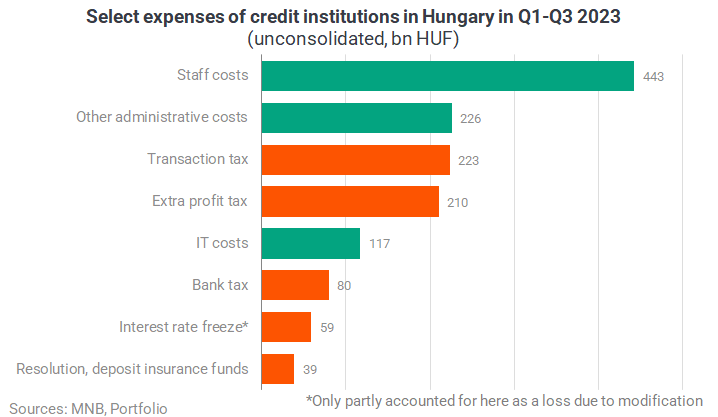
Finally, it is worth noting that the banking sector achieved the above performance under very heavy pressure exerted by the state. Our table below shows these items in orange. The data on the interest rate freeze is only partial (banks only partly account for it as 'adjustment losses'), we estimate the real interest rate freeze burden to be around HUF 150 billion in the first three quarters of 2023.
Excluding the burden of the transaction tax directly passed on to customers,
the extra state burden could have cost the banking sector around HUF 500 billion this year.
Cover photo: Getty Images





