Hungarian passenger car market hits new low, er, high

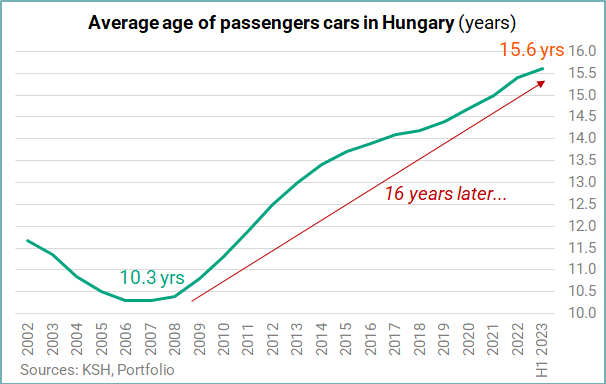
The Hungarian passenger car market broke a negative record as regards the average age of the fleet, totalcar.hu reported. The average age of the cc. 4.1 million passengers cars in circulation reached 15.6 years by the end of June this year.
The charts below show that the average age of passengers cars grew markedly from 10.3 years in 2006 to this level over a 16.5-year period. The 15-year mark was first hit at the end of 2021.
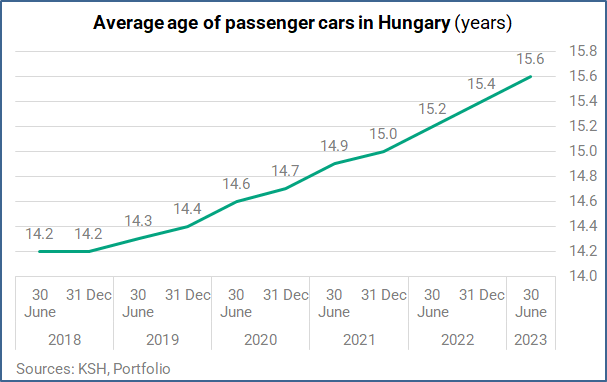
A graph for a shorter period allows a closer look at the change in the average age of the Hungarian passenger car fleet.
The ageing process could be slowed down and halted if the new car market were to grow. There was no chance of that last year. Partly because of rising car prices, and partly because the surge in inflation has driven spending higher, causing a large part of the population and many firms to postpone major investments. Buying on credit or leasing was not a way out either, as interest rates were very high precisely because of inflation, although there were signs of improvement in the second half of the year.
According to Datahouse figures, fewer than 100,000 new cars were registered in the first eleven months of 2023, down 4% from a year earlier. Moreover, Hungary is the only EU country where the new car market has shrunk in January-November, and it had the sharpest (-12.6%) yr/yr decline in November alone.
Nor could the second-hand car market be expected to contribute to the reduction in the average age. This market has also seen a decline, with less than 99,000 used cars put on the market in the first eleven months of last year, compared to nearly 119,000 a year earlier. In addition, 32% of used cars imported were older than 16 years and 34% were aged between 11 and 15 years. Only the remaining 34% of used cars were less than 10 years old.
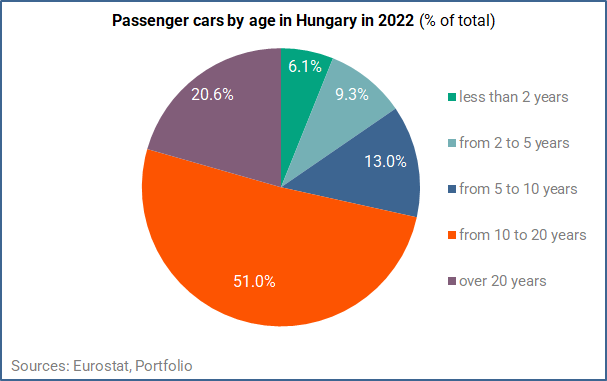
Eurostat data showed that
more than half of the Hungarian passenger car fleet was aged between 10 and 20 years in 2022.
One fifth of the car fleet was older than 20 years, and merely 6.1% of it was less than two years old.
We need to note, however, that the trend in the different 'age groups' was mixed.
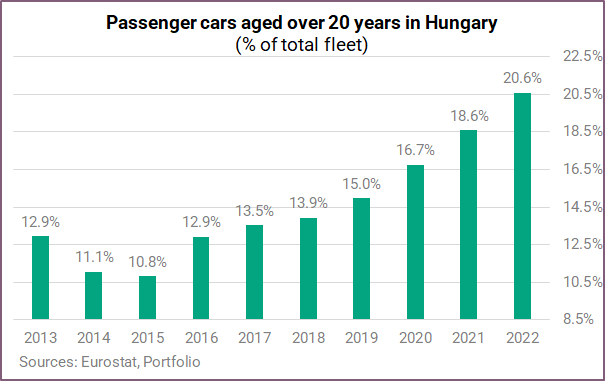
On the negative side, the share of the new car fleet (up to 2 years of age) of the total number of passenger cars in circulation has been shrinking, while the share of cars aged 5 to 10 has been rising since 2019, and the share of those older than 20 has been going up since 2015.
On a (slightly) positive note, the share of cars aged 2 to 5 has been rising since 2014, and there has been an improvement in the 10 to 20 age category since 2019 too.


Cover photo: Shutterstock





