One graph to show how the 2023 budget and fiscal policy collapsed


Minister of Finance Mihály Varga held a press conference yesterday on the current state of the budget, where he presented essentially one precise and important figure: in 2023, the budget's cash deficit was HUF 4,593 billion, i.e. the central subsystem (excluding the local government subsystem, but including social security funds) spent so much more than it received. The minister said that this figure was lower than in 2022. This is undoubtedly true, but it is not at all indifferent what benchmark we can use to gloss over this gigantic 2023 deficit.
At this point, it is worth recalling where the 2023 budget, which has now become unrecognisable, started from. In the summer of 2022, the Parliament passed the 2023 budget law with a cash deficit of HUF 2,352 billion.
This means that last year, the government almost doubled the original cash deficit set in the summer 2022 budget. It is hard to remember the last time such a dire situation for the budget has arisen.
Ez már önmagában jól tükrözi a 2023-as költségvetés összeomlását, amely első verzióját 2022 nyarán nyerte el, majd jött 2022 őszén a rendeleti költségvetés (első hiánycélemelés), 2023 januárjában az újabb parlamenti kör, 2023 őszén a második hiánycélemelés, majd a tavalyi év utolsó napjaiban még egy nem hivatalos hiánycélemelés. Külön érdemes felhívni a figyelmet arra, hogy a tavalyi év utolsó napjaiban az egész éves hiányra a kormány 4540,3 milliárd forinttal kalkulált, de közben 4593 milliárd forint lett a mínusz, ami azt jelenti, hogy a friss prognózisában sem tudta eltalálni a kormány, hogy mennyi lesz a tavalyi hiány.
This in itself reflects the collapse of the 2023 budget, the first version of which was passed in the summer of 2022, followed by the decree budget in the last days of 2022 (first deficit target), another round of parliamentary budgeting in January 2023, a second deficit target in the autumn of 2023, and then another unofficial deficit target in the last days of last year. In particular, it is worth pointing out that in the last days of last year, the government projected a full-year deficit of HUF 4,540.3 billion, but in the meantime it turned out to be minus HUF 4,593 billion, which means that even in its latest forecast, the government could not hit the deficit of last year.
This process is summarised in the graph below, which shows how last year's budget cash deficit changed and how the budget collapsed in tandem.

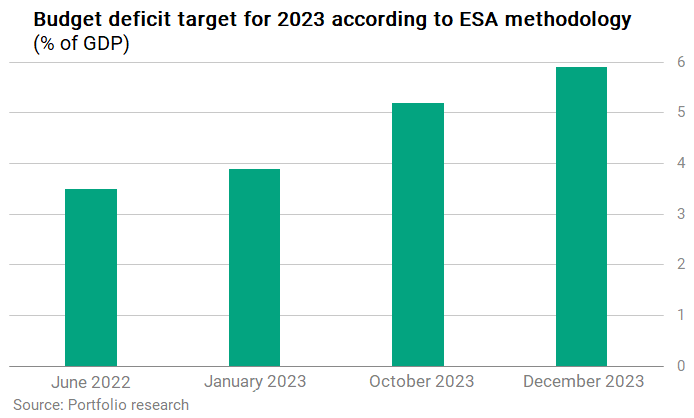
The same graph can be drawn for the ESA deficit target calculated according to the EU methodology. The budget deficit target started at 3.5% in the summer of 2022, and by the end of last year it had reached 5.9%, and we will only know in March where it has finally stopped.
The graph below conveys several messages about the Hungarian budget and fiscal policy at the same time:
- Disciplined fiscal policy, and the drive for it, has weakened considerably.
- The practice of early budget adoption does not make much sense, but it has significant risks, as the budget does not fulfil its most important function: the role of compass, the anchor.
- The successive increases in deficit targets, as well as the failure to meet them and the possible consequences, lead to the credibility and "set in stone" nature of all subsequent deficit targets being called into question.
In the light of the above, it is not surprising that the deficit target of 2.9% of GDP for the 2024 budget is already being questioned by many. The consensus among analysts is that the question is not whether the government will raise this year's deficit target, but when it will do so and by how much.
Based on the figure presented by Finance Minister Mihály Varga, it can also be calculated that last December the budget was HUF 518.7 billion in deficit, which is unusually low compared to the last 3 years. We will only know the detailed figures for December in mid-January, but it is possible that the government has gained some leeway by rescheduling and postponing expenditures.


Cover photo: Getty Images





