Hungarians go to work abroad in greater numbers


Employment continued to expand in Hungary in the third quarter of 2023, mainly due to the recovery in the primary labour market and an increase in foreign employment, while the number of unemployed and the unemployment rate also rose, according to the quarterly publication of the Hungarian Central Statistical Office (KSH). The size of the potentially available labour force also increased slightly.
The average number of employees in the 15-74 age group was 4.737 million in Q3 last year, up 24,000 in annual terms.
The largest part of the increase in employment was due to an increase of 18,000 in the number of people working abroad,
the KSH said. The number of temporary workers abroad - who are counted as employed - is now stable at over 100,000.
- The number of those employed on the primary labour market grew further by 13,000,
- while the number of those in subsidised employment as public workers declined by 6,000.
The share of older workers (over 55) in the age composition of the workforce is increasing.


The number of people in employment increased by 40,000, excluding those in public works, and although the growth in employment remained significant, it slowed down over the year. The largest absolute increases were in market services, including administrative services (+9,100 persons) and professional scientific activities (+8,800 persons), but there were also high rates of growth in real estate, accommodation and food services and information and communication.
Within administrative services, the largest increase in the number of temporary agency workers was due to a rise in the number of foreign workers,
the KSH commented.
The increase in the number of employees in scientific and technical activities and in the information and communication branch was significantly affected by the tightening of the conditions for the flat-rate itemised tax on small enterprises (kata), which led to many self-employed persons continuing to work as employees. The growth in industry (+ 4,700 persons) was driven by the slowing down of manufacturing and a smaller expansion in energy (+ 1,200 persons).
In the area of public services, the number of staff in public administrations has fallen in many organisations, explained by tight budget management
The largest fall in employment (-4,600) was in construction, where output was also below the 2022 level. There were also falls in trade and transport and storage (-2,200 and -1,000 respectively), explained by a decline in trade and staff cuts in postal services.
Meanwhile, the average number of unemployed people was 200,000, and the unemployment rate was 4.1% among 15-74 year olds. The number of unemployed increased by 22,000, or 12%, and the unemployment rate by 0.4 percentage points compared to the same period in 2022.

The share of long-term jobseekers (at least a year) was 37%, and 42% of the unemployed - almost 83,000 people - started looking for work within three months.
23% of the unemployed have never worked or have been out of work for more than eight years.
More than half of the unemployed with work experience have lost their job, or their public employment or seasonal work has ended, and a third have quit, paused or closed their business.
Unemployment rose in most counties compared to the same period last year.
The biggest increase was in Somogy county, where the unemployment rate rose by 3.5 percentage points to 8.8%. The rate rose by a similar amount, by 3.2 percentage points to 9.1% in Békés county, the highest in the country, together with Szabolcs-Szatmár-Bereg county. Unemployment was lowest in Budapest (1.9%) and was below 3% in Csongrád-Csanád county, which has a traditionally favourable labour market situation, along with the six Transdanubian counties.
On average, 294,000 people were in the labour reserve, 15,000 more than a year earlier.
Unemployed people who are active in the labour market make up an increasing share of the reserve, while the share of inactive people is decreasing. More than one third of the potential labour reserve live in the Northern Great Plain and Northern Hungary region, almost 60% have no school leaving certificate, 32% have only primary education and 14% have tertiary education. The majority of those with previous work experience had previously worked in manual jobs, typically in manufacturing, construction, trade and public employment.
Employment has risen over the past year, while unemployment has also increased. This is an unusual phenomenon, linked to the fact that more people are entering the labour market, i.e. the number of active people is increasing.

The big question is whether this is related to the fact that people who were previously inactive have entered the labour market in the midst of the crisis, or whether the growing number of foreign workers in Hungary is also a factor.
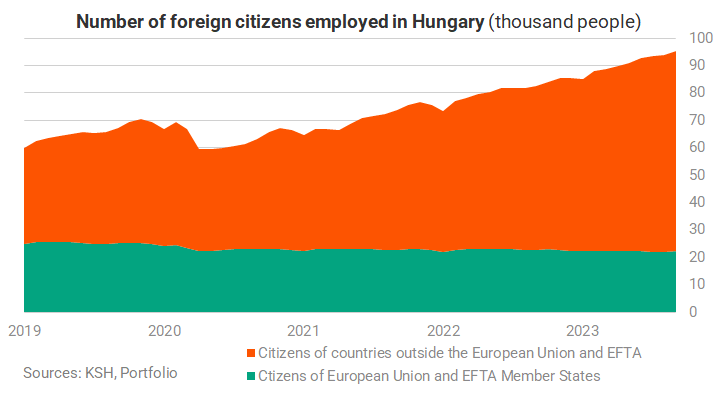
Another source of data tells us that there are already almost 100,000 foreign workers in our country (see third chart from above), and their numbers are growing. However, it is questionable how they appear in the unemployment and employment data (Labour Force Survey).
Cover photo: Getty Images





