Thousands of Hungarians are being put on the streets - Numbers evoke the Covid crisis


Where are the data?
In an unusual way for countries that take statistical releases seriously, detailed data on jobseekers appeared on the website of the National Employment Service (NES or NFSZ in Hungarian) only a day after the Ministry of National Economy published its own set of figures.
The ministry stressed in its statement that "never before have there been so few registered jobseekers as in 2023", but did not mention that almost as many people have been affected by collective redundancies in recent months as during the Covid crisis.
"In December, the number of jobseekers fell below 225,000, the second lowest number in three decades," the Economy Ministry said, before listing the government's achievements. In other words, no further information on jobseekers, labour shortages or even redundancies was available.
After the release of the statement, we visited the NFSZ website, but the report was not available on Tuesday. (Interestingly, the report was dated 2 January.) This violated an important criterion for statistical releases: the report was not available on the data provider's website until later than the Ministry of Economy had published some of its details.
The NFSZ analysis showed that almost 900 workers were affected by collective redundancies in December.
In one month, employers "announced collective redundancies affecting a total of 894 people. The redundancies took place mainly in the human health care and electrical equipment manufacturing sectors, but also affected the food processing, information services and publishing sectors in Budapest, Pest, Fejér, Komárom-Esztergom, Baranya, Somogy, Nógrád and Hajdú-Bihar counties," the NFSZ report said.
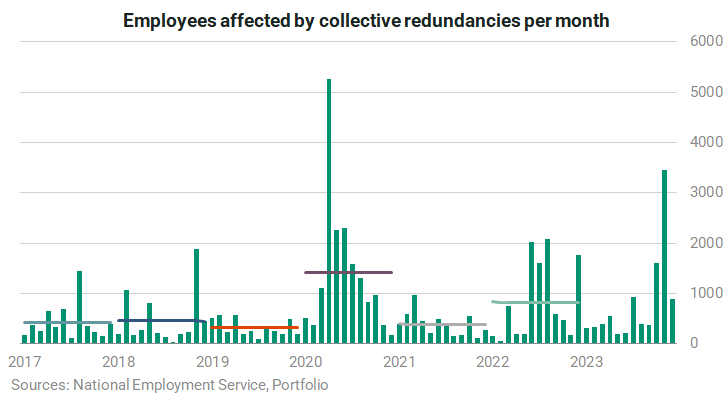
Between October and December, an average of almost 2,000 workers were made redundant each month in collective redundancies as the economy emerged from recession in the third quarter of last year. We have only seen such a high figure twice in recent years. Once at the start of the last recession, in mid-2022, and before that curing the Covid pandemic. We also saw higher numbers than now, with a three-month average peak of over 3,000, during the coronavirus crisis.
November was the worst month in Q4 2023, when 3,400 people were affected by collective redundancies.
The last time we saw a higher monthly redundancy figure than this was during the Covid crisis, and then only for a single month.
In November, redundancies occurred mainly in the human health activities sector, but also affected the financial intermediation, electrical equipment manufacturing, legal, accounting, tax consultancy, real estate, non-metallic mineral products and publishing activities sectors.
In October, nearly 1,600 workers were affected by redundancies in manufacturing (food, machinery, road transport equipment, electrical equipment) and construction in the capital, Pest, Heves, Nógrád, Szabolcs-Szatmár-Bereg, Békés and Csongrád-Csanád counties.
It is fair to say that in peacetime, when the economy is growing, only 200 to 300 people are affected by collective redundancies each month, so the figures for recent months (with between 900 and 3,400) are particularly bad news.
Layoffs in construction
However, rising redundancies are not reflected in unemployment and employment figures. This is mainly because there is still a marked shortage of labour (albeit it is diminishing), meaning that those who are made redundant find jobs quickly.
Put simply, more people are hiring than are being laid off. Detailed employment data by industry from the Central Statistical Office (KSH) are only available for the third quarter, but they are telling as to which sectors may be in trouble.

The largest absolute increases were in market services, including administrative services (+9,100 persons) and professional scientific activities (+8,800 persons), but there were also high rates of growth in real estate, accommodation and food services and information and communication in the third quarter of last year.
Within administrative services, the largest increase in the number of temporary agency workers was due to a rise in the number of foreign workers,
the KSH commented.
The increase in the number of employees in scientific and technical activities and in the information and communication branch was significantly affected by the tightening of the conditions for the flat-rate itemised tax on small enterprises (kata), which led to many self-employed persons continuing to work as employees. The growth in industry (+ 4,700 persons) was driven by the slowing down of manufacturing and a smaller expansion in energy (+ 1,200 persons).
IN THE AREA OF PUBLIC SERVICES, THE NUMBER OF STAFF IN PUBLIC ADMINISTRATIONS HAS FALLEN IN MANY ORGANISATIONS, EXPLAINED BY TIGHT BUDGET MANAGEMENT
The largest fall in employment (-4,600) was in construction, where output was also below the 2022 level. There were also falls in trade and transport and storage (-2,200 and -1,000 respectively), explained by a decline in trade and staff cuts in postal services.
Cover photo: Daniel Ingold





