Hungary central bank releases flash assessment of inflation surprising on the downside


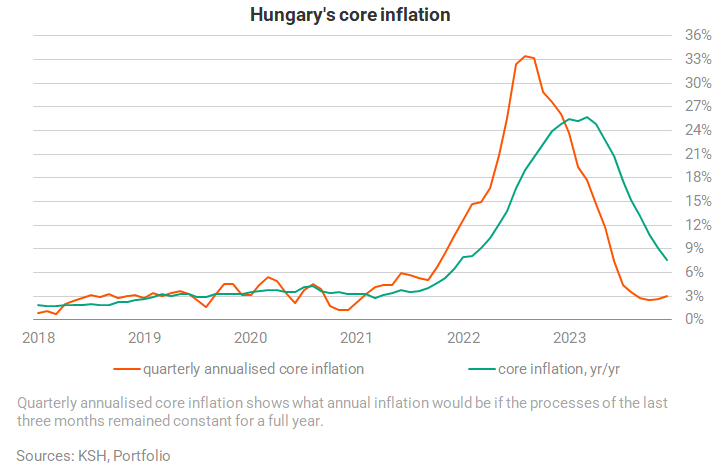
On Friday morning, the stats office reported that inflation fell more than expected in December to 5.5%, below even the most optimistic analyst forecasts. The Hungarian CPI was last lower than this two and a half years ago, in the summer of 2021. Core inflation slowed to 7.6% yr/yr from 9.1% in November.

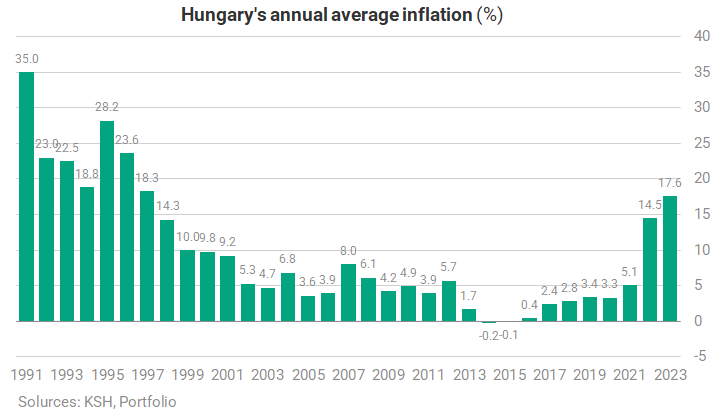
Annual average inflation came in at 17.6%, up from 14.5% in 2022. This is the highest average rate since 1997.
The National Bank of Hungary has also released its assessment of the Dec CPI data on Friday morning, noting that domestic inflation continued to decline rapidly, with consumer prices up 5.5% year onyear. Core inflation and core inflation excluding indirect tax effects fell to 7.6%, and "the rate of price change compared to the previous month was below the historic average usually seen this time of year primarily due to a fall in fuel prices."
"A slowdown in inflation is still perceived on a broad base, reflecting the combined effects of tight monetary policy, the Government’s measures to strengthen competition, the subdued demand environment, base effects and the significantly lower external cost environment compared to last year.
Overall, core inflation was in line with the mean of the forecast range in the December Inflation Report, while headline inflation was lower than that. This deviation is primarily due to the fall in piped gas and processed food prices,
the MNB added.

Inflation slowed down by 2.4 percentage points compared with the previous month, to which the decline in fuel prices (-2.4 percentage points) contributed decisively. Year-on-year core inflation fell by 1.5 percentage points, with disinflation being a general factor. The Bank’s measures of underlying inflation developments capturing persistent inflationary trends, calculated on a year-on-year basis, also fell. The inflation of sticky-price products inflation and the core inflation excluding processed food prices both declined by 0.9 percentage point relative to the previous month.
The continued slowdown in underlying inflation is signalled by the fact that core inflation and inflation were below 3% in a shorter-based comparison (3 months/3 months), the bank added.
The annual inflation of tradables fell to 6.6%. The prices of this product group rose by 0.3% compared to the previous month. Within this product group, the monthly rise in non-durables prices was partly offset by the decline in durables prices. The rise in the prices of non-durables was primarily caused by the volatility in air fares prices, while in terms of durables, the main contributor to the fall was second-hand cars.
Year-on-year price index of market services declined to 12.6%; and as a result, the fall in annual price growth, started in June, continued. On a monthly basis, prices rose by 0.3%.
Annual food inflation fell to 4.8%in December based on KSH data release. Within the product group, the annual price index of processed food fell considerably with unprocessed food prices rising slightly as a result of basis changes. Compared to November, unprocessed food prices and processed food prices decreased by 0.2% and 0.4%, respectively. The decline in unprocessed food prices was due to the fall in poultry meet and fresh domestic and southern fruit prices, as the drop in the prices of unprocessed food was attributable to the fall in milk and dairy products prices.
Fuel prices decreased by 5.0% on a monthly comparison mainly reflecting a fall in oil prices. In addition to the monthly decline in prices, the significant base effect arising from the discontinuation of the price cap in December 2023 was also a contributing factor to the decline of 4.2% in the annual average price of the product group.
The prices of regulated products and services fell by 0.2% compared to November. Primarily this was caused by a decrease in piped gas prices, which was the result of the further increase in the proportion of household consumption below the volume limit of the lower, officially regulated price.
The indicators, measuring households’ inflation expectations, showed unusually high volatility. Corporate expectations for retail sales and services prices fluctuated at pre-Covid19 levels in December, the MNB concluded.

After the flash analysis, the main practical question will be how the central bank will react to the lower-than-expected Dec CPI data. We will probably only get an answer to this question at the very end of January, when the Monetary Council will hold its first rate-setting meeting of the year. Initial comments from analysts suggest that the chances of a move higher than the 75 basis points seen so far may be increasing.
Cover photo: Getty Images





