Hungary gov't did not expect to collect so much money from tolls


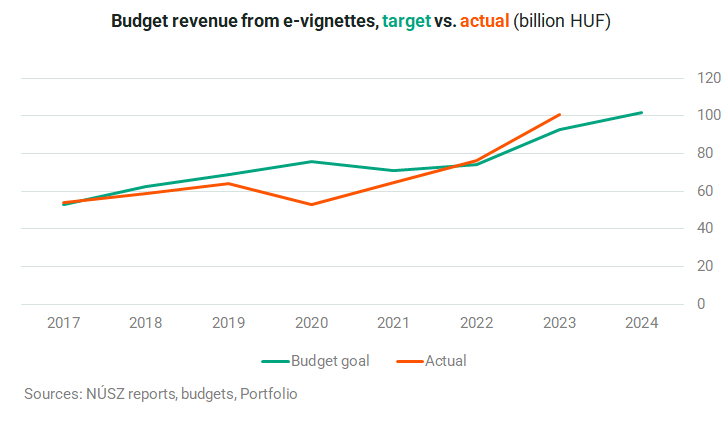
According to data from the National Toll Payment Service Company (NÚSZ), a net HUF 100.7 billion (gross HUF 127.9 billion) was collected from e-vignettes in 2023. This is 8.5% more than the HUF 92.8 billion the state budget had pencilled in. This is interesting in the light of the fact that e-vignette sales fell by 1.4% to 14.88 million.
| E-vignette sales | |||
| 2022 | 2023 | change | |
| Annual | 584 284 | 651 095 | 11.43% |
| Monthly | 2 804 525 | 2 195 095 | -21.73% |
| Weekly / 10-day | 9 270 146 | 9 394 113 | 1.34% |
| County (annual) | 2 425 535 | 2 633 882 | 8.59% |
| Total | 15 084 490 | 14 874 185 | -1.39% |
| Source: NÚSZ | |||
This is due to a 21.7% drop in the sale of monthly passes, which is not surprising given that last year's differential price increase made this type of toll the most expensive, with a 71% surge for passenger cars.
However, other entitlements have amply compensated, with demand for annual and county stickers in particular rising, with these barely more expensive in 2023 compared to the previous year, by just 5%.

The purpose of the differential increase was to allow the government to raise the price of stickers used by locals less and those used by tourists and transit passengers more.
The graph below shows how the target e-vignette revenue compares to the actual revenue collected. The 2023 figure (HUF 100.7 bn vs. HUF 92.8 bn target) is almost as high as the goal for this year, which is HUF 102 billion. It would appear that the government has once again significantly under-forecasted revenues, as this year it has already increased prices by the August inflation of the previous year, according to the previous methodology, and by a uniform 16.4%. In addition, new road sections are being added to the toll network.
However, two factors could reduce e-vignette revenues:
- One is the one-day sticker, which will be available from 1 March and, although it will cost HUF 5,150, which is extremely poor value for money, it will still save motorists in transit who buy it instead of the weekly / 10-day pass that costs HUF 6,400 (saving 19.6%). From a budgetary point of view, this means that while last year a passing motorist could use motorways for HUF 5,500, now it is 6.3% cheaper (the reason for the change is an EU regulation that wants to soften the price system of national tolls that "penalises" foreign passers-by.)
- From 1 February, buses will be exempted from the e-vignette system and will be transferred to the e-toll system proportional to the distance travelled, as will lorries weighing more than 3.5 tonnes. This will generate extra revenue for the budget, as this calculation method is much more costly, but technically this move will actually reduce e-vignette revenue.
Cover photo: Getty Images





