Hungary's debt ratio has hardly diminished in 2023


"Following the Covid-19 induced increase in the debt stock of 2020, debt-to-GDP decreased to 76.7% in 2021 and 73.9% in 2022, while the Government expects ratios of 73.4% in 2023 and a below 70% figure in 2024 according to the budget act," the ÁKK said in its latest Investor Presentation today.
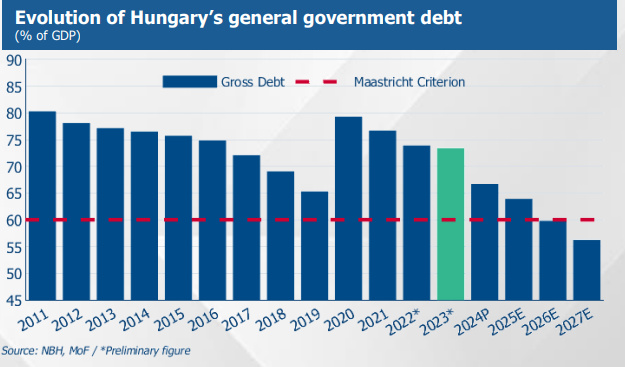
This is interesting because no preliminary debt statistics have been released yet, with the central bank (MNB) scheduled to publish preliminary financial accounts statistics on 19 February. All we know at the moment is that gross public debt stood at 75% of GDP at the end of the third quarter, and the question is how much it has fallen from there in the last three months of 2023.
Last year, high inflation allowed nominal GDP to still be robust, even though GDP contracted in real terms. At the same time, annual average inflation was 17.6%. That is why, a year ago, most people expected the debt ratio to fall below the 70% psychological threshold as early as 2023, but
the marginal decline now being reported may be disappointing by comparison.
The main reason for this disappointment must have been the budget deficit, as the government raised the target from the original 3.9% to 5.2% in the autumn, and then at the end of the year it was announced that this was unlikely to be met, with a deficit of 5.9% of GDP.
This year could be even more challenging from a budget deficit and debt reduction perspective. Under the budget law passed last year, the government aims to achieve a deficit target of 2.9% of GDP, but analysts agree that the chances of meeting that goal are minimal, with a deficit of 4-5% looking more likely. In addition, with inflation expected to shrink to 4-6%, nominal growth could be more subdued,
posing a serious risk of a rise in the debt ratio.
Cover photo: Getty Images





