Rating agency sees a huge risks in Hungary, with bitter ending on the cards


The whole region is facing risks
Budget deficits have widened significantly over the past four years in Central and Eastern European countries, and most of them will find it difficult to meaningfully start reducing their debt, S&P projects. Among the key risks to fiscal consolidation over the next two years it highlighted the busy election calendar, higher-than-anticipated inflation, high defense spending, weak GDP growth, and permanently higher interest costs. In addition, the uncertain fiscal situation could also affect the sovereign ratings of the countries concerned.
S&P's analysts pointed out that the cost of debt has risen and 2023 deficits proved much larger than they had expected. In fact, some CEE sovereigns still have among the highest deficits in EMEA following four years of elevated deficits in the wake of the pandemic and amid the Russia-Ukraine conflict.
As fiscal fallout from these shocks fades, and assuming there is a policy effort toward consolidation, S&P expects CEE sovereigns will reduce their fiscal deficits in the medium term. This should see their debt-to-GDP ratios stabilize at still low-to-moderate levels compared globally.
S&P's current projections see most CEE sovereigns consolidating their fiscal deficits through 2026, but only gradually. Deficits will narrow to about 2.8% of GDP on average by 2026 (GDP-weighted average) from an estimated 4.7% in 2023.
"Coupled with still-high nominal GDP growth, this will mean debt levels will stabilize or decrease as a share of GDP between 2023-2026 for seven out of the 11 CEE countries we rate, even if--except for Croatia and Slovenia--they are permanently higher than in 2019."
Elections, war, interest rates
The analysis also looks at the reasons for the persistent tensions in fiscal policy. This is explained by several factors:
- Elections in several countries, with implications for fiscal policy, i.e. pre-election spending.
- Rising defense spending, fuelled not only by the Russian-Ukrainian war but also by NATO expectations.
- The sharp rise in interest expenditure, which will affect the countries concerned for years to come.
Over the next two years, several countries in the region are preparing for key elections that will worsen fiscal discipline. Six out of the 11 will hold a general election (parliamentary or presidential) over the next two years; five have scheduled regional or municipal elections; and all will participate in EU elections in 2024.
S&P brings Hungary as an example, reminding that the government's pre-election spree in 2022 saw government debt, net of liquid assets, increase by almost 10% of GDP, which was far more than all the other CEE countries and resulted in economic overheating.
Higher-than-anticipated inflation, including via further global energy price shocks, remain a fiscal risk, S&P warns. Possible commodity price shocks could prompt governments to extend or introduce new fiscal measures to support households and businesses, it explains. According to the think-tank Bruegel, CEE countries allocated almost €50 billion for energy support measures for households and private companies (excluding utilities) between September 2021 and January 2023--equivalent to almost 2% of their combined GDP during that timeframe.
Higher-for-longer inflation could also weigh on public finances.
The flipside of an expected rebound in domestic demand is the risk of more persistent inflation for longer, even if--absent a shock to energy and food prices--we do not think price increases will come close to those of 2023.
Demand pressures, amplified by tight labour markets amid one of the world's worst demographic outlooks, bear the risk of keeping inflation high, S&P added. "For 2024 and beyond, higher inflation could delay monetary normalization (and keep interest costs above current projections), weigh on private consumption and so depress value-added tax revenue, and likely require governments to raise specific spending above current budgets."
At the same time, a VAT revenue rebound, backed by strengthening domestic demand, will underpin consolidation efforts across CEE, the analysts noted.
Defense spending is more pressing in CEE than for most peers globally. Given their proximity to Ukraine, most CEE governments have committed to defense spending well above NATO's 2% of GDP requirement.
Typical CEE defense budgets will be 3%-4% of GDP over the next few years,
which, for many, doubles or triples such spending compared to 2014 (in % of GDP terms). This is particularly so for the Baltics, Poland, Slovakia, and Hungary."

The third major item is the evolution of interest expenditure, which is the result of tight monetary policy. Due to the soaring inflation in the region, central banks have had to raise interest rates much more than their developed counterparts, which has pushed up the cost of financing debt.
S&P expects CEE's financing costs will remain higher than developed markets' and consume an increasing share of government revenues over the next few years.
"Although monetary policy rates have stabilized or started to decline in some CEE countries, government funding costs will remain high given underlying price pressures. Coupled with a rising stock of nominal debt on the back of high fiscal deficits, this will permanently elevate interest bills even as a share of rising revenues.
Moreover, as seen in the last few years, S&P anticipates government funding costs could experience greater volatility depending on domestic and global interest-rate developments, exchange-rate trends, and investor sentiment (which is, not least, sensitive to the evolution of the Russia-Ukraine war).
Hungary could be in big trouble too
In addition to the general findings, the rating agency's experts have published a fresh forecast for individual countries. In the case of Hungary, they believe that
the deficit target of 2.9% of gdp in 2024 will not be met, and the gap will reach 4.5%.
Even after that, the path of fiscal consolidation will be slower than the government would like, with a deficit of 3.3% of GDP in 2025 instead of the 1.9% target, and the gap will still be as high as 2.9% even in 2026.
Interest expenditure could be by far the highest in Hungary, close to 10% of budget revenues. The second highest in this indicator could be Romania at 6.5%, according to S&P.
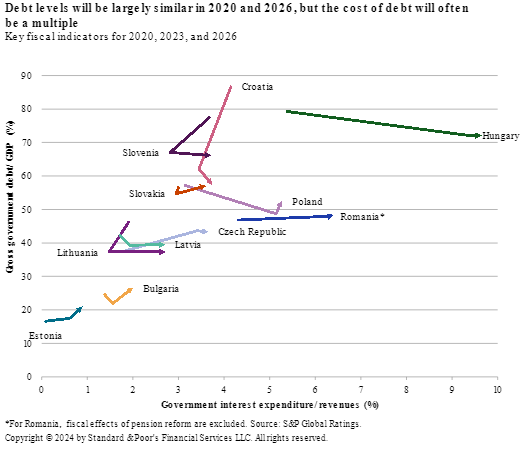
Fiscal issues in Hungary could result in a higher debt-to-GDP ratio in 2024 than in 2023.
The rating agency expects the debt ratio to rise to 72.4% from 72% last year, and to stagnate at that level next year. At the same time, the S&P analysts point out that the debt profile of the region remains favourable, with relatively low debt levels and long average maturities of government bonds, meaning there is little need for annual renewals.
Of course, the worst-case scenario can be avoided, for example with stronger-than-expected economic growth, to which EU funds can make a major contribution. After the positive developments at the end of last year, analysts expect that Hungary and Poland could start receiving some of the funds that were previously frozen.
From a Hungarian perspective, S&P's opinion is also crucial because they currently have the worst rating of the three major credit rating agencies. The BBB- rating is one notch above the investment grade, which was assigned a stable outlook last year. This means that if a significantly worse path than the above were to materialise,
Hungary could even lose this investment grade and move into the so-called 'junk', i.e. non-investment grade.
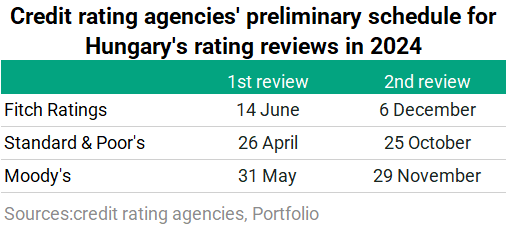
This would have tangible negative consequences, since there are investors who cannot buy assets with poor ratings, and they could easily sell their Hungarian interests. This year, S&P experts will come for the first time at the end of April, when the fiscal data for the first three months will be known, so the outlook may be clearer.
Cover photo: Getty Images





