Hungarian state collects HUF 2.26 trillion more in taxes in 2023 than in 2022


The 2023 budget has come a long way and this week it reached its penultimate stage: the Ministry of Finance published last year's detailed public finance figures (cash flow data) after the preliminary release of data in early January. The next important milestone is expected in April, when the Central Statistical Office (KSH) will send Eurostat, the statistical office of the European Union, last year's accrual deficit data. It will reveal the final deficit-to-GDP ratio, which the government initially committed to 3.9%, then raised to 5.2% last autumn, and finally projected a deficit of 5.9% at the very end of 2023.
Revenues inflated by inflation
We wrote a year ago, when the 2023 budget reached a brand new form, that it was also about massive austerity. The detailed figures show that these preliminary expectations have been borne out. If we look at the direct and indirect taxes paid by companies and individuals on the total revenue side of the budget of HUF 36,515 billion, the main picture that emerges compared to the 2022 figures is as follows:
- payments by economic operators increased by 25% to over HUF 3,632 billion from HUF 2,895 billion;
- consumption-related taxes increased to HUF 9,054 billion from HUF 8,718 billion;
- and household contributions increased by 38% to HUF 4,333 billion from HUF 3143 billion.
The increase is around HUF 2200 billion for the above three lines. So this shows that Hungarians paid a high price last year for the fiscal profligacy of the preceding years.
The heavy taxes paid by households and companies are also illustrated by the fact that, for example, social security contributions rose by 43% to nearly HUF 4,000 billion, corporate tax revenues jumped by 36% to over HUF 1,000 billion, and the proceeds to the tune of billions of forints from special taxes and windfall taxes also increased spectacularly.
In addition, more money came in from social contribution taxes and contributions in 2023 than in 2022: the Health Insurance and Pension Insurance Fund received HUF 6,689 billion in this way last year, a 14% increase compared to 2022.
However, even all these revenue increases were not enough to keep the budget from being turned upside down. Budget expenditure increased by 19% to HUF 41,109 billion from HUF 34,565 billion in 2022, making the shortfall much bigger than the government expected.
Péter Benő Banai, State Secretary of the Ministry of Finance, in an article published last week on Portfolio, explained in detail why the budget turned out as it did. Among other things, he said that "the 2023 budget process proved that high inflation is "no friend of the budget".
Painful rise in expenditure
On the expenditure side, high inflation last year has indeed left a deep mark. The state spent HUF 2.600 billion on individual and normative subsidies, including the financing of the utility bills reduction scheme, after HUF 995 billion in 2022.
The ministry notes here that the main reason for the discrepancy is that in 2022, HUF 699.2 billion was paid out in relation to compensation for district heating suppliers and compensation for the overheads protection system, while this year HUF 1,373.5 billion was paid out under this balance sheet heading for compensation for district heating suppliers, universal service and stockholding of electricity and natural gas for households, and energy subsidies for industrial consumers.
Expenditure on compensation for the costs of national and suburban public transport services totalled HUF 744.2 billion this year (compared to HUF 588.8 billion in the same period last year). Under road availability charges, the balance sheet showed HUF 346.3 billion for 2023. The state has paid out nearly HUF 200 billion in relation to the new expressway concession contract, which was inked in 2022.
Spending on housing subsidies was HUF 444.7 billion at the end of December, down HUF 190.1 billion compared to 2022.
There is hardly any expenditure item that has decreased or remained flat, which makes the stagnation of family allowances particularly interesting in the light of the high-inflation environment. In 2023, a total of HUF 404.9 billion was paid out for this purpose, which was just HUF 3.9 billion more than the previous year.
The government has also increased spending on state assets, to HUF 1,750 billion in 2023 from HUF 1,154 billion in 2022. This already includes the settlement of the Vodafone deal, while the budget will have to settle the expenditure obligation arising from the purchase of Budapest Airport this year.
Expenditure on the Social Security Funds also rose spectacularly compared to 2022: total expenditure increased by 12% to HUF 9587 billion. Within this, the government spent HUF 5,759 billion on pension benefits, 20% more than the HUF 4,790 billion recorded in 2022. This means that here too the impact of high inflation has been felt, and it is worth remembering that in November an additional increase had to be paid to pensioners.
The above does not seem like a significant overspend, but the government also paid out more in the pharmaceutical subsidies line last year than two years ago: after HUF 440 billion, the expenditure was HUF 505 billion, compared to the revised target of HUF 472 billion. In addition, the curative and preventive care also cost more, with expenditure up at HUF 2,410 billion from HUF 2,203 billion, including the amount of the significant hospital debt consolidation at the end of the year, which also had personal consequences.
What happened to VAT receipts?
One of the biggest scares and headaches for the government during the year has been the development of VAT receipts, so it is worth taking a look at how the detailed VAT revenue figures have developed, both gross and net.
Total VAT payments (excluding reimbursements) amounted to HUF 12,805 billion last year, only 5% higher than the 2022 figure. This in itself suggests that something happened to the fundamentals of the economy in 2023, as consumer prices have risen by nearly 18% on average in the meantime. There were several explanations for this phenomenon during the year, which have not been refuted by officials:
- The consumption of the population has been reduced and restructured by high inflation, and the fall in real earnings has reached a level that has took its toll on consumption and, through it, lowered the amount of consumption-based tax revenue.
- Beyond household consumption and retail trade, there were also sectors where performance diminished spectacularly, and investments and equipment purchases did not pick up as much as before (partly due to the lack of EU funds), which, naturally, may also be a cause of a drop in VAT revenue.
- Deteriorating economic conditions and declining standard of living may have bolstered the grey economy last year, i.e. the concealment of income to avoid paying tax.
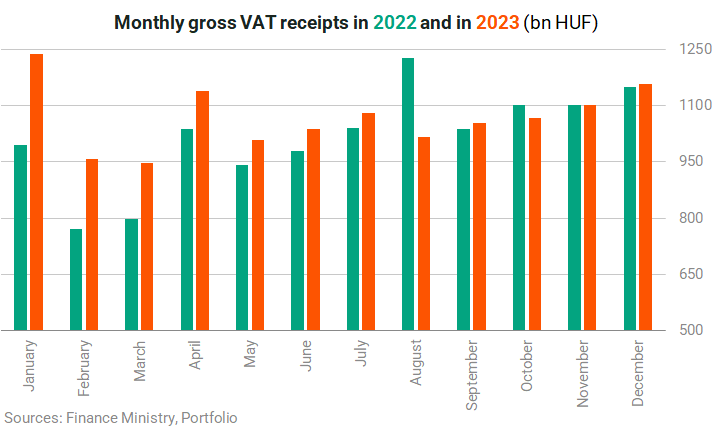
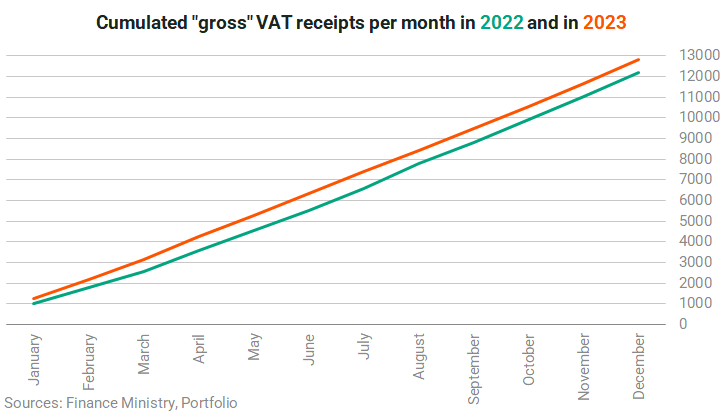
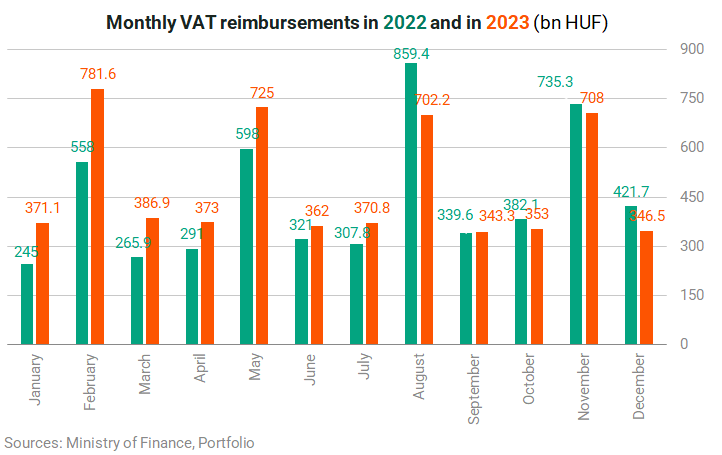
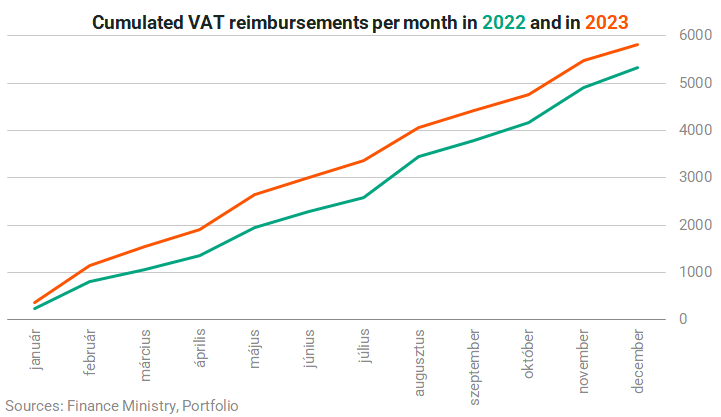
VAT reimbursements also increased significantly for a long time during the year, reducing the stabilising effect of VAT receipts on the budget balance. Finally, the situation returned to somewhat normal by the end of the year, with a total of HUF 5m823 billion in VAT refunds to firms, representing a 9% increase from HUF 5,324 billion in 2022
Cover photo: Getty Images





