Hungary will not replace BUBOR, but still makes credit cheaper


Discussions between the government and the Banking Association have continued on Monday. For new corporate loans, the interest rate spread over BUBOR ( Budapest Interbank Offered Rate) will be reduced to 0% for six months during the term, the Ministry of National Economy said in a statement.
It wrote that Ministry of National Economy and the Banking Association have recently engaged in intensive and constructive professional dialogue to promote market lending. This also includes the professional debate launched by experts from the Ministry of National Economy at the beginning of last week.
At the heart of the debate was the fact that the 3-month BUBOR rate, which is the key rate for bank loans, and the yield on the Discount Treasury Bill of the same maturity have diverged significantly - something that has not happened in the past 20 years - causing confusion in the pricing of money market products.
It would have been possible to use the lower T-bill yield level as a reference rate. However, banking practice is to use the BUBOR, which is generally used by the market and has a higher interest rate.
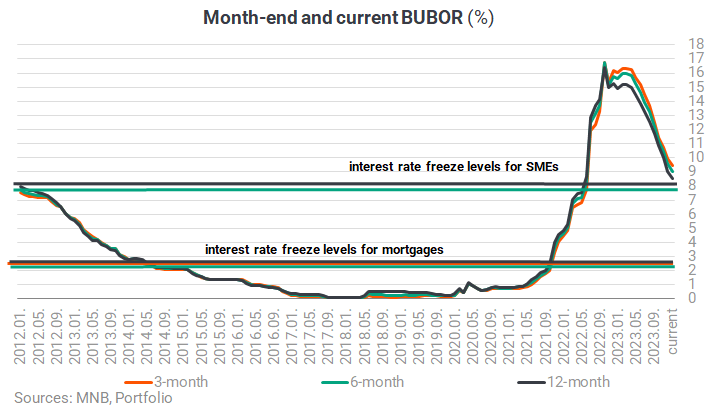
In line with the ministry's remark, the Banking Association acknowledged that there was a disconnect between these two core benchmark rates and responded constructively to resolve this situation. It made it clear that the government and the market, as well as the banking sector, are facing a negative environment due to lower credit demand and investment activity resulting from high interest rates.
In order to address the interest rate decoupling, the Banking Association has suggested that banks could voluntarily join the scheme and offer HUF-based market loans to corporate customers on a "promotional" basis for a transitional period, which could in practice mean a substantial reduction in lending rates, they said.
The government's goal is to restore economic growth in 2024, but the only way to achieve this is for banks to sign new corporate loan agreements in the next three months that will
reduce the interest rate spread over BUBOR to 0%, which will remain at 0% for 6 months from the date of the loan, after which it can return to the normal level.
At today's meeting between the Banking Association and the Ministry of National Economy, the Banking Association found the government's proposal to be a good solution. Banks will then voluntarily agree to apply it.
The Banking Association encourages its member banks to consider the following options for corporate loan restructuring. Each commercial bank that voluntarily joins the scheme will, on the basis of an individual decision, undertake to reduce the interest rate spread above BUBOR to 0% for all new forint loans to companies concluded between 1 February 2024 and 1 May 2024, on a temporary basis, i.e. for the first six months of the term, as part of a preferential period, thereby substantially reducing the interest rate level of corporate loans.
The voluntary commitment can apply to all business loans, including overdrafts, working capital loans and, if disbursement starts this year, investment loans, regardless of the purpose of the loan, and to all new business loans, regardless of maturity.
this translates into an interest rate reduction of two to four percentage points.
The Minister of National Economy provided information to the representatives of the Banking Association on the phasing out of the SME interest rate freeze. Márton Nagy stressed that the interest rate freeze could only be abolished if it does not lead to any increase in repayments.
He added that on current trends, in line with market interest rate expectations, benchmark rates could fall below 8% by April, which is below the level set in the interest rate freeze. This means that no one would be adversely affected by the phasing out. As a consequence, the government intends not to extend the SME interest rate freeze, which expires on 1 April 2024 under the current legislation.
Márton Nagy noted that the voluntary commitments by the banks will help to further stimulate market lending and boost economic performance.
We believe this is a healthy compromise for several reasons. Firstly, in the long term it is not harmful for monetary transmission or the profitability of banks and thus to borrowing opportunities. Secondly, as the rate reduction is voluntary and temporary, it does not dent the banks' willingness to lend. In fact, the lower interest could in the short term it even fuel demand. Thirdly, contrary to the original idea, it does not shift pricing by the banks to a market that operates even less efficiently than the unsecured interbank market tracked by BUBOR, or in a way that is dependent on government intervention.
Cover photo: Portfolio





