Hungary's debt reduction at risk? Never before has the Orbán government faced such a challenge


Debt ratio hardly dropped last year
There are no final figures on the end-2023 debt-to-GDP ratio, but a preliminary figure was given in a recent investor presentation by the Government Debt Management Agency (ÁKK), which shows that the government expects the ratio to be 73.4%, up from 73.9% at the end of 2022. If this is true, then we can state that
the debt-to-GDP ratio has declined significantly less than expected, showing only a minuscule, symbolic reduction.
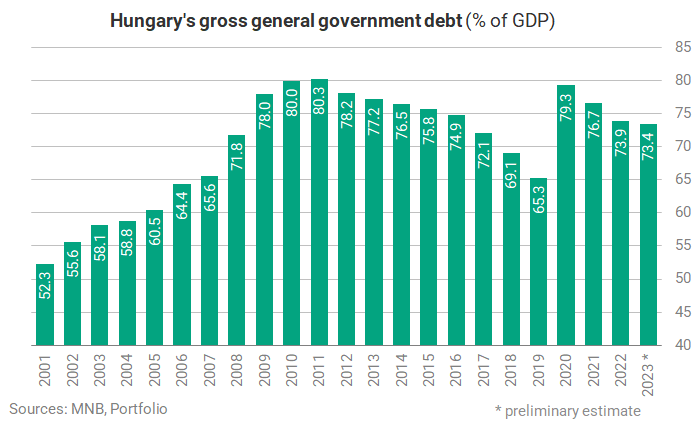
It was already apparent that there would be no significant reduction in debt, as the ratio stood at 75% at the end of the third quarter. The preliminary figures for the fourth quarter will only be published by the central bank (MNB) in mid-February in the context of the financial accounts. Earlier in the year, however, we also expected the debt ratio to fall below 70%. In the end, there were two main reasons why this did not happen:
- The government sharply revised the deficit target for 2023, to 5.2% of GDP in the autumn from 3.9% originally, and upped it further to 5.9% at the end of the year. This implies higher financing needs and therefore a higher debt burden.
- Eximbank's balance sheet grew strongly last year, with the state-owned banking group raising a lot of funds, especially in the second half of the year, which also had an impact on public debt. A few years ago, the Hungarian authorities already had a dispute with Eurostat on the status of Eximbank, which they lost, so Eximbank must be included in the official debt indicator (Hungary was not allowed to reclassify it outside the general government sector).
This year will be really a tough nut to crack
Based on the above, there is a good chance that the 2011 Stability Law's requirement for the debt ratio to decline each year until the 50% of GDP threshold is reached was met last year. Inflation has helped most in recent years, as nominal GDP growth has been significantly boosted by a dramatically rising consumer price index.
Last year, for example, even though the Hungarian economy contracted in real terms, average inflation was 17.6% (although the GDP deflator that is relevant for us now may have been lower, around 13%, but that is still very high), so GDP still rose significantly.
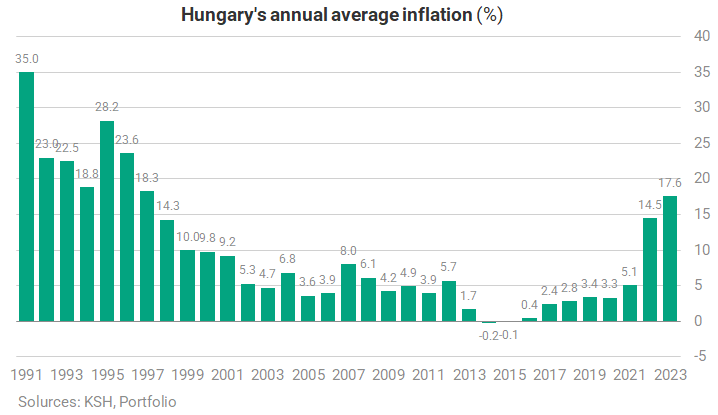
However, this positive effect is expected to diminish significantly from this year, as analysts now project annual average inflation of between 4 and 6% for 2024. This means that the nominal increases of the past two years will almost certainly not be repeated. Thus, the budget deficit and its reduction will become increasingly important if the debt ratio is not to rise.
And there's the rub, given that the budget is the most vulnerable point of the Hungarian economy at the moment. In the budget act passed last summer, the government set a deficit target of 2.9% of GDP, but today there is no analyst who believes this can be achieved without a major adjustment.
Experts say that a deficit of 4 to 5% seems more likely, which would represent a reduction from last year's deficit of around 6%, but would seriously jeopardise debt reduction efforts.
There are very few scenarios that promise success
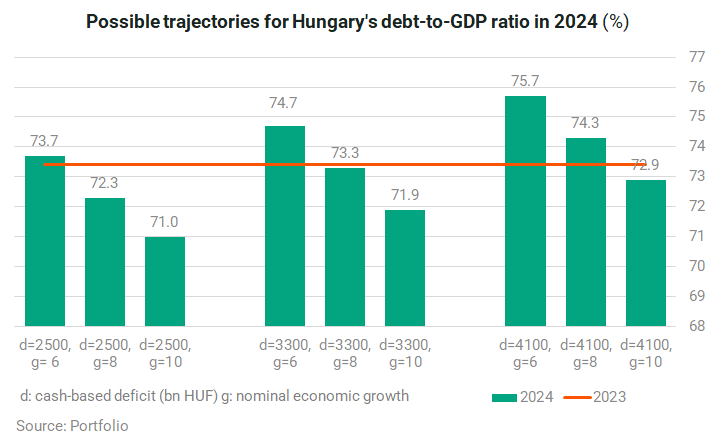
As for the expected debt trajectory, we have resorted to a model we have been using for years, which we will try to update throughout the year depending on how the different variables evolve. We have now outlined the following possible scenarios:
- How much will the economy grow in nominal terms? This depends on two factors, inflation (GDP deflator) and real growth. We have mentioned that the 4-5% range for inflation now seems the most likely, while growth could pick up again after a weaker year in 2023, the question is how much. The government would like to see economic output growth by around 4%, but some analysts say that 2-3% seems more realistic. Thus, we have assumed in our three scenarios that nominal GDP growth will be between 6 and 10% in 2024 (4-6% deflator and 2-4% real growth).
- How much will the budget deficit total in the end? Besides GDP, the other important variable is the budget deficit, which by default affects the amount of public debt. We have mentioned that the government's target of 2.9% does not seem realistic, as it would imply a cash deficit of HUF 2,515 billion. In addition, we consider two alternative scenarios: a deficit of HUF 3,300 billion would be around 4% of GDP, while a pessimistic scenario of HUF 4,100 billion would correspond to a deficit of around 5% of GDP. (In fact, there is no clear correspondence between the cash deficit to be financed and the accrual deficit, and this year in particular there is not expected to be one, which we will come back to later.)
The above variables give a total of nine possible scenarios, which are shown in the graph below:
The main findings that could determine the path of the debt ratio this year:
- There are five out of nine scenarios in which the debt ratio would fall from 73.4% at the end of 2023, meaning that in principle the slight majority of options would still be favourable.
- Nominal growth will be key, as even at a 6% nominal GDP growth it may not suffice even to keep the shortfall under 3% of GDP, and a higher deficit would almost certainly lead to a higher debt ratio.
- Calculating with the highest assumed budget deficit of 5%, the coveted target would only be met at 10%, i.e. the highest nominal growth rate under review.
- The graph shows that with a budget deficit above 3 to 4%, Hungary would be highly dependent on growth to bring the debt ratio down.
Airport buyback, forint could upset things too
Of course, there are both positive and negative risks surrounding the above scenarios. One of these risks is the planned acquisition of Budapest Airport, which the government has been working on for months. While the transaction will not increase the accrual-based budget deficit, it will increase the cash flow-based gap, so financing will have to be found, and could therefore have an impact on public debt.
In other words, it is not certain that the increase in nominal debt will be close to the accrual deficit. So far, there have only been speculation in the press about the possible price of the airport, with more concrete details to be announced after the closing of the deal at the latest.
Another risk is the development of the forint exchange rate. With the foreign currency debt issues at the beginning of the year, the share of foreign currency in total debt has risen to close to 30%, which means that a one percentage point weakening of the forint alone increases the debt ratio by around 0.225 percentage points. That is, compared to the current level of around 385, say EUR 400 at the end of the year is in itself an increase of 0.7-1 percentage point.

There is, of course, room for the government to improve the debt trajectory if necessary, should it prove challenging to reduce the rate during the year. The most obvious solution, of course, is to lower the budget deficit through various adjustment measures.
In addition, they can play with the so-called Treasury Single Account (KESZ), the government's liquid reserves deposited with the central bank. At the end of December, this stood at HUF 1,528.4 billion, and there was certainly a significant increase in January due to the aforementioned FX bond issuance.
At the end of the year, the government can release funds from this account and the ÁKK can use them to buy back government bonds to reduce debt. Of course, the extent of this is limited by the pool of ready cash, meaning that the government can resort to such a "trick" if it is short of the amount needed to meet the falling debt ratio.
Overall, meeting the need to reduce the debt ratio further was perhaps as challenging in the early 2010s as it will be in 2024. Except for 2020, when the recession caused by the coronavirus pandemic saved Hungary from meeting the rule.
Cover photo: MTI Photo/Prime Minister's Press Office/Zoltán Fischer