Something very strange happened in the Hungarian budget in January 2024


Data published two weeks ago about the January performance of the state budget was deceptive at first glance, as the balance showed a surplus, i.e. more revenue than expenditure, and this should be seen as a positive development. However, this is relative, especially after having seen the detailed January public finance data.
Compared with previous years, the surplus is smaller, and looking at the revenue and expenditure items, we are witnessing less than reassuring trends.
The big picture
General government revenue in January was 16.9% higher than in January 2023, at over HUF 3,320 billion, with central government revenue up 16.6% to HUF 2,364 billion.
Meanwhile, the government kept expenditure relatively in check: it increased by 9.5% year-on-year to HUF 3,267 billion. Within this, the rate of expenditure growth was more moderate for the central budget, which grew by 8.2% to HUF 2,401 billion.
It was mainly due to this, i.e. the central budget, that the overall general government balance turned positive, as the central budget was "only" HUF 37 billion in deficit, compared to last year's HUF 190 billion shortfall.
Meanwhile, social security funds also fared better than in the base period.
Developments on the revenue side
Looking first at the three major sources of revenue, two of them show rather negative trends. Payments by economic operators amounted to HUF 229 billion, compared to HUF 232 billion last January. Smaller direct payments by companies is explained mainly by a drop in mining fee receipts and smaller payments by the energy sector.
The performance of consumption taxes in the first month is not very encouraging either. Overall, HUF 1,034 billion was collected under this heading, a 2.6% drop compared to January 2023. Within this, it is worth highlighting that
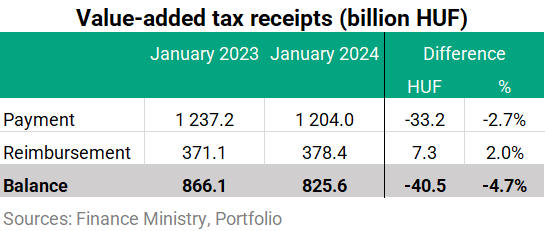
revenues from value-added tax (VAT) came in at HUF 825 billion this year, down from HUF 866 billion last year.
This corresponds to an annual decline of 4.7%, which is particularly interesting (as referred in the headline of our article - ed.) because inflation has been subdued at just 3.8%.
The high rate of price increases in recent years seems to have left a lasting and deep imprint on consumers and their spending patterns, and this is also reflected in VAT receipts.
The situation looks a little better if we look at incoming payments (gross VAT receipts) and outgoing payments at the same time. In this case, the shortfall in payments received is "only" 2.7%: HUF 1,204 billion paid in state coffers.
The decline in sales-type revenues occurred while the revenues from insurance tax booked here exploded, with HUF 30.5 billion collected in this category against HUF 9.8 billion in Jan23. Meanwhile, excise duty revenues fell by 10%.
Meanwhile, contributions from the general public paint a positive picture: these types of revenues increased by 14.9% over a year, reaching HUF 450 billion, and within this, personal income tax revenues increased by 15.7% to HUF 430 billion.
Similarly impressive growth figures are also seen in the social security funds' receipts of social security contributions and general contributions. In total, HUF 661 billion was collected in these lines, 18.2% more than in January last year.
This is what actually saved the budget
The balance sheet of EU funds showed HUF 226.0 billion revenue by the end of January 2024. This amount represents 9.1% of the statutory appropriations (HUF 2,479.8 billion). Last year, only HUF 34 billion was collected on the same line.
Meanwhile, spending on EU programmes fell to HUF 80 billion from HUF 151 billion.
In other words, the balance of revenue and expenditure of EU programmes also had a significant impact on the overall budget balance. After a shortfall of HUF 117 billion last January, the first month of this the budget booked a surplus of HUF 146 billion.
What about the expenditure side?
The utility bills reduction scheme (or energy subsidies) cost less this January than a year earlier, and the state spent a lot less on the standby charges of the road network too, HUF 8.3 bn versus HUF 43.2 bn a year ago. The ministry said the latter had to do with technical factors.
As for the overheads protection expenses, the ministry explained that although the amount paid in January this year for compensation for the universal supply of electricity and natural gas to households was slightly lower than in the same period in 2023, the first instalment of the first quarterly compensation for district heating companies was paid in January this year.
Housing subsidies declined sharply to HUF 15 bn from HUF 65 bn. In this context, the Ministry of Finance stressed that the difference is due to the carry-over effect of the home renovation subsidy and the related loan phased out at the end of 2022, which was paid in the first months of last year.
But the government has not cut pension and health care spending. Pension benefits, for example, were 11.2% higher than last January, and the Health Insurance Fund's January spending was 10.3% higher than in the first month of 2023. It is interesting to note that within this, the pharmaceutical fund amounted to almost HUF 40 billion, an increase of 13.8%.
Conclusion
Overall, the surplus in January was not explained by any positive changes in the fundamentals of the economy, but mostly by one-off or technical factors.
In this respect, the budget situation this year is not reassuring, and the government is probably aware of this. In recent weeks, the government seems to have decided to raise this year's deficit target to 4.5% of GDP, from the 2.9% of GDP set in the original budget.
The government's position can only be reaffirmed by the first preliminary data for 2023. According to the central bank (MNB), the financing requirement of the general government as a share of GDP was 6.8% last year, and Márton Nagy, the Minister of National Economy, recently spoke of a deficit of 6.5%.
This is where the gap should be brought down to 4.5% this year, which would be quite a spectacular feat, as the year has clearly not started strongly for the state's finances.
Cover photo: Finance Minister Mihály Varga arrives to a press conference in the Ministry of Finance to inform the public about the current situation of public finances on 4 January 2024. Source: MTI Photo/Zoltán Balogh





