Hungarian passenger car fleet keeps getting older


Number of passenger cars registered
There were 4.169 million passenger cars registered in Hungary at the end of 2023, which marks a massive increase of 1.13 million over the past 10 and 1.39 million over the past 20 years. At the end of 2003, there were only 2.78 million cars on Hungarian roads.

The number of passenger cars registered in Hungary grew by 74,522 last year, the second smallest increase since 2015.

This statistic is effectively the balance of licence plates taken out of circulation and number registration plates issued. The former includes cars which, because of their age or condition, are no longer tested and end up as scrap metal. The latter is partly driven by the new car market and partly by imports.
Passenger cars per 1,000 inhabitants
It's also worth putting the number of cars registered in perspective. Although Eurostat, the statistical office of the European Union, has no figures for 2023 yet, we can take a look at the number of passenger cars per 1,000 inhabitants in the European Union for 2022 and see how we got there.
In this particular ranking, Hungary was third from the bottom in 2022, with just 426 cars per 1,000 inhabitants, followed only by Romania (413) and Latvia (409). The highest numbers were found in Italy (682), Luxembourg (673) and Finland (660). The EU average was 563.

Hungary recorded the 7th largest growth in the number of cars per thousand inhabitants between 2012 and 2022, with Romania, Estonia, and Portugal in the Top3. Only Malta and Lithuania saw a shrinkage in their passenger car fleet in this metric, although in absolute terms they both recorded an increase (4,057 and 39,241 respectively).

Age of the fleet
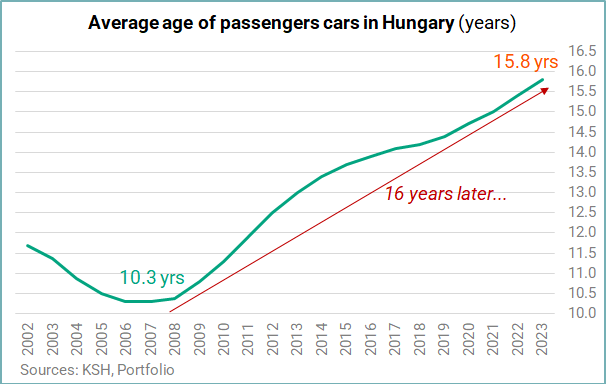
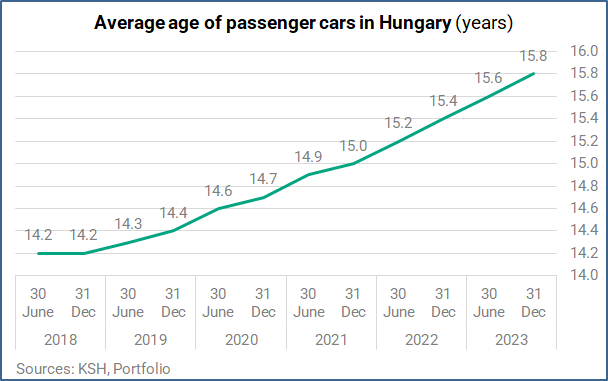
By the end of 2023, the average age of Hungary's passenger car fleet reached 15.8 years, up from 15.4 at the end of June. Before the financial crisis, the average age was hardly over 10 years.
A graph for a shorter period allows a closer look at the change in the average age of the Hungarian passenger car fleet.
The oldest brands are unsurprisingly the former socialist range, with the average age of the Zastava, Wartburg, Polski Fiat and Trabant models all over 36 years old. Fewer and fewer of these are on the road, presumably the ones still with licence plates are in the hands of collectors. There are still 8,000 Trabants and 3,400 Wartburgs and only 553 Zastavas with registration plates on the road.
The youngest brands are those that entered the Hungarian market in the last decade, such as Dacia (7.6 years), Kia (9.1 years), Lexus (9.8 years) and Hyundai (10.6 years).
The average age of the Suzuki fleet (16.7) is above the national average, a consequence of the fact that the first-generation Swifts that defined the streetscape in the 1990s are now very old and new cars sold cannot make the entire fleet younger.
Of the three German premium brands, BMW is the youngest with 14.8 years, followed by Mercedes (15.4) and Audi (16.7).
According to the European Automobile Manufacturers' Association (ACEA), the average age of passenger cars in the European Union is 11.8 years.
Most cars are Opel (485,000), followed by Suzuki (420,000) and Volkswagen (410,000).
62% of Hungarian passenger cars run on petrol, 32% on diesel, 5% are hybrid, 1% electric and 1% other.
Eurostat data showed that
MORE THAN HALF OF THE HUNGARIAN PASSENGER CAR FLEET WAS AGED BETWEEN 10 AND 20 YEARS IN 2022.
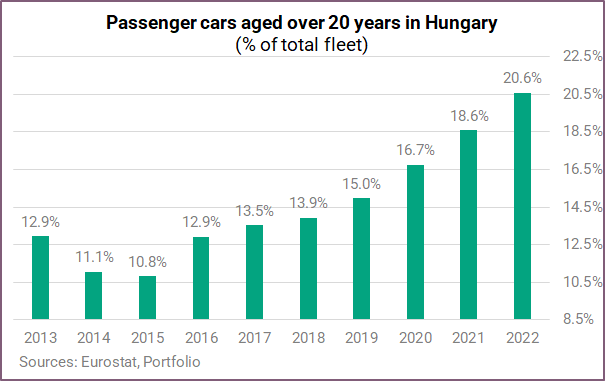
One fifth of the car fleet was older than 20 years, and merely 6.1% of it was less than two years old.
We'll need to see how 2023 turned out, but until then we have the 2022 figures, which show that the trend in the different 'age groups' was mixed.
On the negative side, the share of the new car fleet (up to 2 years of age) of the total number of passenger cars in circulation has been shrinking, while the share of cars aged 5 to 10 has been rising since 2019, and the share of those older than 20 has been going up since 2015.
On a (slightly) positive note, the share of cars aged 2 to 5 has been rising since 2014, and there has been an improvement in the 10 to 20 age category since 2019 too.


Cover photo: Getty Images





