Bread prices in Hungary have seen a dizzying rise in recent years


According to the Hungarian Central Statistical Office (KSH), the price of bread increased by an average of 35.6% in 2023 in Hungary, while the price of other bakery products rose by 29.6%. This is higher than the overall food inflation rate of 25.9% and double the overall consumer price index.
For a long time, the price of a kilogram of white bread ranged between HUF 200 and 300, from 2007 until 2018. In 2019, it exceeded HUF 300, in 2021 HUF 400, before last year HUF 600, and last year HUF 900, which means that many people have certainly seen prices above HUF 1,000.
A bun that had cost less than HUF 20 for a decade reached an average price of HUF 50 in 2022 and HUF 68 last year.

These products, examined separately by the KSH, have shown extreme price increases in recent years, but if we look at the whole bread product group, the price increase was 2.5 times higher last year at its peak compared to January 2019. Since then, prices have moderated a little, but we are still seeing a price increase of more than double the 2021 levels.
It is worth comparing this with the fact that in 2019 the average net salary was HUF 236,000, and last year it was HUF 380,000, which is a 60% increase.
In other words, today an average salary buys much less bread than 4 years ago.
In the EU, bread prices have risen by just 37% in the last 5 years, and by an even lower 29.5% in the Euro area. By contrast, in Hungary, the price increase was 148% in March last year, or two and a half times higher, but in January this year, it fell to 124%.

Among the V4 countries, bread prices rose at a higher rate than the EU average, but were well below the Hungarian rate. The closest one to Hungary in this regard is Poland, but even that is only 73% higher than at the beginning of 2019.

The picture is similar if we compare the increase in Hungarian bread prices with Romania, Croatia and Slovenia. Croatia is second in this group, with an increase of 60%.

Hungarian food prices in a European comparison
According to December inflation data from Eurostat and the Hungarian National Bank (MNB), only Poland and Romania deviate significantly from the European food price averages, but Bulgarian and Czech food prices are also lower than in Hungary.

Comparing the last two years of data, year-on-year inflation for food and non-alcoholic beverages in Hungary has been much higher than the EU average. In November 2023 the Hungarian average fell below the EU average, but since then the trend has been upwards again.
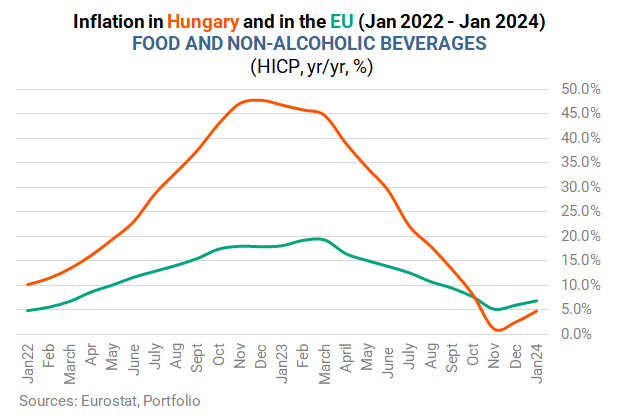
In a regional comparison, we can also see that food and non-alcoholic beverage inflation in some surrounding countries has also been above the EU average over the last year and a half, but none of them have come close to Hungary's levels between the months of August 2022-2023. Hungarian food inflation has also been much more volatile than most: over the last 4 months, it has been well below not only the EU average, but also, for example, the Austrian, Polish and Slovenian food inflation rates. Among the neighbouring countries, only the Czech Republic has seen a more significant fall in food inflation than Hungary, but since then it has also been on an upward trend.

Cover photo: Getty Images





