Pleasant surprise in Hungarian investments


The 1.5% quarter-on-quarter growth is surprising, if only because the fourth-quarter GDP data showed only stagnation in the Hungarian economy. This suggests that the contraction in household consumption may have played a larger role than expected in the feeble economic performance.
The increase also marks the end of a five-quarter slump in investment.

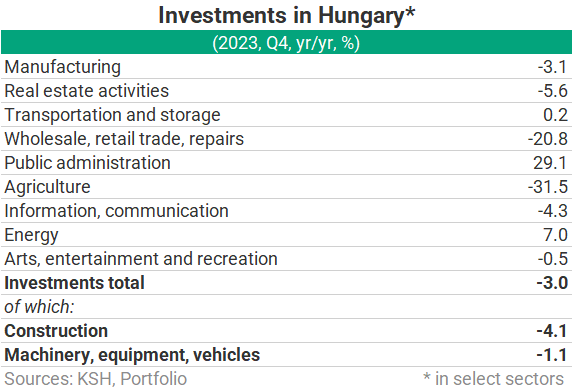
The turnaround is due to an increase in construction investment, while a slight decline in machinery investment means a continuation of a broadly stagnant trend:

A methodological change makes it difficult to understand exactly what caused the somewhat unexpected rebound. From 1 January 2023, some tasks previously performed by 100% state-owned companies were taken over by a central budgetary body. As a result, the classification of some economic operators by type of business has also changed, with entities previously classified as enterprises being transferred to the category of budgetary entities.
The reclassification has typically had a downward effect on the investment performance of businesses, while it has had an upward effect on the investment performance of budgetary bodies. Therefore, caution should be exercised with regard to the growth indicators of the sectoral breakdown, as they may be sensitive to the above change (although we do not know whether firms have changed sector along with the change in the form of business.)
In any case, the manufacturing sector, which has been doing surprisingly well so far, has started to lose momentum, i.e. it is following the opposite path to investment in the economy as a whole. The KSH noted that the main reason for the 3.1% annual decline in manufacturing, which accounts for almost a third of total investment and is the largest contributor, is the end of capacity expansions in battery production. At the same time, the volume of investments in transport equipment production, representing the second largest weight, grew dynamically. This also suggests that the weakness in manufacturing investment is not due to a fall in external demand, but to a more uncertain domestic industrial and export performance.
The investment performance of real estate activities, the second largest investor, accounting for 21% of developments in the national economy fell by 5.6% compared to the same period of the previous year. The volume change was determined mainly by the high investment activity of a year ago, mainly for housing renovation.
Investment volume in transport and storage were approximately on the same level as in the previous year, one of the main factors being that public infrastructure development (e.g. road building and renovation) did not decrease in annual terms. The section of public administration increased the volume of investments very dynamically, by 29%, due to the expanding developments in central public administrations.
The reason of the 21% volume decrease in wholesale and retail trade was the decrease in the investment activity of the enterprises active in both retail and wholesale trade in the current period. This indicates that the sector remains in a wait-and-see mode with retail consumption being week and regulatory uncertainties lingering.
The investment performance of energy industry grew by 7.0%, where an increase in development related spending by enterprises active in the generation and supply of electricity played an important role.
Overall, the fourth quarter data do not yet represent a firm and lasting reversal in the investment trend. The growth on a short-term basis (which still shows a 3% annualised fall) is certainly good news, but whether the trend will be sustained in a deteriorating external environment, a slower-than-expected recovery in the Hungarian economy and a significant need for fiscal adjustment will be seen in the first data for 2024. A pick-up in the transfer of EU fund, an improving interest rate environment and rising real incomes could be stimulative.
In any case, the good Q4 performance was enough for investment in 2023 to shrink by "only" single digits on average, by 8.5% compared to 2022. However, this is still the second worst result since 1996. The only time we have seen an even larger contraction was in 2016, during the unforeseen temporary shortage of EU funds at the time of the seven-year EU budget cycle change.

Cover photo: Getty Images