Hungarian economy comes to a halt right after it starts to growth - This is why


Out of the last five quarters, Hungary's gross domestic product grew in only one on a quarterly basis, stagnated in two and contracted in three.

If we take into account that weather-dependent agricultural crop yields played the main role in the third quarter growth, we can say that the period behind us is characterised by stagnation, with only very modest signs of recovery at the end of 2023.
The stagnation in Q4 is also unwelcome because, with inflation and interest rates falling and energy prices dropping sharply, experts had expected the recovery to continue. Looking at the scene from a distance, we can say that the shocks to the economy (energy crisis, soaring food prices, the price paid for pre-election overspending) have so far brought an 18-month plateau in the development trend.

But why?
Prior to today's release, the monthly data suggested that the new slowdown was due to weak industrial (export) performance and a delay in the pick-up in household consumption. Today's detailed data provide a deeper insight into the reasons for the stalling of growth.
If we look at our sectoral heat map, we see that the performance of industry and construction declined substantially compared to the previous quarter, and similarly, the performance of the services sector was weak, with trade and hotels and restaurants also performing poorly. The good performance of the transport sector saved the economy from another GDP contraction.

If we look at the structure of GDP growth on an annual basis, we can see that the economy's performance in the fourth quarter would still have been 2.5% weaker than in the base period, had agriculture not produced a much better year after the drought of 2022. Outside of this sector, industry, construction and overall services are still dragging GDP down:

On the consumption side, the performance of the economy shows that, compared to the previous quarter, household consumption increased marginally, as did investment, while exports and imports fell.
The big picture, as summarised above, is that the stagnation of the economy is driven by
- a good performance of the agricultural sector,
- a decline in export performance due to the deterioration of the external environment, and
- a slight pick-up in consumer and investment activity.
However, a warning for the near future is that agriculture is unlikely to achieve the same kind of growth surge as last year, and industrial exports and services based on domestic demand should become the driving force instead.
There is a chance for the latter, with rising real incomes having the potential to boost household consumption, but there are more question marks surrounding industrial performance. The first-quarter figures may be embellished by the fact that it is a leap year, so the first three months of this year are a good 1% longer than last year. Of course, this is more a matter of aesthetics, and does not translate into a better performance from an economics point of view.
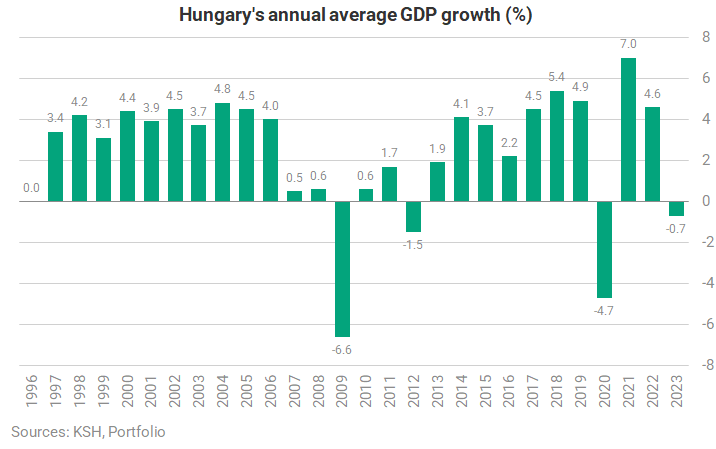
A good Q1 performance is much needed, though. If the economy does not start to pick up now, the government's target of 4% average annual growth will be a long way off. To illustrate this, if the first quarter is stagnant, then, assuming relatively dynamic growth of 1-1% over the next three quarters, average annual GDP growth in 2024 would not reach 2%. This hypothetical path is shown in the graph below.

Whether the Hungarian economy really gets stuck in the first quarter will depend mostly on whether the manufacturing sector gets a boost in the gloomy international environment, and whether the increase in real incomes of the population is reflected in consumption growth.
This will also require an improvement in confidence factors, as we have already seen in recent quarters that households have responded to the problems by increasing their savings rather than moderating their consumption.
We will know much more about the outlook for the first quarter tomorrow, as January's industrial, retail trade and external trade statistics are to be released in the morning. If the economy can gain momentum early in the year, GDP growth of close to 3% could be realistic.
GDP growth in many forms - How we look at it
The KSH publishes several GDP indicators in its report. There are three (annual) indices compared to the same quarter of the previous year: raw, working-day adjusted and adjusted seasonally and for working days. Of these, the Portfolio has consistently considered the seasonally and working-day adjusted index (swda) as the headline index since 2016. This is because the number of working days (especially if there is a leap day in the reference or base period) has a significant impact on performance, which is definitely worth correcting for. In addition, seasonal adjustment for annual indicators only makes sense if the nature of seasonality within the year changes. Since Eurostat refers to the swda figure for all countries, it makes international comparisons easier if this is taken as the main figure.The (quarter-on-quarter) GDP index relative to the previous quarter is, of course, always seasonally and working-day adjusted, as each quarter has a very different weight and structure within GDP, otherwise it makes no sense to expect growth. In most places in Europe, this is the main number and Portfolio tries to treat this number as a priority because of its favourable characteristics. However, this indicator has the unfortunate feature of end-point weakness, i.e. that due to the nature of seasonal adjustment, the numbers change several times afterwards, but it is still very useful as a short-base business cycle indicator.
Cover photo: Getty Images





