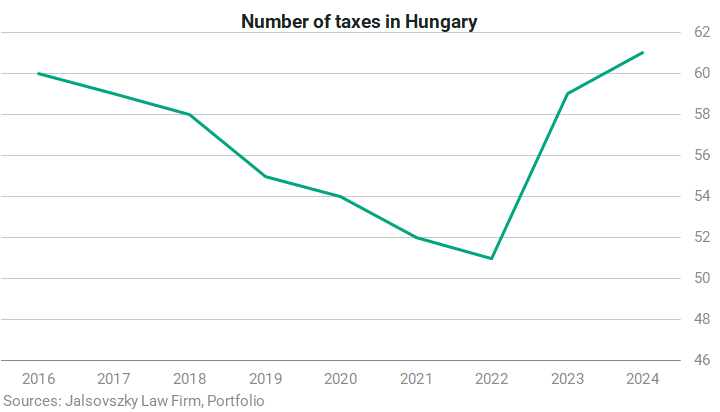
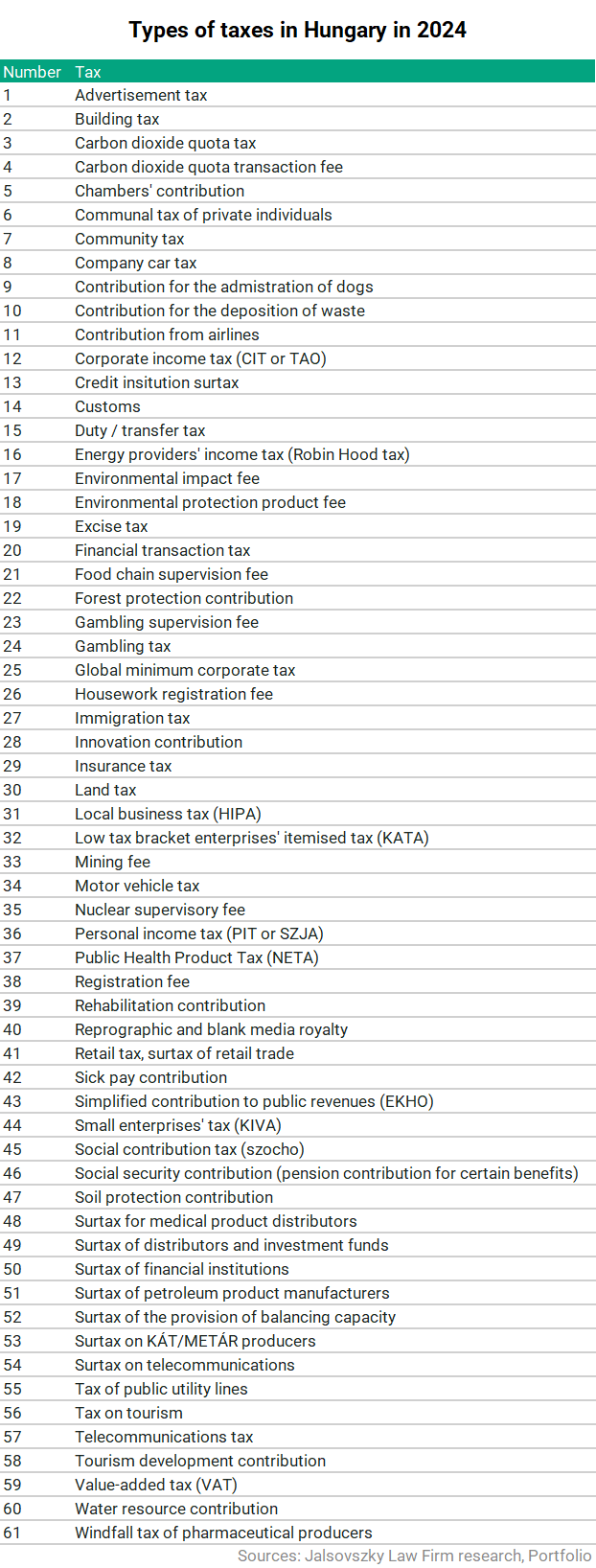
2024 starts with a record number of taxes in Hungary - 61!


The following analysis was prepared by Jalsovszky Law Firm's team of experts.
Taxes we say goodbye to and the new kids on the block
Among the special taxes, we have said goodbye to the transaction tax on investment firms and credit institutions under a separate government decree, which was abolished last year. (This transaction tax should not be confused with the financial transaction tax under a separate law, which still exists.)
Also, from the beginning of this year, the registration fee for domestic work was finally abolished - but not the obligation to register! It should be noted that this otherwise noble tax has generated minimal revenue year after year.
However, the two departing taxes were replaced by four new ones.
Firstly, as a result of many years of OECD and EU legislation, additional taxes ensuring a global minimum tax level have been introduced in Hungary. Their aim is to ensure that groups of companies with a consolidated turnover of more than €750 million are taxed on their global revenues at a uniform minimum tax rate (15%), thus - as the creators of the minimum tax hope - preventing or at least reducing harmful tax competition between Member States.
Secondly, we also considered the pharmaceutical windfall tax as a new addition. This is intended to "regulate" the special tax burden of pharmaceutical manufacturers, in addition to, and with a slightly different tax base from, the special tax on pharmaceuticals, which continues to exist under a slightly different name.
Finally, in a decree in the middle of last year, the government imposed two new taxes on operators of installations with significant carbon dioxide emissions; a carbon quota tax and a carbon transaction fee. The former taxes the amount of carbon dioxide emitted by quota holders and the latter taxes the trading of the quota (allowances).
Not lost, transformed
In some cases, the scope of the tax has been narrowed, and in others, new tax items have been added. An example is the tax on utility lines, which from the beginning of the year no longer covers communication lines. You will no longer have to pay tax on these. The opposite process has taken place with the tourism development contribution, where "hop on hop off" bus transport has been made subject to the tax.
In contrast to the above, the scope of the Public Health Product Fee (NETA) has been both narrowed and broadened: on the one hand, alcoholic beverages have been removed from the taxable items of the tax of 'unhealthy' products, and two new categories of products have been added to the scope of taxation. These are the categories of "delicatessen" and "pre-packaged sweet and savoury pasta", as defined in the legislation, on which the product tax (also) becomes payable.
Finally, newsworthy in this context is the rate of the land protection charge for the permanent reuse of agricultural land for other purposes, calculated on the basis of the value of the golden kroner, which has tripled for all quality classes since the beginning of this year.
A fee that is indeed a fee - The Extended Producer Responsibility (EPR) system
The EPR scheme is the EU's response to rising waste generation. Under the liability scheme, producers of various single-use (so-called circular) products have to pay a fee for their emissions to a concession company, MOHU MOL Hullgazdálkodási Zrt., which organises the complete management of the waste generated, from collection and transport to recycling or disposal. MOHU will invoice the fee on the basis of the information provided by the producers to the waste management authority.
While it is not unknown for some taxes to be described as "fees" in legislation, especially when they are indirectly intended to finance a specific public task (e.g. the food chain supervision fee or the gambling supervision fee), the EPR fee is not, conceptually speaking, a tax.
This is because, in return for the fee, the obligated parties receive a directly accessible service. In principle, the fact that some industry voices dispute the equivalence of the fee paid and the service received does not change this
They do not contribute: the industrial safety contribution
News emerged at the end of last year that the government would impose a new turnover-based tax on certain hazardous materials plants - the industry safety contribution. There was much speculation as to whether the measure was introduced in view of the mushrooming battery factories, but in any case it was not specifically mentioned in the explanatory memorandum to the bill. In any case, the new tax was not introduced in the end, so it does not increase the number of tax types.
Challenging years
It is clear that the economic policy processes still do not allow the government to forego the revenue from the special taxes. In the meantime, other developments, such as the excessive demands on the environment or the fight against tax competition harmful to the common market, are triggering further, also new, tax legislation.
Therefore, a significant reduction in the types of taxes does not currently seem realistic.
The situation may be helped by the increasing number of ways in which the tax authority is helping taxpayers to comply with their tax obligations, including the possibility to ask the tax authorities to fill in VAT returns from February.
Cover photo: Getty Images





