Péter Ákos Bod: Hungary may dream of growth, but here is the darn reality


This is the context in which last year's GDP estimate by the Hungarian Central Statistical Office (KSH) was published, confirming that our economy's performance in 2023 has declined. This was known from the first estimate, as well as from the consumption, production, foreign trade and business cycle indicators. But now we are again faced with the fact of a contraction in GDP at a time when the government is putting economic growth at the heart of its communication. At the Hungarian Chamber of Commerce and Industry's (MKIK) recent opening of the economic year, but also in other forums, it was said that the Hungarian economy, which has so to speak successfully overcome inflation, will return to growth this year. This is said to mean a rate of 4% or more.
In order to interpret the official announcements, it is worth looking at the situation in Europe. According to the European Commission's Winter Economic Forecast published in February this year, average growth in 2023 was 0.5%, meaning that the Community as a whole and most member states have avoided recession. The 2024 real GDP estimate was revised down to a modest 0.9%, while economic activity is expected to expand by 1.7% in the EU in 2025.
Before we mock the EU's growth performance, we should factor in the historically rapid but costly shift away from Russian energy dependence in most of the countries concerned, and the equally rapid European disinflation. Last year's average inflation of 6.5% is expected to be tamed to 3.5% this year in the EU, with a price index of 2.4% projected for next year, which is considered price stability. This is the EU economic framework. If this is indeed the case in 2024-25, it will be good for the strongly connected eastern periphery and the Hungarian economy in it.
However, Hungary's negative annual growth in 2023 is deviating from the majority downwardly. The difference is particularly striking when measured against the region that forms the country's immediate frame of reference. The three Baltic States and the Czech Republic also slipped into recession last year, but the Slovak, Polish, Slovenian, Croatian, Romanian and Bulgarian economies grew despite disinflationary adjustment, and noticeably so, with the latter three growing between 2% and 3%.
The deceleration in regional comparison will be even more visible this year and this may fuel concerns about the Hungarian economic conditions and outlook.
In the meantime, the first statistics on the start of the year have started to come in. The figures for household consumption, industrial production, and construction look depressing. We have the February consumer price index, the January foreign trade balance, and the general government deficit for the first two months. The first is relatively good, the last is perceived in a very bad light by the domestic and international community of economic indicators analysts. We should be prepared for a critical view of our conditions from investors, credit rating agencies and, not least, domestic economic agents, based on last year's indicators and some of this year's disappointing data.

But are the data really worrying and startling?
Journalists and lay people interested in public affairs understandably want to know whether a published figure is good or not. It is often not easy to get an answer without considering the wider context and background. Putting aside deeper data analysis, in what follows I will argue that, for example, last year's recession figure is not unexpected, and is in fact quite logical, making it difficult to classify it as bad - in itself. The source of the bad news is something else.
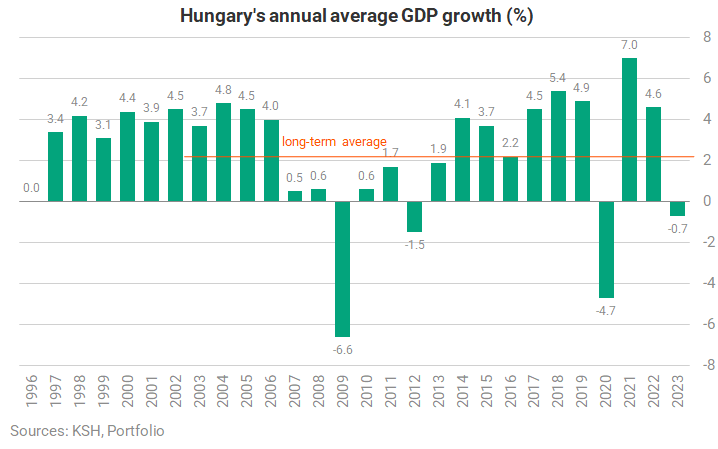
It was also written earlier on Portfolio that in the Hungarian economy, which was obviously overheated from summer 2021 to mid-2022, the year 2022, with its unrealistically high internal consumption (unprecedented growth in household consumption, investment surge), served as a misleading base for the following year. Last year's -0.9% (or -0.7% adjusted for seasonality and the number of working days in the second estimate) looks ugly, but if the two years are taken together, the average of +4.6% and -0.9% for the following year would actually not be that striking.
- That's the good news, so to speak. But we shouldn't keep quiet about the other news either. One is that this two-year average growth rate is close to what the Hungarian economy has been characterised by for a decade and a half or two decades. This is neither bad nor good news in itself, it is just a figure; but it is a message to those who want to double this trend rate.
- But the bad news is that the growth performance of both last year and the year before last was fuelled by a very significant spending binge in public finances, which cannot be justified on the grounds of cyclical policy. The hard data in these years far exceeded the natural sustainable performance of the Hungarian economy.
What the natural capacity, potential GDP, is and what percentage it would be of its current growth trend can only be determined by complex modelling. What is needed is to calculate what the rate would be (would have been) if monetary and fiscal policy were neutral, i.e. neither stimulative nor restrictive. It is also necessary to know at what stage of the business cycle the economy is in in order to estimate the potential level of GDP in a given year. Such models are being developed, and it is worth looking at the OECD workshop's Economic Survey, also published recently.
The OECD publication's growth figures for 2024-2025 do not differ significantly from those published by the Commission's modellers or independent domestic research institutes based on their own methodologies and hypotheses on the external environment and economic policies. What is particularly noteworthy in the analysis, however, is the reconstruction of the Hungarian fiscal policy zigzags. It is easy to see how state intervention overrides natural cyclical movements and, if ignored, it is not understandable why economic growth of 5% or even 7% was achieved in some years, and why there were bumps and even recessions in other years.
But the more important question now is: is it possible to return to the 4% or 5% growth path this year and next?

Government deficit/surplus figures tell us a lot about the years behind us and provide important information about the times ahead. The columns in green show the total annual general government balance as a percentage of actual GDP, which therefore includes the primary balance and the interest burden on government debt.
This indicator is known to have always been in the negative range. The ratio was very severe in the years 2002-2006, not shown in the graph, but it remained above the 3% ceiling of the Stability and Growth Pact in 2010 and 2011, but remained below it for years from 2012 onwards, under pressure from the EU institutions. As soon as the 3% rule was suspended in view of the Covid pandemic, a special circumstance, the Hungarian government deficit soared. Not only in the crisis year of 2020, but for four years: the deficit is now projected to reach 6.5% of GDP in 2023.
A sustained fiscal slippage of this magnitude is a serious matter - the potential consequences are the subject of much analysis. Bad news - but not in the sense of an unexpected development or unpleasant accident. While inflation or current account measures depend on the decisions of a multitude of economic agents, decisions which the modern state can influence but which cannot be precisely set even in a fully developed planned economy, the situation is different for public finances.
The revenue side is largely shaped by laws and government measures based on them; the main items on the expenditure side also depend on government decisions, within the existing legal, administrative and, of course, political framework. Thus, if a government is operating with a sizeable deficit, it is presumably the result of a conscious political decision (or the postponement of a rational decision).
But interest payments on public debt are indeed an item over which the government has only indirect control, and should be considered differently from primary (non-debt-servicing) expenditure. It is therefore logical to treat the interest balance separately from the primary balance.
The blue bars in the graph above show clearly in which years governments pursued a strict fiscal policy (austerity) and when they spent more than their current revenues on current expenditure. In 2020, for example, the primary deficit became large for a reason (and the overall deficit much larger because of the known interest payment obligation). But already in 2021 and 2022, the primary deficit was obviously not raised (left too high) on economic grounds, on the grounds of cycle-cutting. This also applies for 2023, albeit to a lesser extent.
But the total deficit is added to the already accumulated public debt, the interest burden of which has to be sweated out of the public budget. The snowballing debt accumulation can only be contained by years of primary surpluses, with very unpleasant political and economic consequences.
The interest burden on the Hungarian state is already enormous. The OECD study's graph shows that even the government's recent softening of the fiscal adjustment, which has been pushed back, requires a primary balance in deficit in 2024 and 2025. In the current debt situation, there is therefore no objective possibility of stimulating demand in the sense of a "high pressure economy": among the new member states, Hungary has the highest public debt ratio.
Given the fragility of country risk and the unstable forint exchange rate, it is also unlikely that monetary and fiscal policy together will push economic performance above potential GDP capacity.
This leaves GDP growth of 2% or slightly above in 2024 if external conditions are favourable. Then perhaps a better business cycle a year later. But this is highly uncertain, to say the least.
It is better to realise as soon as possible that there is no path of over-pressurised growth in the current circumstances, despite the fact that a return to the golden pre-Covid era sounds good to the political leadership and the unsuspecting voter. Golden ages are not usually repeated. As for the years 2016-2019, the external economic cycle was extremely favourable, EU money was pouring in, international interest rates were low, it was still possible to bring in labour that had not been employed before - a quite extraordinary transition for a short period.
These conditions no longer prevail today. But even so, the growth of that golden age was still enhanced by the state's reliance on a high-pressure economic model. It's worth looking at the blue bars again: the slight primary surplus in 2016 gradually turned into a primary deficit by 2019, unjustified by the business cycle. Yes, the economic policy over-pressure of the time pushed the reported performance well above the natural level of GDP. Then inflation kicked in, as textbooks would expect, only moderately at first, but there was no noticeable reduction in the debt-to-GDP ratio, which would have been a royal road in years of already rapid growth.
That's all in the past. Today's news is that at the current level of labour productivity and skills, with the current physical and institutional infrastructure, and given the energy- and material-intensive economic structure that has been established, the Hungarian economy did not and does not have the +4% value-added growth potential that is promised to the gullible. Unfortunately, the statistical data from the beginning of the year show that in this structure, under these conditions of value creation, there is not enough dynamism.
This situation should lead to a sensible realisation: we should move towards different competitive conditions and better value creation as soon as possible. We too, following in the footsteps of others. After all, a number of our fellow nations in the region - some of them after a great deal of stumbling and wandering - are beginning to find their way upwards.
This story originally appeared on Portfolio's opinion column, 'On the Other Hand' (in Hungarian). The articles reflect the views of the authors, which do not necessarily coincide with the views of the Portfolio editorial team.
Cover photo: Portfolio





