Hungary's industry fared extremely poorly in January - Here's why!


The industry has been performing modestly for some time now, with periods of stagnation and decline alternating since the beginning of 2022, which overall shows a slow downward trend. The weak performance of the last period contributed to the stagnation of the Hungarian economy in the fourth quarter and has not started well this year.

While at the beginning of 2023, the decline in domestic sales caused the industry's weakness, external demand is now more of a problem. Experts attribute the more pronounced fall in output in recent months mainly to the slowdown in Hungary's western and (indirectly) Chinese export markets.
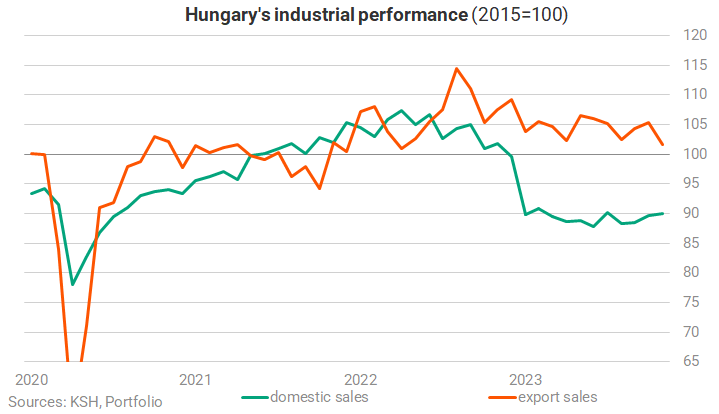
Today's sectoral breakdown reveals several interesting facts. First, there was hardly any area of industry whose performance had not fallen. Of the 13 major sectors, only two managed to grow on a quarterly and monthly basis. The biggest contributors to the industrial recession were the heavyweight sectors. The performance of the vehicle manufacturing sector fell sharply, with temporary supply problems hampering production in addition to the weak economy. The performance of the electrical equipment sector, which includes battery production, has been interesting. After a huge ramp-up, it has taken a sharp turn for the worse, with output falling spectacularly from mid-2023. Behind this, we can best suspect stagnating sales of electric cars. In a generally weak economy, the performance of the electronics, food, rubber and plastics, machinery and metalworking sectors has also declined.

The production zigzags are now pointing downwards to the extent that the industry could even grow next month (helped in particular by the easing of technical reasons in vehicle production), but the outlook for the industry is still not bright. Until the international economy improves, we cannot expect a meaningful recovery in the sector. The slope of the industrial order books curve is becoming increasingly depressed.
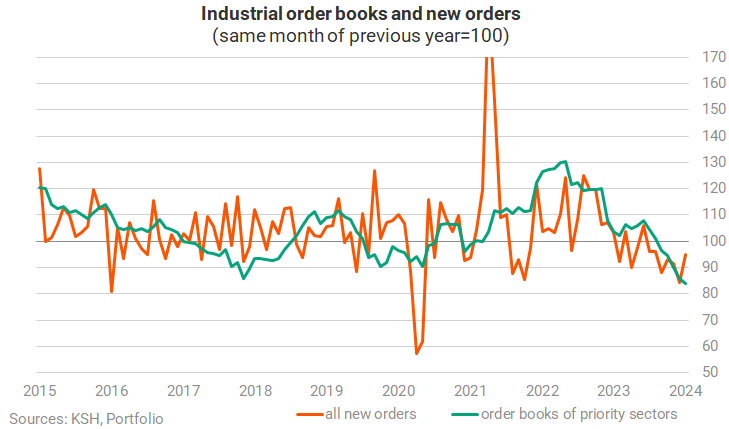
The weak start to the year has dashed dreams of 4% economic growth this year. Economy Minister Márton Nagy said yesterday that this was no longer a reality, with the consensus of recent analyst forecasts being 2.5%. Industry, whose performance in January was already 4.1% below a year earlier, is playing a big part in this deterioration.
Cover photo: Getty Images





