This is why few Hungarians can afford to buy new cars


In 2023, the EU car market concluded with a solid 13.9% expansion compared to 2022, reaching a full-year volume of 10.5 million units. All EU markets grew last year except for Hungary where new passenger car registrations dropped 3.4% yr/yr to 107,700 units.
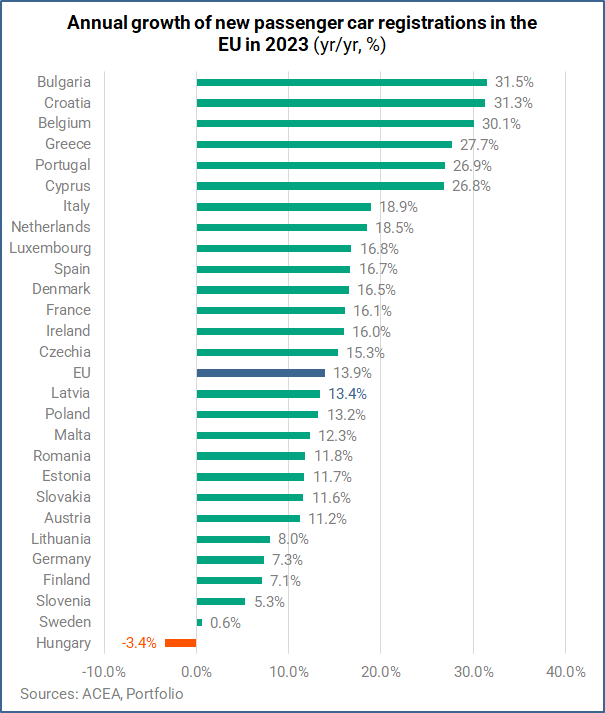
The Hungarian car market was also weaker than the EU in 2022, but the difference was not as big as last year: a 4.6% decline compared with an 8.5% drop in Hungary.
The first two months of 2024 have already seen a slight upturn, with a total of 18,775 new cars sold in January and February, up 4.1% year-on-year, according to Datahouse. The European Automobile Manufacturers' Association (ACEA), which is set to release data for February shortly, reported a 3.3% yr/yr decline in new car registrations in Hungary (8,040) for January. Based on Datahouse's estimate, 10,735 new cars were registered in Hungary in February. This would translate into a 3.95% yr/yr growth for the first two months and an impressive 10.14% growth for February alone.
Click on the link below for ACEA's January statistics, including Hungary's place in the region in terms of new passenger car registrations:
However, even if Datahouse were right, it's only a small consolation, as the renewal of the Hungarian car fleet is driven not by new vehicles, rather than by imports. This is why the average age of the fleet has been constantly rising since 2008 and reached 15.8 years by the end of last year. In order to turn this around, we need to rejuvenate the supply and increase the volume, but there is no sign of that happening yet.
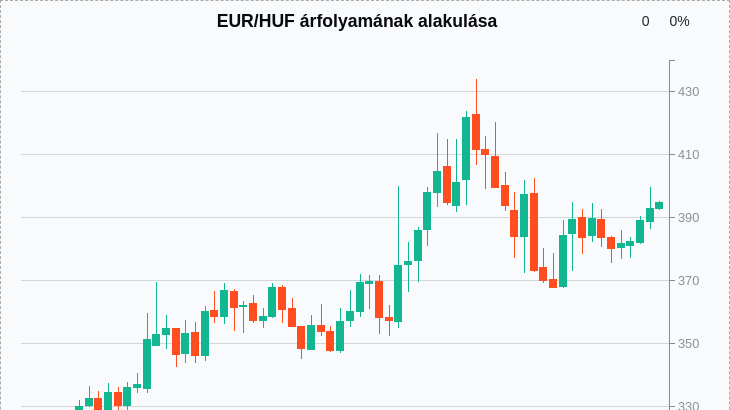
The reason why Hungarians are not buying new cars is not only that the domestic purchasing power is a fraction of that in Western Europe, but also that the price of new cars has risen dramatically. The weakening of the forint, as seen in recent years, is a major factor behind the latter.
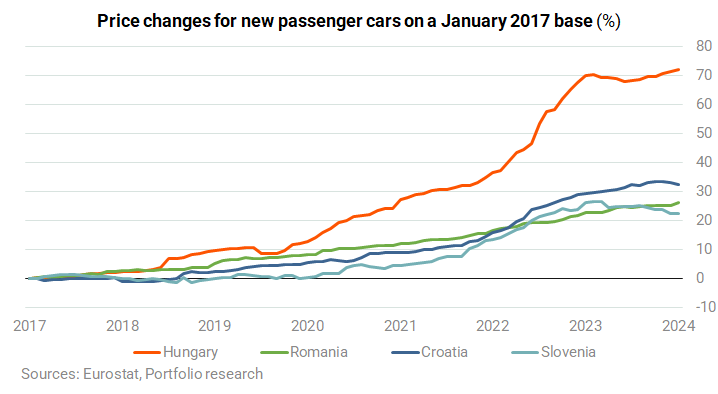
Based on data by Eurostat, the statistical office of the European Union, we looked at the change in the price of new cars on a January 2017 base in Hungary and the EU. The difference is staggering, with prices in the EU up by just 24.4% compared to almost 72% in Hungary. This means that a car that cost 5 million forints at the beginning of 2017 is now 8.6 million forints.
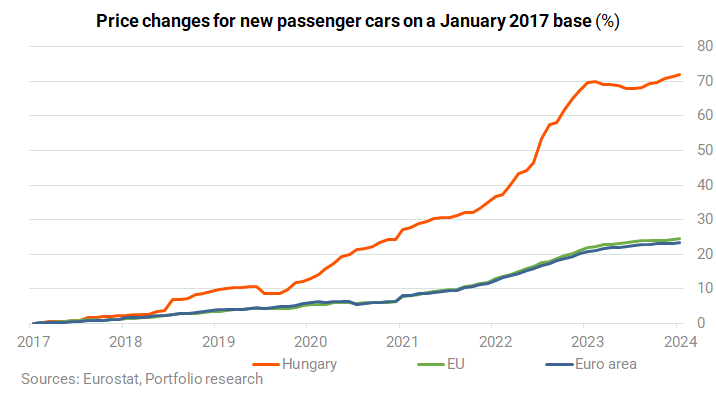
This increase has effectively neutralised domestic wage growth, meaning that even though Hungarians earned more than 70% more in 2023 than in 2017, it has not made it any easier to buy a new car.
The difference is also striking compared to the countries of the region. In the V4 countries, prices have risen by 24-30%, also based on early 2017, and this has been accompanied by more dynamic wage growth. It is therefore not surprising that the car market in the Visegrad countries managed to grow at double-digit rates last year (Czechia: +15.3%, Poland: +13.2%, Slovakia: +11.6%).
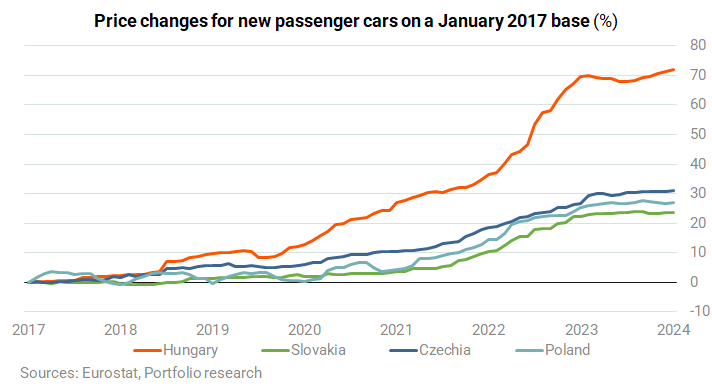
Similar growth rates can be seen in the Romanian, Croatian and Slovenian car markets, with prices rising by 22-32%. Last year, Croatia recorded one of the largest increases (31.3%) in new car registrations, but the introduction of the euro may have played a significant role. In Slovenia, however, only 5.3% more cars were sold than in 2022.
The rising price of cars is not only affecting private individuals, Zoltán Metál, Secretary General of the National Taxi Association, recently told Portfolio Checklist podcast that taxi drivers are finding it difficult to afford the price of a new car, and because they spend most of their lives behind the wheel, they find it harder to compromise.
Cover photo: Getty Images





