Hungarian state would need to raise HUF 4 trillion to stabilise the budget


A veritable barrage of public finance data arrived this morning, giving a clearer picture of the state of government management. In addition to the EPD report to the EU, a report from the Central Statistical Office (KSH) and the National Bank of Hungary's (MNB) Financial Accounts statistics on the government sector have been released. These provided answers to two important questions:
- What was the official budget deficit (reported to the EU on an accrual basis) last year?
- What is the financing requirement for the state under this year's deficit plan of 4.5% of GDP, i.e. what kind of cash deficit could emerge this year?
The plan was already overturned last year
Preliminary data already show that the government's deficit target from last year, which has been revised several times, has not been met. The government had set a deficit target of 3.9% of GDP for 2023, which was revised in two steps to 5.9% by the end of the year, but various data and indications suggested that the indicator would be somewhere in the range of 6.5-6.7%. It is now a foregone conclusion that the deficit will be higher than in 2022, meaning that instead of the expected normalisation, the government's fiscal discipline has been relaxed. According to today's official data from the Hungarian Central Statistical Office (KSH), the 2023 accrual-based (ESA) budget deficit is 6.7%. Since 2020, the general government deficit has never been below 6%.

The annual fiscal accounts again show a roughly fiscally constrained run-off: in the last quarter of the year, the deficit as a share of GDP was 10.6%. The year-end shows a double-digit deficit-to-GDP ratio for the fourth consecutive year.

In 2023 compared to 2022, revenues increased by HUF 3,645 billion, or 12.9%. The largest increase of HUF 1142 billion, or 9.5%, was in revenues from taxes on production, of which HUF 363 billion (5.4%) was in VAT revenues. The latter is an unpleasant surprise in the context of high inflation and is one of the main reasons for the huge hole in public finances last year.
Income tax revenues were HUF 1,037 billion, 22.7% higher than a year earlier. Social contributions were HUF 959 billion, 14.8% higher. Other revenue increased by HUF 507 billion, or nearly 10%.
Expenditure increased by HUF 4,556 billion, or 14.1%. The increase was HUF 456 billion (6.7%) for compensation of employees and HUF 1,265 billion (18.4%) for social benefits in cash. Intermediate consumption increased by HUF 400 billion (7.0%) and interest expenditure by HUF 1,660 billion (88.8%). Of course, the increase in interest expenditure due to high inflation plays an important role in deficit reduction.
Gross fixed capital formation increased by HUF 232 billion, or 6.5%. Other expenditure of the general government sector was HUF 543 billion, up by 7.3%.
Overall, the government's failure to deal with the impact of the recession, falling household consumption and rising interest rates on the fiscal balance was the main reason for last year's high deficit.
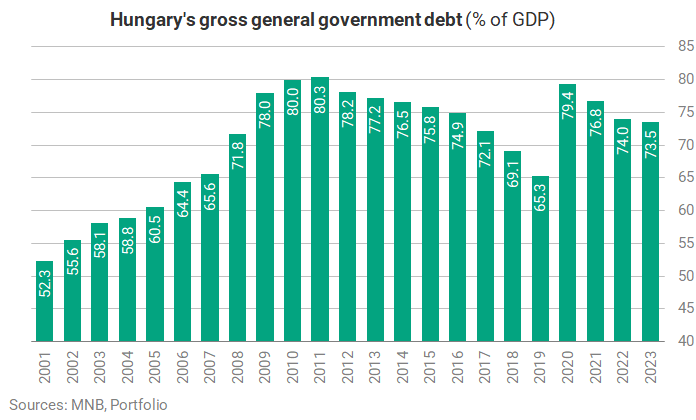
Given the sizeable deficit, the public debt ratio has understandably barely decreased. The ratio fell from 74% to 73.5% of GDP in a year. This year is expected to be even more exciting in this respect (more on this later).
This year's budget plan is already a thing of the past
The government plans a budget deficit of 4.5% this year. This figure was actually first written down in official material in the EDP report to the EU, the budget in force to date, prepared last spring, was based on 2.9%.
The deficit is higher than originally planned even though the government is also cutting investment (fixed capital formation) in nominal terms compared to last year (from EUR 3,801 billion to EUR 3,664 billion), which is unprecedented in recent years. Meanwhile, however, interest expenditure continues to rise significantly (from EUR 3,531 billion last year to EUR 3,951 billion), so the government's higher deficit expectations are not surprising in the context of weak economic performance. Overall, therefore, the government will have little room to stimulate the economy, and the minimal reduction in investment implies an even more significant decline in real terms, which will dampen an already weak economic performance.
According to the original budget document, there would have been a cash deficit of HUF 2,514 billion this year, which is the nominal increase in government debt that could have been expected, or in other words, the net issuance of government bonds during the year to ensure the viability of the state. According to the latest report, this has turned from HUF 2,514 billion to HUF 3,982 billion, i.e. this is the increase in financing needs caused by the slippage in budgetary plans. The increase of HUF 1,468 bn is not only due to the increase in the accrual-based deficit target, but may also include, for example, the cost of the airport acquisition, which does not increase the deficit according to the EU methodology, but still needs to be financed somehow. (How exactly is not yet known, as part of the money needed for the airport is expected to be raised by the state not through a simple public debt issuance, but through other means, such as raising funds from state-owned development banks.)
The government expects public debt to reach HUF 59.3 billion by the end of the year, while this year's GDP will climb to HUF 81.1 billion. This suggests that the end-year debt ratio could be 73.2%, an even smaller decline than last year. It could be said that the declining debt trajectory is only just materialising, any slippage in the deficit or GDP would easily mean a shift to an upward trajectory.
This indicates that there are serious risks to this year's debt reduction plan.
- For GDP, the government is projecting nominal growth of 8%, which could be made up of roughly 3% real GDP growth and a 5% GDP deflator. Neither of these are very far-fetched assumptions, but it would not be at all surprising if either ended up being slightly less. With a nominal GDP growth of 7%, this budget plan would already cause the public debt to rise to 74%.
- But it is not only the denominator, but also the risks around the numerator that threaten the decline in the debt ratio. After 6.7% last year, the deficit will not be 4.5% this year on its own, and the deficit-absorbing effect of moderate economic growth and falling inflation (which is debatable anyway) will not be enough. Our previous calculations suggest that the budget could be strained by around HUF 1,000 billion, which is the amount that would be needed to correct public finances to reach the deficit target.
This year's high financing needs also mean that the financing plan of the Public Debt Management Centre, presented at the end of last year, will also need to be revised (despite the fact that it contained a noticeable buffer for the perceived fiscal slippage). The ÁKK is expected to clarify the cornerstones of public debt management. It will be interesting to see what the source of the additional financing will be and how this will affect the debt structure, for example the foreign currency debt ratio.
Overall, the fiscal picture that emerges from the latest data is far from promising.
- Although the deficit is expected to fall this year, it will still be high and there are risks to the plan's feasibility. A fiscal adjustment is expected around mid-term, after the municipal elections.
- The downward trend in government debt is also forecast by the government to flatten out, but the risks suggest that there is a meaningful chance of an increase in the debt ratio this year.
- Although the fall in interest spending next year will improve the outlook, the election mode is not coming to a halt and is expected to pick up with the upcoming parliamentary elections in 2026. Under these circumstances, it is unclear when the budget deficit will fall to an acceptable level.
Cover photo: Getty Images





