Report from Hungary's home loans market: Good news and bad news


If you look at what banks are now offering to prospective home loan borrowers, there are three main phenomena:
- interest rates range between 6% and 7%, with one or two exceptions, thanks to the voluntary APR cap of 7.3% that has been in place since the beginning of January and fierce competition between banks, which has mainly favoured less well-rated customers (typically in lower income categories and/or living in smaller municipalities),
- the playing field has become much narrower, with a much smaller gap between the best and worst offers than before, and the bargaining power of borrowers has been reduced accordingly,
- loans with fixed interest rates up to the end of maturity and 10-year interest periods dominate the market, with shorter interest periods almost disappearing.
Without meeting special conditions (e.g. green rating), the lowest interest rates and expected repayments are currently offered by UniCredit, Granit and CIB Banks, according to Pénzcentrum's online calculator.

With a loan amount of HUF 20 million, a term of 20 years and a net monthly income of HUF 800,000, the repayments range between HUF 143,000 and HUF 154,000, while the total amount to be repaid varies between HUF 34 million and HUF 37 million.

For those looking to take out a mortgage next month, we have good news and bad news. The good news is that interest rates have fallen significantly, so anyone borrowing now could expect monthly repayments and total repayments that are on average 20% lower than a year ago.


The bad news is that, as in the past two months, we do not see much chance of a further substantial decline in interest rates. Indeed, the international and domestic interest rate environments do not support this, and government bond yields and interbank swap yields (BIRS), which are the benchmarks for pricing longer-term housing loans, have even risen in recent months, by roughly a full percentage point compared to their Dec23-Jan24 levels.

Banks are still offering home loans with a near-zero interest rate premium. So it looks very likely that interest rates will be locked in for a while at the current level of between 6 and 7%, and as a borrower it is probably not worth waiting: with house prices continuing to rise, there is a good chance that we could lose more than we could gain from paying lower interest. Especially when you consider that a badly timed borrowing can be corrected later by a loan restructuring, and that the cost of a restructuring can be recovered in a year or two through lower repayments.

So the time to take out a home loan is now, and there may be / is a mass of people on the demand side of the housing market who are planning to buy a home on credit and have been holding out for they considered interest rates of 7-10% too high.
Duna House estimates that HUF 240 billion worth of new housing loans were taken out in the first quarter, which is already the peak in 2020, just before Covid (the central bank is expected to release the actual contracting figures for February on Friday).
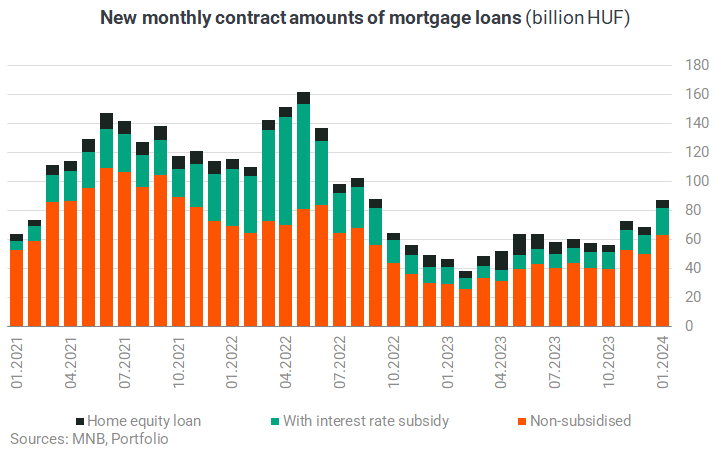
Of course, an important driver of mortgage lending is not the market-rate housing loans described above, but the subsidised schemes. Around 1,000 couples apply for CSOK Plus, which was launched on 1 January, for HUF 25-30 billion per month, which represents more than a quarter of the volume of new housing loans.
Cover photo: Getty Images





