Hungarian restaurants raise prices on the low-low


"We charge a 10 percent service fee at our restaurant." "We charge a 12 percent service charge on our food and beverage prices." Notices of this kind are often seen when you sit down in a restaurant and open your food or drink menu. But nowadays, higher service charges of 13 to 15 percent have become more common.
There seems to have been such a significant increase in restaurant prices recently that
- more and more businesses are introducing service charges,
- or those that have already introduced them are increasing them.
Because they can no longer raise the price of food and drink enough to be acceptable to their customers. We have written several times in the past that restaurants have been hit by rising energy tariffs, increasing prices for raw materials and record inflation, while they have to raise wages.
This year, most restaurants have raised wages by at least 10%, as the hospitality sector continues to face a substantial labour shortage. And they should be able to pass these on to consumer prices, but they can't always do so.
High prices mean that people go out to restaurants less often and even when they do, they don't eat out as much as they used to. Experts say that a quality main course can no longer be offered for less than HUF 5,000.
A plate of better quality food costs more like 6,000 to 7,000 forints. In restaurants, the average number of plates per diner has fallen below 2, to around 1.8. If 10 guests go out to dinner at the same time, they eat on average from 18 plates. Either they skip the starter, or dessert, or eat only one course without soup.
So there is really no choice but to pay the service fee. László Kovács, President of the Hungarian Hospitality Industry Association (MVI), told Portfolio that he believes it is fair if the guest can see from the menu what the costs are when ordering.
In response to our suggestion that we generally do not see the service charge in the consumer prices shown, but only a percentage rate, he responded that "it is legal, but not guest-friendly", whatever the rate. "This part of the revenue goes to the staff and the idea is that it is a way of providing extra income for the staff through more favourable taxation," he said of the service charge.
There is now a bit of chaos over the service charge. Some restaurants still haven't introduced it, while others can charge up to 15%. There is broad agreement among restaurateurs that where service charges are introduced, tipping will fall.
According to the Eventrend Group's experts, the service charge should be used to pay the wages of the employees. "The service fee is more tax-efficient, as only the 18.5% social security contribution is payable after deduction of VAT". They say the state introduced the tax relief because of high labour demand and low revenues in the hospitality industry, helping to pay and whiten wages.
The President of the Hungarian Hospitality Industry Association is considering that at the next meeting of the Tourism Advisory Board, established by the Ministry of National Economy, he will initiate a clarification of the law on service charges, so that the fee cannot be charged to guests on top of the price of food and drinks.
It would be nice if only the gross price could be shown on the menu, which already includes the service charge. This would make it easier and more comparable for customers to compare the prices of different restaurants,
said László Kovács.
Annual inflation in the restaurants and hotels product group peaked at 31.2% in Hungary last April, and dropped to 9.8% in February this year. The EU average also fell to 5.7% from 5.8% in January.
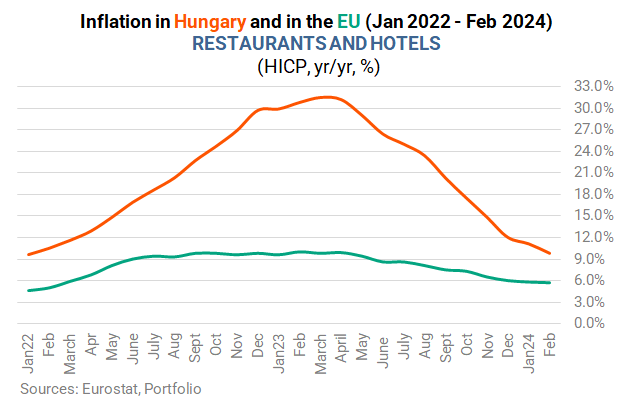
Hungary was on the 1st spot in November and on the 3rd in December in the CEE ranking, but snatched the 'silver medal' in January and again 'bronze' in February (9.8%) behind Croatia (10.8%) and Romania (12.5%).

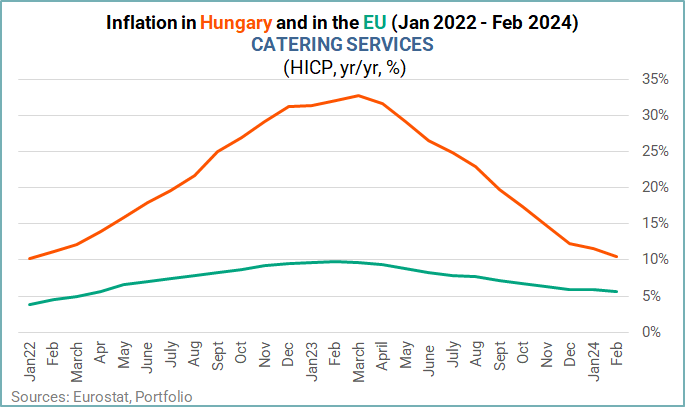
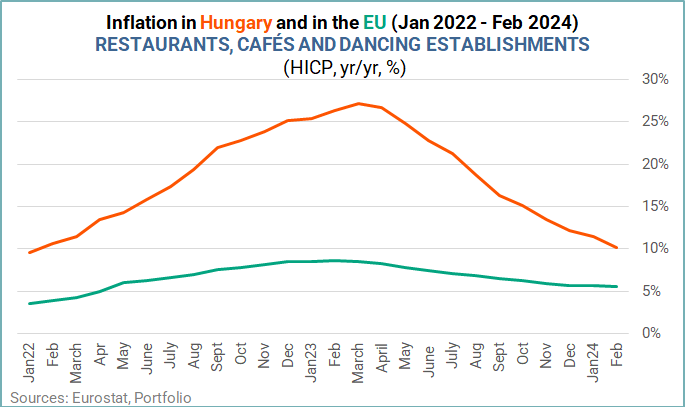
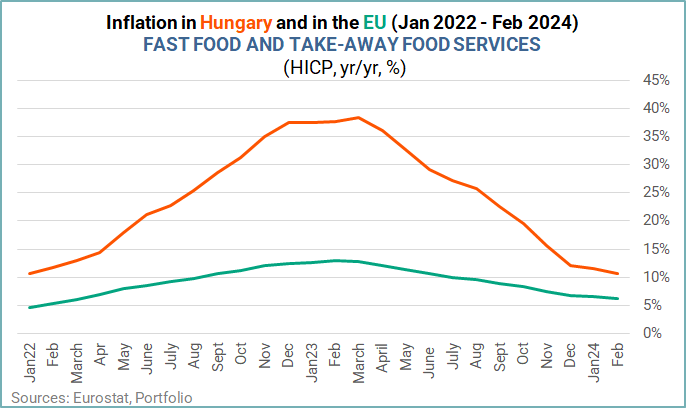
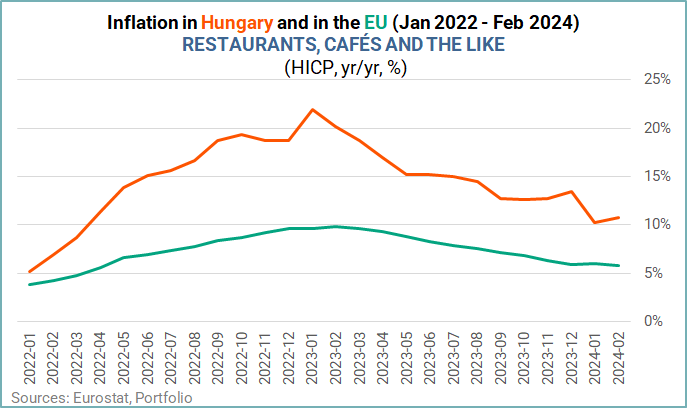
The breakdown of eating out shows that inflation in this area remains about double the EU average in all four sub-categories, and also that price increases in Hungary were the highest in the CEE region until October or November 2023. Since then, however, Romania's prices rose the most, with Hungary generally ranked 2nd or 3rd.
The upper (smaller) charts show price changes in Hungary and the EU between January 2022 and February 2024, while the lower (larger) graphs give us a regional perspective for a shorter period between January 2023 and February 2024.




Cover photo: Getty Images





