Electric vehicle sales buoyed by state scheme in Hungary


Weak new car sales in Europe in March
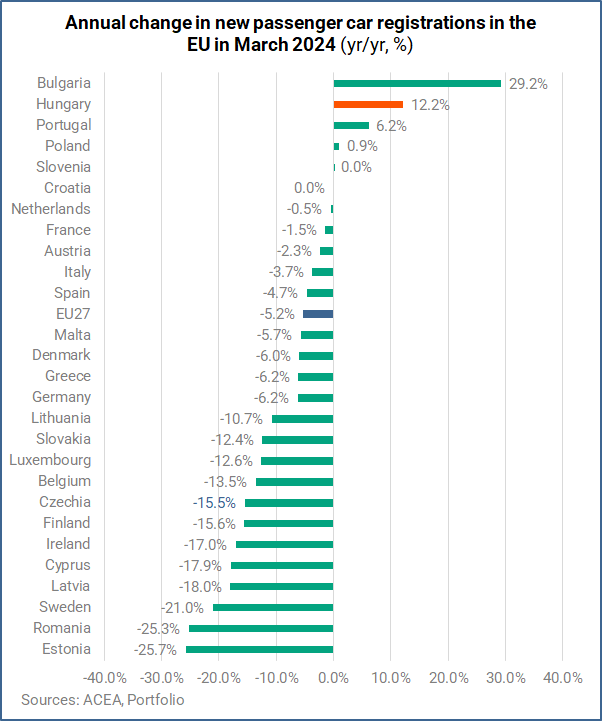
In March 2024, the European Union car market experienced its first decline of the year, registering a 5.2% decrease to 1 million units.
The timing of the Easter holidays negatively impacted last month’s sales across most EU markets, including the four largest: Germany (‑6.2%), Spain (-4.7%), Italy (-3.7%), and France (-1.5%). The market decline has affected almost the whole bloc, with a few exceptions, including Hungary where sales went up 12.2% yr/yr to 12,900 units, the second-largest growth in the bloc.
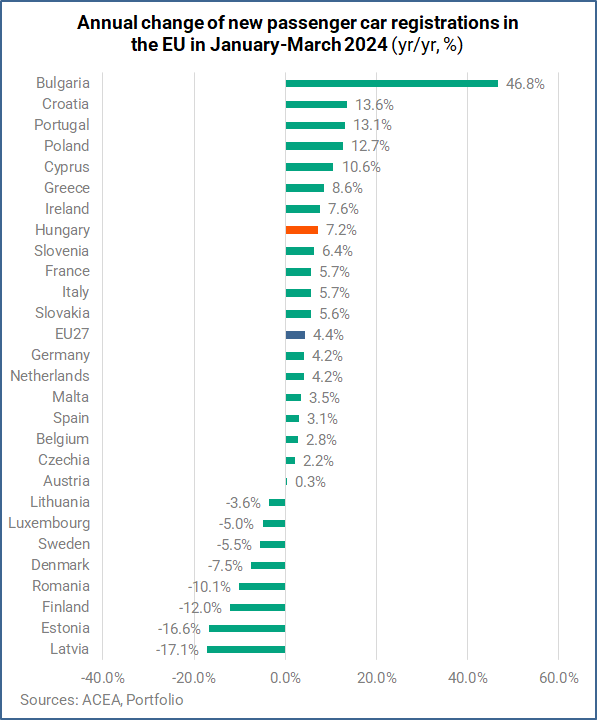
Owing to a strong start, new passenger car registrations grew on an annual basis in the first quarter despite the March decline. For Q1, car registrations increased by 4.4%, reaching nearly 2.8 million units. The bloc’s major markets saw solid growth from January to March, with Italy and France each recording a 5.7% increase, followed by Germany (+4.2%) and Spain (+3.1%). Sales in Hungary expanded by 7.2% to nearly 31,700 cars, which follows a 4.1% increase in the first two months.
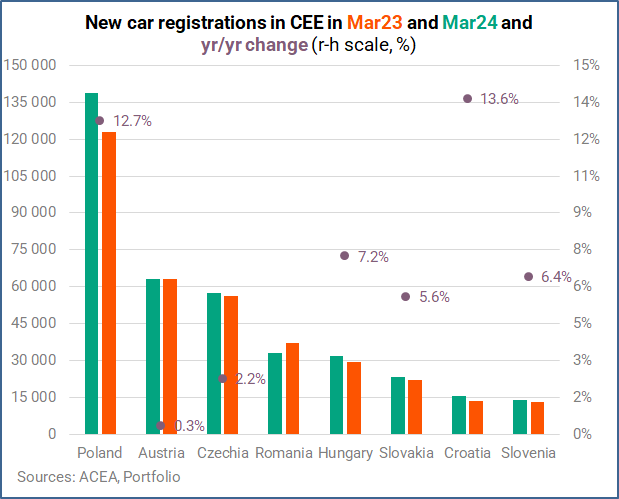
The chart below shows the number of new passenger car registrations in Central and Eastern Europe in the third month of 2023 and 2024, as well as their yr/yr change. All of the selected countries recorded yr/yr increases in March, with Poland standing out in terms of the number of new cars registered.
New EU car registrations by power source
March 2024 saw a shift in the car market’s composition: battery-electric cars slipped to a 13% share from last year’s 13.9%, while hybrid-electrics charged up to 29% from 24.4%. The share of plug-in hybrid vehicles shrank to 7.1% from 7.2%.
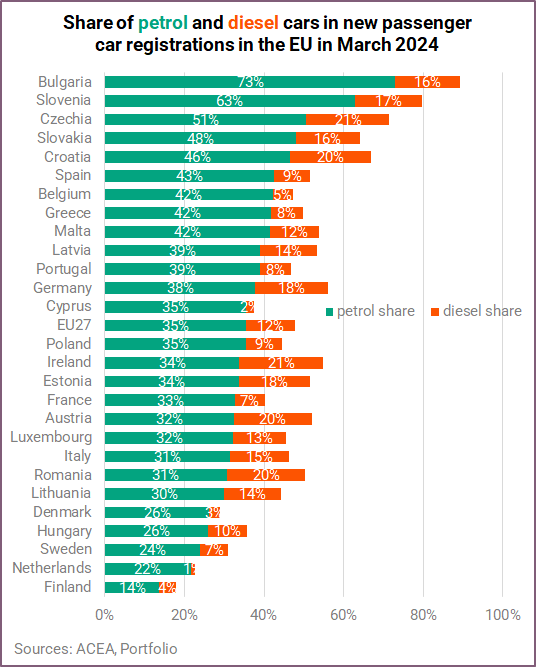
Petrol (35.4%) and diesel (12.4%) combined captured less than half the market (47.8%, from 51.8%).
The share of hybrid electric vehicles (HEVs) in total new passenger car registrations in Hungary remains much higher at 51.2% than the combined share of petrol and diesel cars (35.8%).

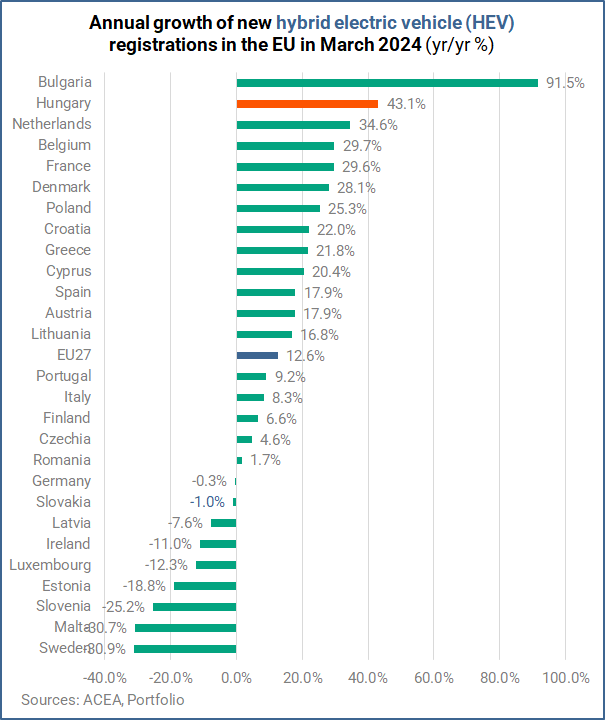
New passenger car registrations in the EU showed a yr/yr decline of 10.2% and 18.5% in March in petrol and diesel cars, respectively. The only area with some growth was hybrid electric vehicles (HEVs) with a 12.6% increase in new registrations.
However, it is clear that there are countries, especially in our region, where electric and hybrid cars are finding it harder to gain a foothold. In Bulgaria, for example, 89% of cars sold are internal combustion engine cars, but in the Czech Republic and Slovenia the share is 80% and 72% respectively. In comparison, the Nordic countries typically see figures below 30% (18% in Finland, 31% in Sweden, 23% in the Netherlands in March).
Hybrid electric vehicles
Hybrid electric vehicles (HEVs) are becoming increasingly popular around the world, and this is also true in Europe, where 29% of all new cars registered were HEVs in March.
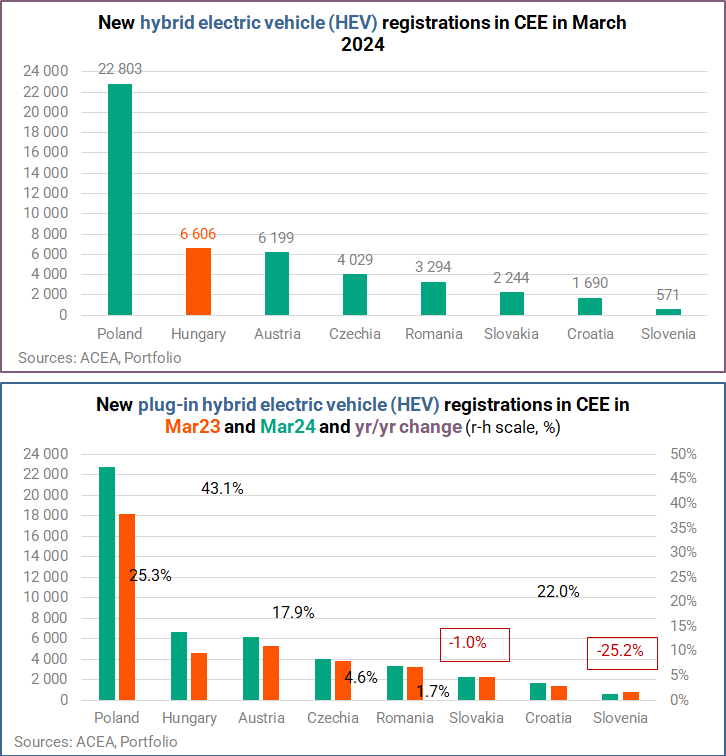
In Hungary, more than half of the newly registered cars were HEVs last month, followed by Cyprus and Poland.
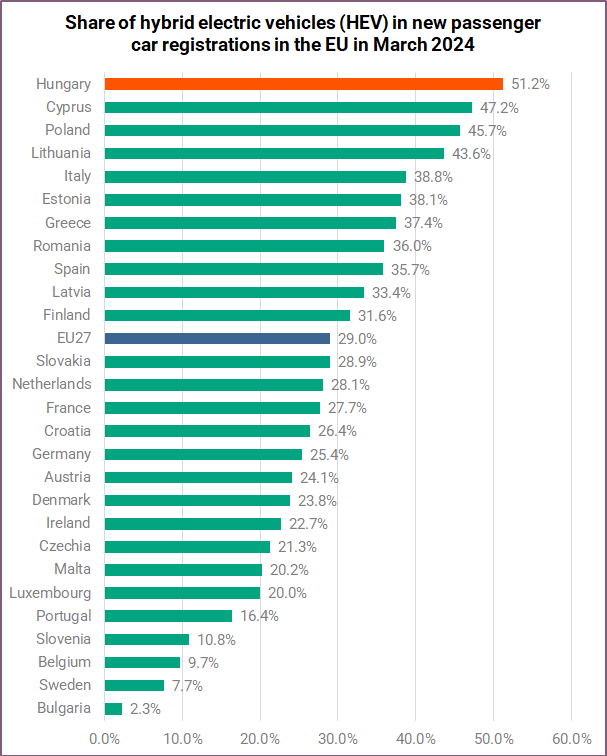
HEV sales in Hungary jumped by 43.1% yr/yr to over 6,600 cars, which compares with a 12.6% average growth in the EU, down from almost 25% in February. Although Hungary finished behind Bulgaria, the comparison is futile, given that only 90 HEVs were sold there.
Battery electric cars
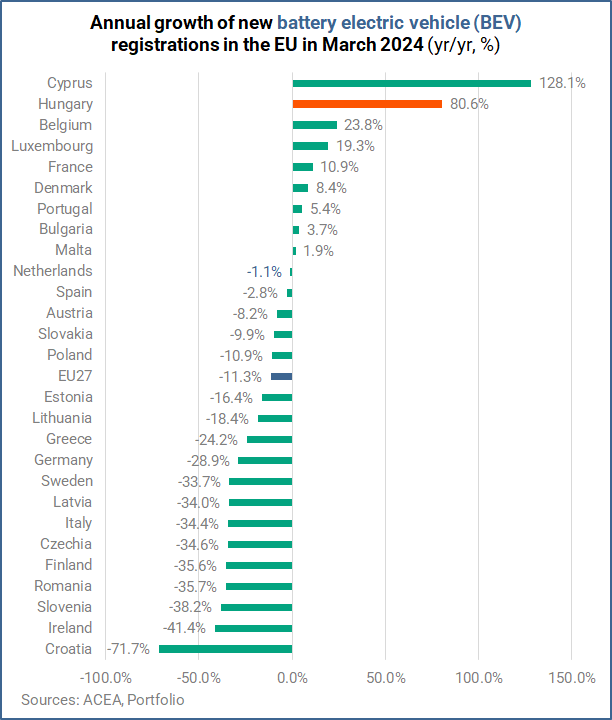
In March 2024, battery-electric car registrations declined by 11.3% to 134,397 units, reflecting the broader market downturn.
Consequently, their market share shrank from 13.9% in March 2023 to 13% in the same month of this year.
Among the three largest BEV markets, Belgium (+23.8%) and France (+10.9%) enjoyed double-digit increases, while Germany faced a significant decrease of 28.9%.
The first quarter of 2024 ended with a total of 332,999 new battery-electric cars registered, a 3.8% rise from the same quarter in the previous year.
The countries that were at the bottom of the petrol/diesel ranking above are now at the top. Of the Nordic countries, Denmark (42.1%) has the highest share of electric cars in total sales, but the Netherlands and Sweden now have one in three cars sold that are fully electric.
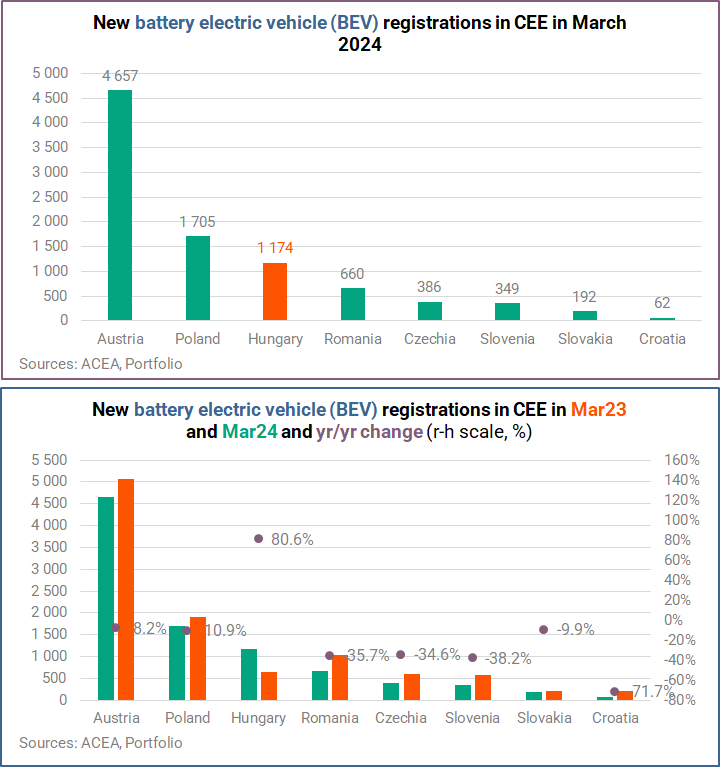
At the bottom of the list are the countries of our region, with hardly any BEVs sold in Croatia, the Czech Republic or Slovakia, and the big markets of Italy and Spain have not caught on to electric cars. In Hungary, 1,174 electric cars were sold in February, a share of 9.1%.
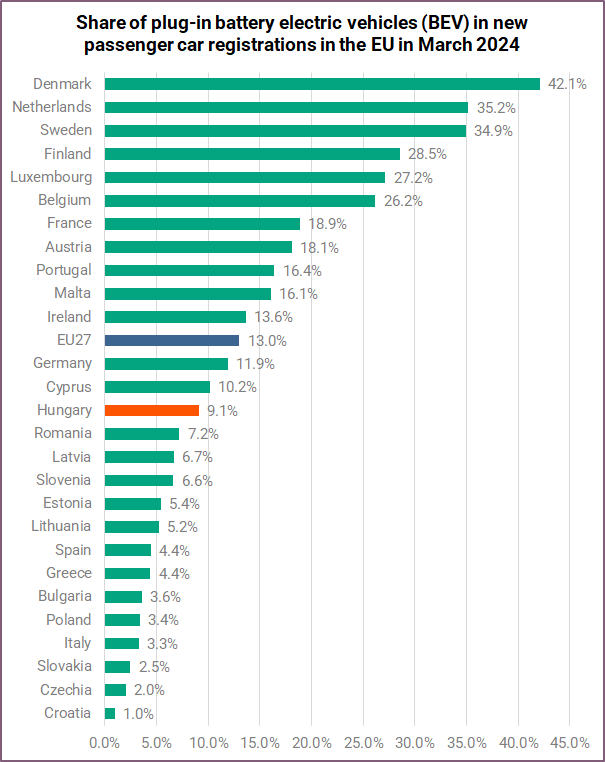
BEV sales in Hungary soared by over 80% yr/ry in March, against a 11.3% decline in the EU.
Norway is often quoted as a prime example of going electric in driving, where the share of EVs in total sales remains brutally high. In March, the share was 89.3%, meaning that nine out of ten cars sold in Norway were electric. Electric cars were able to gain market share in Norway compared to 86.8% last year, even though overall market sales practically halved in March.
Plug-in hybrids
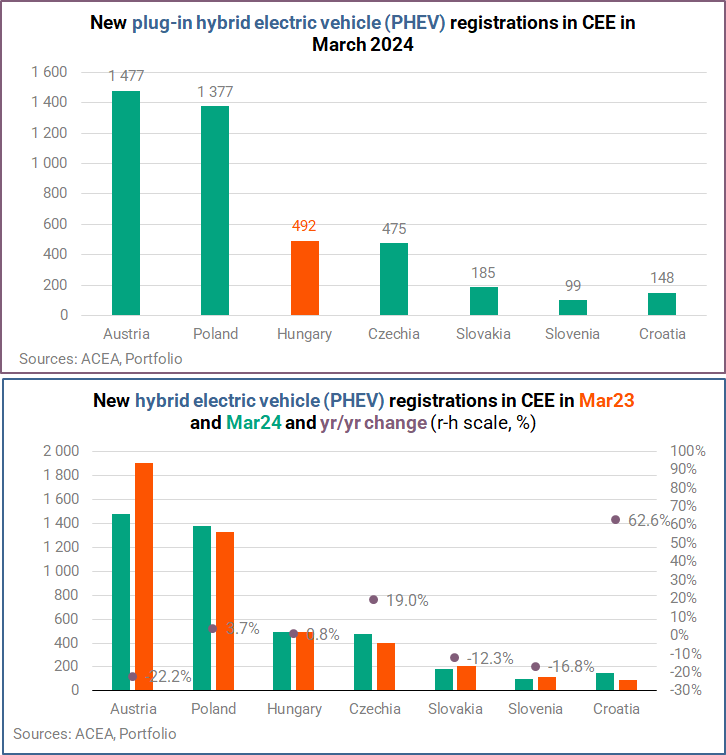
In terms of the share of plug-in hybrid electric vehicles (PHEVs) of total new car registrations, Sweden came out on top with 23.2%, followed by Finland and Belgium. Hungary's share in this category was 3.8% in March, while the EU average was higher at 7.1%.
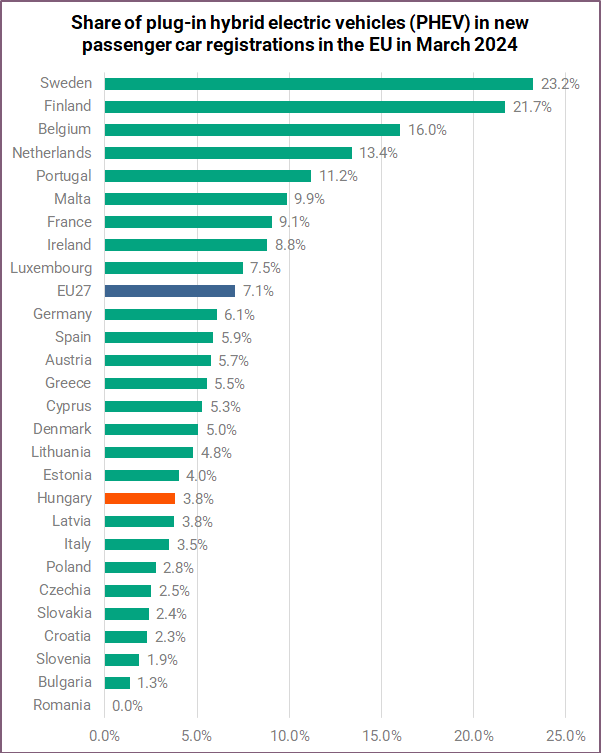
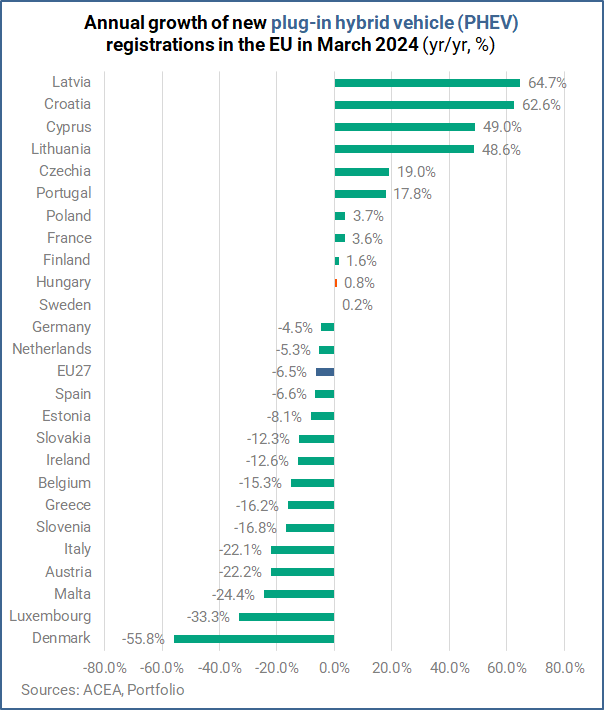
Only 492 PHEVs were newly registered in Hungary in March, versus 488 in the same month of 2023. This 0.8% increase compares with a 6.5% average contraction in the EU.
Hungary and its regional peers
A total of 12,895 new passenger cars were registered in Hungary in March this year, 12.2% more than in a year earlier. Most new cars are HEVs (51.2%), followed by petrol (26.0%), diesel (9.8%), BEV (9.1%) and PHEV (3.8%). The evolution of these shares can be seen in the chart below. The race is clearly between HEVs and petrol cars, with the former coming out on top steadily since last July. The share of HEVs was also higher between November 2022 and May 2023.
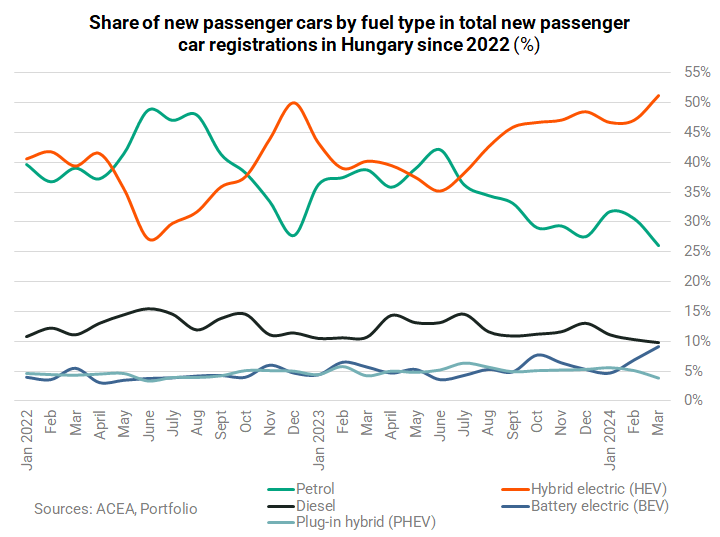
As for the evolution of the share of the three main power sources (petrol, diesel, HEV) in Hungary's new passenger car registrations take a look at the three graphs below. The diminishing share of petrol engines year by year is evident.

The share of diesel cars in new registrations has been showing greater fluctuation but the decline remains evident.

The share of HEVs has never been this high for as long as the date series goes back (Jan2022).

As for the yr/yr increase in sales, BEVs showed by far the highest figure (+80.6%), followed by HEVs (+43.1%), and diesel (+2.4%), and PHEVs (+0.8%, while there was a 24.7% yr/yr decline in the registration of new petrol cars.
It is worth nothing that the government launched an electric car subsidy scheme earlier this year, which has helped boost EV sales. As the scheme has not yet expired, it is expected to continue to have a positive impact on domestic EV sales for the rest of the year.
We can compare Hungary's performance also in regional terms, both in respect of the actual number of cars sold (by fuel type) and the annual change in new registrations. Here we go:
In the first quarter of 2024, new passenger car registrations grew by 7.2% in Hungary, including a 38.6% growth in BEV sales, a 28.3% expansion in HEV sales, and a 5.9% increase in PHEV sales. Meanwhile, diesel car sales edged up 4.0% and 17.3% fewer petrol-fuelled cars were registered than in March 2023.
Cover photo: Getty Images





