Painful wounds of the Hungarian budget are healing very slowly


Hungary's budget went topsy-turvy in 2023, with a deficit of 6.7% of GDP exceeding all previous prognoses and government expectations. We also know that the main figures of the 2024 budget adopted last summer are no longer valid and the government has therefore raised this year's deficit target to 4.5% and decided to put off HUF 676 billion worth of investment projects, which seems more like a gimmick than a real measure.
Meanwhile, institutions monitoring the budget process are sounding the alarm: the Fiscal Council has warned that last year Hungary had one of the largest deficits in the EU, credit rating agencies are increasingly taking notice of the fiscal slippage and the central bank (MNB) is also calling for the budget to be put back on track.
In light of this, the budget figures for this year have attracted a lot of attention, with the Ministry of Finance now providing detailed figures for the first three months of the year.
It is worth taking inventory of the factors that have determined the budgetary situation in recent years: VAT receipts, interest expenditure, residential overheads. In the light of these, it is not surprising that Hungary's budget shortfall reached 92% of the original annual target and the 58% of the upwardly revised goal by the end of March.
Sobering VAT data
In the first three months, VAT receipts (the balance of gross payments and refunds) stood at HUF 1,647 billion, only HUF 45 billion, 2.8% higher than in the first three months of last year.

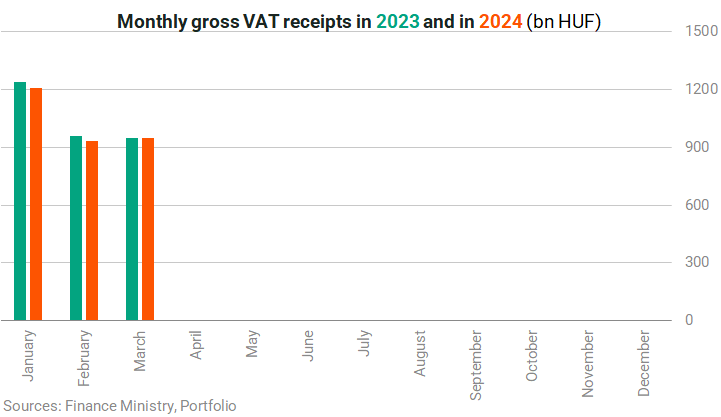
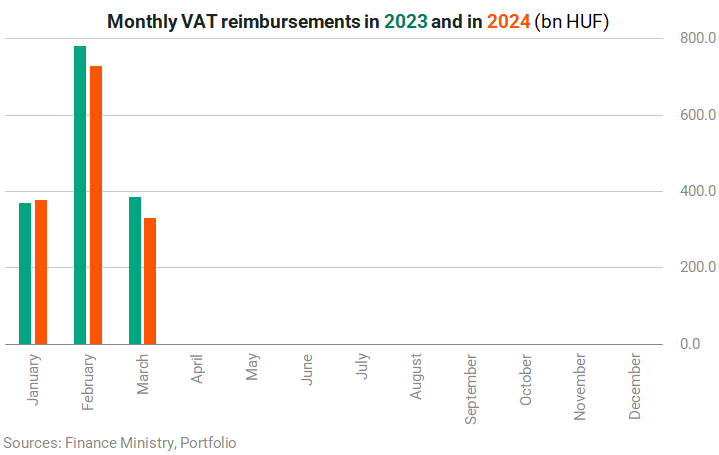
To get a more accurate picture of the evolution of the most important tax revenue item in the budget, VAT receipts are broken down into VAT receipts and VAT reimbursements, as the Finance Ministry's bulletin published in the second half of each month also provides detailed information on these items.
- In this respect, it is worrying that overall VAT revenue (let's call this gross VAT receipts) were 1.8% lower by the end of March than in Q1 2023. It is important to note, however, that the big VAT revenue puzzle started mostly in the second half of last year (when high inflation had already taken a significant bite out of household incomes and thus consumption), with high monthly VAT receipts in the first months of 2023.
- VAT reimbursements offer a slight relief, as they were 6.6% lower in three months than this time last year. This shows that the phenomenon known as the VAT mystery is improving somewhat.
Interest expenditure ruins "everything"
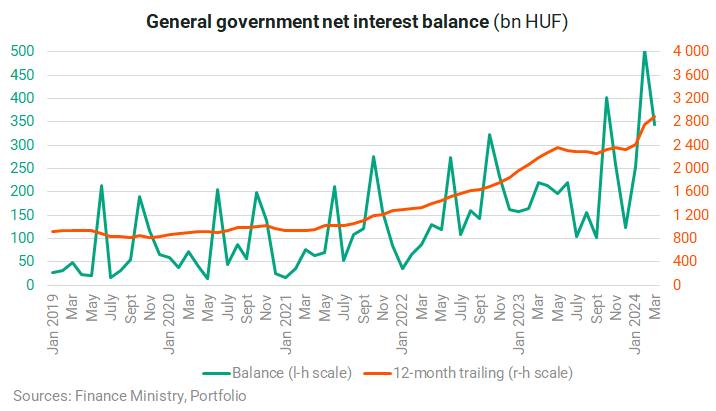
By the end of March, interest expenditure amounted to HUF 1,241 billion, which is 40% of the markedly revised annual plan for HUF 3,103 billion cash interest expenditure. A year ago, interest expenditure amounted to HUF 637 billion, or 23.1% of the annual target.
Interest expenditure (excluding interest income) has therefore almost doubled compared to last year, which is not at all surprising given the high interest rates paid on retail government bonds. It has been known for months that the Hungarian government can only finance its overspending at extremely high costs due to the falling inflation.
It is also worth looking at the interest balance (which shows how much the government can reduce its interest expenditure thanks to the interest income it receives), which is extremely gloomy. Since the beginning of this year, interest expenditure has risen to a whole new level, with the state having to spend hundreds of billions of forints every month on interest alone. In other words, in 2022 it was the overheads protection scheme that sucked the money out of the budget, now it is mostly interest expenditure.
What else is going on in the budget?
A substantial additional burden (but one that the government had expected) is the increase in pensions. HUF 1,895 billion flowed out of the budget for pensions in January-March this year, 9.5% more than in the first three months of 2023. What is noteworthy in this context is that in three months, 31.5% of the annual pension envelope was spent this year, compared to 29.7% last year.
It was expected that the public burden related to the utility bills reduction scheme would be more moderate this year. The government had paid out HUF 461 billion under the utilities subsidy heading by the end of March, compared with HUF 679 billion under the same heading last year.
However, detailed figures for the first three months show that public transport reimbursements and subsidies are spectacularly up: after HUF 35 billion last year, the government spent HUF 123 billion on this in the first three months of 2024. The ministry noted briefly in its statement that "the reason for the difference is that this year the payment of public transport service reimbursements started earlier than in 2023".
The state is also cutting back on housing subsidies this year: last year at this time the tally was HUF 226 billion, but now it stands at HUF 48 billion at the end of March.
The state is also spending less on EU projects: in the first three months, it spent HUF 533 billion on EU programmes, compared to HUF 852 billion last year. It is worth adding, however, that the receipts from EU programmes are also lower: HUF 328 billion against HUF 536 billion a year ago. In other words, because EU funding is not forthcoming, the government is not spending significantly out of this budget.
What is not yet included in the first three months of the budget is the allocation of over HUF 60 billion to public hospitals for debt consolidation. This, plus the HUF 40 billion planned for June, was not included in this year's budget, meaning it will worsen the overall deficit process.
Cover photo: Getty Images