Another wage boom in Hungary, with average wage north of HUF 600,000


Almost everyone was surprised to see that gross wages rose by 14.6% year on year in January. But the rapid wage growth in February is hardly unexpected. The Central Statistical Office (KSH) reported on Wednesday that the average gross wage of full-time employees was HUF 605,400, up 14% in annual terms. Average net earnings were HUF 402,600 excluding tax benefits and HUF 417,100 including them.

It is important to point out that the wage of the "average person" corresponds to the median rather than the average wage (the median wage is the wage of the worker in the middle of the earnings scale).The median gross wage was HUF 491,900, 16.2% higher than a year earlier.
As median wages have grown faster than the average, it can be argued that the growth in wages for those with particularly high incomes has lagged behind the national average. In other words, it is likely that wage increases in each income quintile will follow a similar pattern this year as in 2023. The fact that wages are rising faster in the bottom two or three income quintiles is largely related to the fact that the minimum wage and the guaranteed wage minimum have risen significantly, by 15% and 10% respectively.
Wage growth was slower in the private sector and higher in the public sector. On average, companies raised wages by 12.6% on an annual basis, bringing the average gross wage for companies to HUF 611,700.

Earnings in the public sector grew by 17.2% yr/yr to gross HUF 582,100.

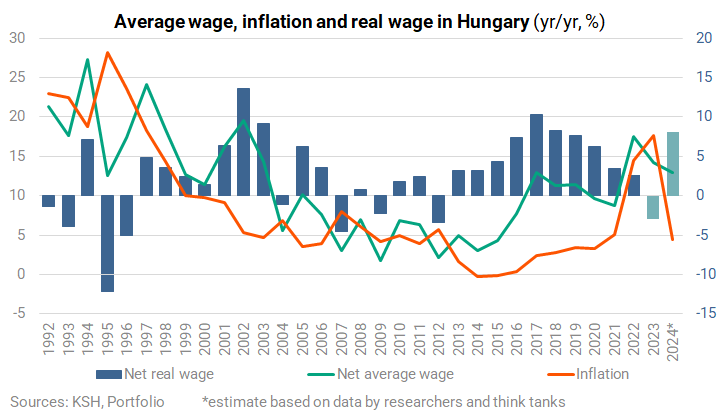
With inflation having fallen to low levels after last year's record highs, it is fair to say that the purchasing power of earnings is also rising rapidly. Inflation was 3.7% in February, so real wages rose by 9.9%.

As for the outlook, wage growth could be rapid throughout this year. After the better-than-expected January pay data, Portfolio asked analysts about wages, and found that instead of the previously expected 8-10% increase, they believe, earnings could rise by 12-14% in 2024. This could translate into a real wage increase of around 8%.
The last time real wages rose as fast as they are expected to go up this year was in the early 2000s, and between 2016 and 2019. A common feature of both periods is that minimum wages have increased markedly while inflation has remained low.
Cover photo: Getty Images





