Commission dissects Hungarian economic policies, warns of serious risks


The vulnerabilities in Hungary are analysed in a macroeconomic context characterised by low economic activity, decreasing inflation, high budget deficit and significant uncertainties over the strength of the recovery in 2024.
This year’s IDR, which follows the 2024 Alert Mechanism Report (AMR) published in November 2023, assesses the persistence or unwinding of the vulnerabilities identified last year, potential emerging risks, and relevant policy progress and policy options that could be considered for the future.
Compared to its expansion by 4.6% in 2022, GDP declined by 0.9% in 2023 against a background of high inflationary pressures, tighter financing conditions and weakening global demand. According to the Commission Winter 2024 Interim Forecast, GDP growth is projected to recover to 2.4% in 2024 and 3.6% in 2025, supported by falling energy prices, lower inflation and lower interest rates.
Nonetheless the economic outlook remains sensitive to energy prices, potential supply disruptions and global investor sentiment. According to the EU executive, these constitute downside risks
suggesting that the growth estimates may not be met.
The EC reminded that headline inflation started to decrease in 2023 and reached 3.6% in February 2024 after averaging 17.2% in 2023. The recent moderation in commodity prices and the economic recession helped ease inflationary pressures, but high labour cost growth and price indexation in certain sectors has kept core inflation (excluding energy, food, alcohol and tobacco) elevated, reaching 7% in February 2024. Rapid wage growth is forecast to continue on the back of a tight labour market, following a 14% increase in nominal compensation per employee in 2023.
In 2024, inflation is expected to continue decreasing, but to remain at 4.5% – above the target set by Magyar Nemzeti Bank (MNB), the country’s central bank – as the recovery of consumption is expected to increase the pricing power of companies.
The recession reduced tax revenues while high inflation added to interest and pension expenditure, keeping the budget deficit elevated in 2023, at some 6.7% of GDP.
Read the Commission's staff detailed analysis of the permanently imbalanced Hungarian budget here:
Economic policies are geared toward stimulating the recovery from the 2023 recession, but risks to government finances and the need to address them could create headwinds to growth in the medium term, the Commission added.
A high level of integration with Germany, and some non-EU partners, makes Hungary prone to spillovers resulting from developments in these economies,
the EC warns.
The Hungarian economy relies on imports of German, Austrian and Polish products, while Germany, Italy and Austria are major destinations for Hungary’s gross exports. When it comes to external demand, the largest shares of total value added in the Hungarian economy are generated to satisfy domestic demand in Germany and US, while Hungarian domestic demand is mostly satisfied by value added generated in Germany and China. Due to Hungary’s direct or indirect links to non-EU partners, geopolitical and trade tensions appear to pose a non-negligeable risk to its economy.
Not much room for spending
In recent years, Hungary’s economy has been characterised by an expansionary fiscal policy, significant external and government financing needs, and very strong price pressures. The current account and fiscal deficits have been sizeable for several years, with medium fiscal sustainability risks over the medium term.
The combination of external and fiscal deficits added to external sustainability risks, which were exacerbated by the high energy intensity of the economy and by policies that slowed the adjustment of the economy to rising energy prices and interest rates. High inflation and interest rates have weighed on Hungary’s competitiveness and increased debt-servicing costs. The net international investment position (NIIP) has remained negative, although the associated risks have been mitigated by a sizeable share of non-defaultable instruments.
After recording in 2022 the largest deficit in nearly two decades, the current account improved in 2023 owing to lower energy prices and weaker import demand. Following a multi-year trend deterioration, the current account balance declined from a surplus of 4.5% of GDP in 2016 to a deficit of 8.3% in 2022, driven by a lower trade balance due to domestic overheating, and soaring energy import prices that worsened the energy trade deficit by 5.6 percentage points (pps) to 10% of GDP in 2022.
High-frequency data point to a sharp improvement in 2023, with a preliminary estimate of a 0.1% of GDP current account surplus. Lower energy prices amid the economic recession at home helped improve the current account balance in 2023, with the nonenergy trade balance rising to its highest level since 2017.
At the same time, the income balance deteriorated due to higher financing costs (Graph 2.1 a).
Based on a comparison of the headline and cyclically-adjusted current account balances, some 2.5 pps of the current account improvement in 2023 could be attributed to the economic recession that reduced import demand (Graph 2.1 b).
The improvement in the cyclically-adjusted current account balance was mostly driven by external developments – falling import prices, essentially – rather than domestic policy action,
the EC said.

The government deficit continued to weigh on the external balance in 2023, but the rising net lending of the private sector reduced the country’s external financing needs. Net borrowing by the government remained substantial in 2023, at 6.7% of GDP according to preliminary financial accounts data.
The improvement in the external balance of the economy compared to 2022 was driven by the higher net lending of the private sector (Graph 2.7 b).
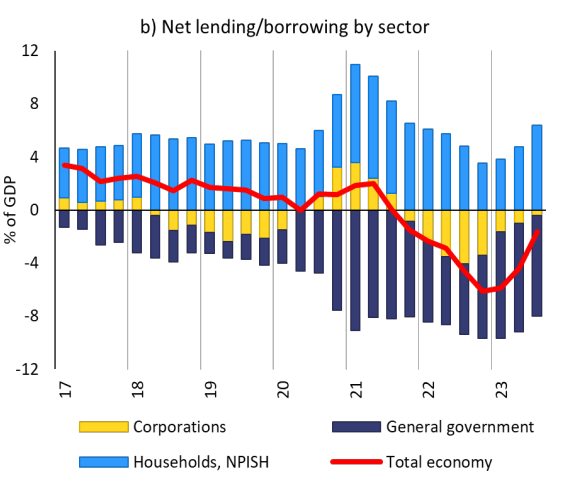
Household saving rose, partly recovering financial buffers which had been eroded by high inflation. Meanwhile, household investment fell due to rising interest rates. The net borrowing of corporations fell mainly due to the drawdown of inventories (i.e. negative capital formation). Meanwhile, corporate savings fell more than investments, as the recession and higher production costs reduced profitability.
The Commission Autumn 2023 Forecast projected the current account balance gradually decreasing towards these levels in 2024-2025, as the negative output gap closes. From a sectoral saving-investment perspective, the pick-up of corporate investment and the gradual decrease of household savings were projected to reduce net lending by the private sector, partly to be offset by the decreasing net borrowing of the government.
Expansionary policies and renewed increases in international energy prices might adversely affect the external balance in the medium term,
the Commission warned.
Should economic policies remain expansionary, they might worsen the trade balance and add to financing costs. The current account also remains exposed to developments in energy prices, due to the economy’s high dependence on energy imports, which is likely to persist in the medium term. Hungary’s updated national energy and climate plan (NECP) expects the gross inland consumption of fossil fuels to decrease by just 7.5% between 2023 and 2030, while there remains little scope to increase the domestic production of these fuels.
Furthermore, the doubling of nuclear energy generation by 2030 and the substantial increase of renewable energy sources are crucial premises of the NECP. Until these capacities are installed, Hungary could also remain a net importer of electricity. However, while the government has almost met its solar energy targets, the Paks nuclear power plant expansion project is not progressing on schedule.
The NECP envisages gross electricity generation to rise by nearly 20 TWh between 2023-2030 (a 57% increase). Nuclear energy is expected to contribute to this increase by more than 18 TWh, new renewable capacities are expected to add 7 TWh, while electricity generation from fossil fuels is set to decrease by approximately 6 TWh.
The external deficit has recently been financed by significant debt-generating capital inflows that continued in 2023. In the four quarters up to Q3-2023, these added up to 6.3% of GDP, largely driven by:
- (i) the increasing role of non-residents in government debt financing;
- (ii) borrowing by state-owned development banks to finance subsidised lending schemes (see also Thematic chapter below); and
- (iii) international bond issuances by Hungarian banks as they prepare to comply with new capital requirements.
Meanwhile net inward foreign direct investment (FDI) amounted to just 0.2% of GDP, as gross FDI inflows were partly offset by some large outward transactions.
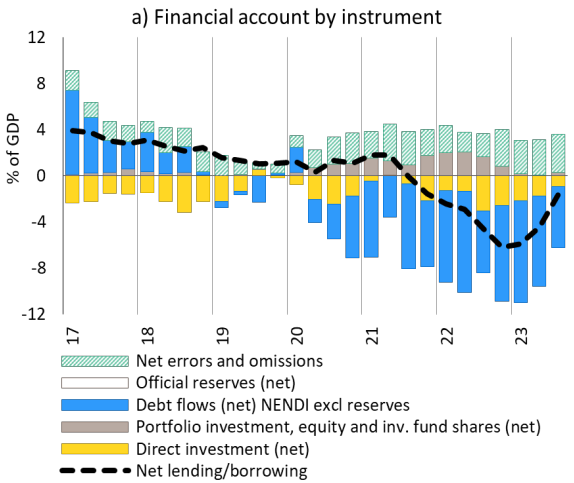
High inflation and valuation effects have reduced the rise in external debt. In Q3-2023, Hungary’s NIIP stood at -47.6% of GDP, slightly above the estimated prudential level of -53%, with the negative position mainly due to a large inward FDI stock. At the same time, the NIIP, excluding non-defaultable instruments (NENDI), stood at -9% of GDP, having worsened from -1.2% in 2021.
This marks a reversal in the long-term improvement in the NENDI, which stood at -52% of GDP in 2008.
The current account surpluses of the early 2010s were driven by private deleveraging and fiscal consolidation, but since 2019 these turned into deficits that were mainly financed by external borrowing. Gross external debt increased from 53.4% of GDP in 2019 to 67.2% in Q3-2022 but decreased afterwards to 65.2% in Q3-2023.
The build-up in external debt was partly mitigated by high nominal GDP growth. In 2022, valuation effects added 1.1% of GDP to external debt, mainly due to currency depreciation, but in 2023 this effect was partly reversed, as the currency appreciated again. In recent quarters, reserve assets were just sufficient to cover short-term external debt.
Commission paints a forlorn picture
"A tighter monetary policy, lower energy prices and weaker import demand improved the external balance and reduced the very high inflation over the course of 2023. However, the recession also contributed to a persistently high budget deficit, on the top of continued expansionary policies even during earlier years of strong economic growth. High interest rates contributed to the slowdown of house prices and an easing of overvaluation in 2023," the EC said.
"A gradual reduction of interest rates and moderate energy prices can support a gradual economic recovery from 2024 onwards. However,
fiscal consolidation needs weigh on growth prospects, and the economy remains exposed to external developments in energy prices and risk premia.
The EC also noted that "policy progress has been limited, keeping Hungary vulnerable to both external and domestic shocks."
A more coherent approach to economic policy is needed to deliver fiscal consolidation and macro-financial stability, and to lay the foundations for sustainable economic growth, without risking the overheating of the economy, which would worsen external sustainability and keep inflation and interest rates entrenched at relatively high levels,
the EU executive stressed.
"The fiscal framework continues to lack a medium-term orientation. Large hikes in the minimum wage are based on the premise of future productivity gains that might not be achieved due to structural factors such as low innovation, low digitalisation, and barriers to competition in the service sector.
"The cost of household energy subsidies has been passed on to companies, weakening their price and cost competitiveness.
"Support schemes for home purchase appear to remain generous and risk fuelling the overvaluation of house prices amid low housing supply.
"Frequent credit market interventions have had a limited impact on economic growth while they have interfered with the functioning of monetary policy and create longer-term fiscal burden through central bank losses and contingent liabilities," the Commission concluded.
According to the Commission, Hungary's outlook is characterised by low economic activity, falling inflation, a high budget deficit and considerable uncertainty about the strength of the recovery in 2024. The country's vulnerabilities include very strong price pressures, significant external and government financing needs, and possibly newly emerging risks.
They warn the government against excessive fiscal loosening and the reintroduction of high-pressure economic policies, as this would only increase inflation risks and could be counterproductive in terms of kick-starting growth.
Cover photo: Getty Images





