Unemployment is getting worse in Hungary


The number of unemployed people in Hungary has risen significantly recently, as more and more companies are deciding to make redundancies due to the weak economy and persistently high prices have convinced people to enter the labour market who were previously inactive and not looking for work.
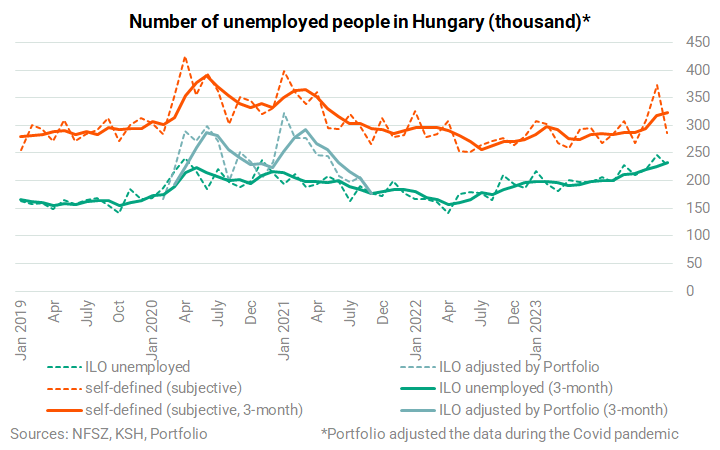
From a low of close to 3% in spring 2022, unemployment has now risen to over 4.5%, according to official KSH data (ILO unemployed), which translates into 220,000 to 230,000 unemployed.

Portfolio has also requested the so-called self-defined unemployment data from KSH. These figures are not published, but are surveyed every month in the same way as the official unemployment statistics (this is also part of the KSH's Labour Force Survey).
The data released by the Central Statistical Office (KSH) shows that 320,000 people now claim to be unemployed.
18 months ago, the number was 60,000 to 70,000 less. The interesting thing about self-defined unemployment is that it shows almost 100,000 more jobseekers than the official figures. The difference is due to the fact that "the number of unemployed according to the ILO definition is based on strict, objective facts, while the number of unemployed according to the self-classification is based on the subjective perception of the respondent's life situation", the agency wrote in response to an enquiry by Portfolio.
The Labour Force Survey is the largest continuous data collection of the Central Statistical Office, and aims at providing comparative data about the country’s labour market situation and employment and unemployment rates. "Each quarter we ask approximately 36,000 households to answer our questions. The households are selected via random sampling from various communities across the country. Participation is voluntary, " the KSH says on its website. In order to be classified as unemployed according to the ILO’s definition, a person needs to fulfil three criteria: (i) not to have worked at all in the reference week, (ii) to be available to take up work within the next two weeks and (iii) to have been either actively seeking work in the past four weeks or have already found a job that starts in the next three months.
The deterioration in labour market trends is indicated by the fact that the self-defined unemployment was last as high as at the beginning of this year in mid-2021. Last year, the number of people who considered themselves unemployed remained stable below 300,000 for most of the year, but the last few months have seen an upward trend.
This is certainly not unrelated to the fact that, on the one hand, firms announced major collective redundancies towards the end of last year and, on the other, more and more people are looking for work. The problem is that the labour market is less tight, the number of vacancies is falling and most companies are reluctant to increase their workforce in an uncertain economic climate.
Thus, even people who were previously inactive are entering the labour market, but are finding it difficult to find a job. Their situation is made more difficult by the fact that they have been absent from the labour market for a longer period of time, and it is their employment that the government's new programme aims to support.

However, the problem is that they often live in municipalities where finding a job is not easy or their skills are so low (and have been eroded by a long period of inactivity) that companies cannot hire them.
And in many places (especially where unemployment is rising anyway) there is no recruitment. And last year's recession and this year's weakening economy are making the east-west divide in the country increasingly visible again.

The Beveridge curve, which measures labour market tightness, also attests that there has generally been a gradual easing in recent quarters, as fewer vacancies have been associated with rising unemployment.

However, the different unemployment figures are somewhat contradictory. Every month, the Ministry of National Economy shows that the number of jobseekers is particularly low, according to the National Employment Service (NFSZ), and there is no upward trend. But the service only includes those those in the statistics who register with them.
As the situation is worsening, according to KSH data, the long-standing gap between the jobless figures of the stats office and the NFSZ has disappeared: the employment service data show no deterioration, while the KSH's survey shows an upward trend, both in terms of self-classification and official (ILO unemployed) data.
Based on our interviews with labour market experts, the picture that emerges is that the people who register in the NFSZ database are mostly those who expect the state agency to help them find a job or receive unemployment benefits. But they are few in number. Those who were previously inactive and are entering the market are not really going to register. Neither will the young unemployed, who are more likely to look for a job online than browse the job offers of the employment services.
Thus, the NFSZ data on jobseekers in these months should be treated with caution, as the increase in unemployment is not "classical", i.e. there are not only people that have just lost their job but also former inactive and young newcomers.
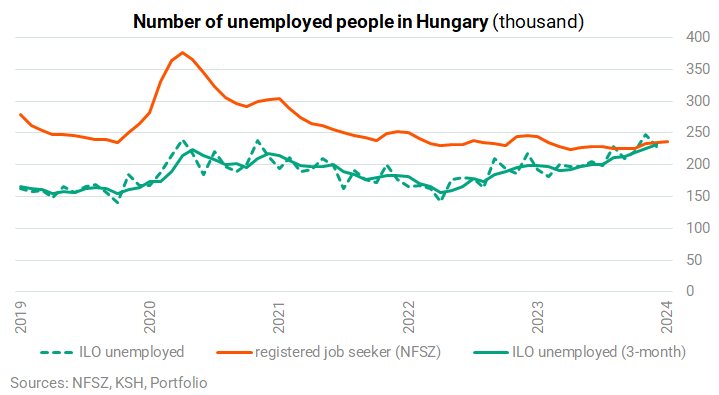
Overall, the unemployment rate has risen substantially in recent months, but the current economic slowdown has so far been much less of a shock to the labour market than previous recessions. However, it is also clear that in fact more than 300,000 of Hungarians consider themselves unemployed, a higher figure than the official figures (220,000 to 230,000).
Cover photo: Getty Images





