Hungary gives fuel traders two-week ultimatum


Request for a 'voluntary' price reduction
Nagy told journalists that local fuel prices must be matched with the regional average and traders have two weeks to comply. If they don't, the government will intervene, news portal Index reported.
In a rather absurd / cynical manner he stressed that the traders will have to adjust their prices to the regional average on a voluntary basis.
He noted they have to act in the case of both the 95-octane petrol and diesel prices.
If market players fail to reduce their prices sufficiently,
the government will re-discuss the possibility of using regulatory instruments and will take action. They have been given a two-week ultimatum to do so.
The minister said that the rise in fuel prices is a very serious burden for Hungarian families, and attributed the rise in petrol and diesel prices to the impact of the [Russia-Ukraine] war. He said the regional comparison data released last week by the Central Statistical Office (KSH) had had an effect: diesel prices will be cut to 633 forints and petrol to HUF 647 by Friday.
But the government does not consider this to be sufficient, as they believe it is higher than the regional average, with a difference of HUF 10 for diesel and HUF 27 for petrol.
Impact on Mol
Mol's share price has not reacted meaningfully to the announcement.
As the leading player in domestic fuel sales and the most important wholesaler, Mol may suffer serious losses due to the intervention in the fuel market, as we have seen during the previous price freeze. The measure has been a significant burden for the company in the short and medium term, with the relevant financial statement showing that the price caps and special taxes in Central Europe have dented the company's profit by $1.6 billion.
In any case, Mol currently sells about 30% of the 95-octane petrol and diesel marketed in Hungary, according to Portfolio's industry sources and the fuel statistics of tax authority NAV. Last year 2 billion litres of petrol and 3.6 billion litres of diesel were consumed in Hungary, so Mol's share is an average of 140 million litres of fuel per month (the petrol:diesel ratio was 1:3.3, according to the flash report).
As the pricing will be voluntary, it is difficult to calculate the exact impact on the company's profitability, but if we take the margin realised on current average regional prices (20 HUF per litre for petrol and 31 HUF per litre for diesel) as a basis, this could lead to a monthly EBITDA decrease of HUF 3.98 billion and an annual EBITDA decrease of HUF 47.8 billion.
The calculation is 33*20+107*31, where 33 million litres is the average monthly petrol volume, 107 million litres is the average monthly diesel volume, and 20 and 31 are the rate of price reductions per litre. Just to give some context, the annual profit of Mol group in 2023 was HUF 1,149 billion, so the effect is 4.2% of the annual profit.
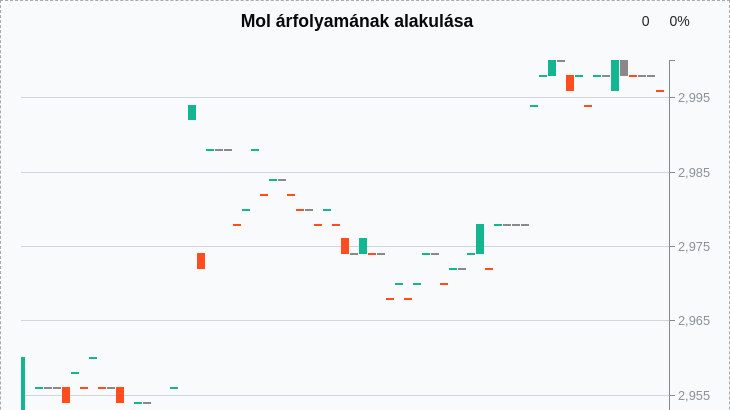
Although investors also reacted badly to the previously introduced price freeze measure, in the longer term Mol has gained by strengthening its market dominance. During the period of the fuel price cap, which was phased out at the end of 2022, the company has significantly increased its market weight in the retail and wholesale sectors, mainly at the expense of privately owned, independent (white) wells.
The government also capped the wholesale price of fuels in March 2022, which significantly distorted the market, as gasoline and diesel could be sold at higher prices in any of the neighbouring countries, so foreign wholesalers essentially withdrew from Hungary, leaving Mol to supply almost all domestic wells.
And the fuel shortage did not affect all market players in the same way: Mol prioritised the supply of its own filling stations, while white wells - small pumps often operated as a family business -, which also buy from the company, complained all year that they did not get enough fuel from Mol as a wholesaler. As a result, Mol has also been able to significantly increase its share in the retail segment (i.e. the service station market).
As the government now expects voluntary price cuts, it is difficult to predict the market effects.
How did we get here?
Since October last year, the government has been communicating its objective that domestic fuel prices should be in the middle of the regional ranking, and in this context and in order to achieve this, the government has also concluded an "agreement" with fuel market players.
The issue has been getting a lot of attention in recent weeks, with the Minister of National Economy Márton Nagy holding several meetings with the leaders of Mol and the Hungarian Petroleum Association (MÁSZ) on fuel prices, as he believes that the parties have not fulfilled their agreement.
Government intervention then became more and more likely, followed by the inception of a regional fuel price comparison system of the Central Statistical Office (KSH). Márton Nagy indicated that this statistic would provide the basis for possible intervention in the fuel market (the distortions in the statistic are discussed in a detailed analysis).
Energy Minister Csaba Lantos said that if intervention is necessary, it is likely that a kind of dynamic price cap could be expected, based on the regional average price for domestic fuel prices.
What was wrong with the price freeze?
For many, the price freeze measure introduced in November 2021 and its impact on the market will be a painful memory - as we all know, the measure did not change the tax content of fuel, the margin for traders decreased and they were not compensated.
They were also unable to adjust the excise tax because the European Union sets the minimum to 36 euro cents on petrol, and because the forint weakened significantly against the euro in the months preceding the measure, the domestic rate fell below this minimum.
This is why both Mol and MÁSZ stressed the importance of the stability of the domestic fuel market following a government briefing last September, while the secretary general of MÁSZ also warned that
IF THE GOVERNMENT REINTRODUCED OFFICIAL PRICES, SERIOUS SHORTAGES WOULD EMERGE IN A VERY SHORT TIME.
But what exactly was wrong with the measure? Here's a recap.
From the outset, the fuel price freeze proved difficult to maintain and highly distortive of market conditions, so the government revised the measure several times in the months before its introduction, successively excluding a growing proportion of consumers from the price freeze. The government imposed the official price of HUF 480 at the end of 2021 with temporary effect, and then repeatedly extended the measure to the last day of 2022. The following problems and difficulties were encountered in 2023 before the price cap was phased out:
- In early March 2022, the voices of the Hungarian Road Haulage Association were getting louder and louder, pointing to disruptions in the supply chain. The government responded to this at a press briefing, outlining the response measures to be taken in the fuel market to maintain the price freeze and security of supply. This was the first time that access to the capped fuel price of HUF 480 was streamlined, allowing trucks over 7.5 tonnes and foreign vehicles over 3.5 tonnes to fill up only at the high-pressure pumps at market prices.
- Then, at the end of May, it was announced that, in order to avoid 'fuel tourism', Hungary would set different fuel prices for vehicles with foreign plates and those with Hungarian plates.
THE EUROPEAN COMMISSION OPENED AN INFRINGEMENT PROCEDURE AGAINST HUNGARY OVER THE NEW DUAL FUEL PRICE REGIME,
requesting the Hungarian authorities to comply with EU law provisions with regard to the free movement of goods and services including transport services, the freedom of establishment, the free movement of citizens and workers, the principle of non-discrimination as well as rules on notifications under the Single Market Transparency Directive. - Then, at the end of July, another restriction was imposed, and the HUF 480 price was then maintained only for private vehicles, taxis and agricultural machinery. As a precursor of the tightening, Mol announced the shutdown of its Százhalombatta refinery for maintenance, which has made the supply of petrol in the country more difficult. Minister in charge of the PM's Office Gergely Gulyás said at a Government Press Briefing that the two ways of supply are imports and the use of strategic stocks. The latter was only possible to a certain extent, and covering demand from import was not an option, because
IT WAS NOT WORTH IT FOR FOREIGN SUPPLIERS TO EXPORT TO HUNGARY AT THIS FIXED PRICE.
- As of November, Mol restricted the top-up volume at its local pumps at 100 per litre per transaction. Other networks introduced (much) lower limits on capped-price fuels.
- Due to the prolonged maintenance work at the Százhalombatta refinery and the loss of imports, which used to account for 30% of domestic fuel consumption, fuel supply problems became more and more serious at the end of November, and the population started panic buying, with partial fuel shortages occurring practically throughout Mol's network. Subsequently, the fuel price freeze was phased out, although it was supposed to remain in place for longer.
Thus, based on the previous example, intervention in the fuel market could even lead to a security of supply risk. In addition, the prospects are further worsened by the fact that a periodic maintenance at Mol's Százhalombatta refinery started on 20 April and is scheduled to last until 24 June.
Past examples paint a negative picture: in July 2022, the previous price freeze was still in place, when the refinery also needed maintenance, which led to a difficult situation for the country's gasoline supply, to which the government responded by reducing the scope of the price freeze and tapping strategic stockpiles.
Cover photo: Getty Images





