Standard and Poor's affirms ratings on Hungary


S&P Global Ratings said late on Friday (26 April) that it affirmed its 'BBB-/A-3' long- and short-term foreign and local currency sovereign credit ratings on Hungary. The outlook is stable.
Analysts did not expect S&P to modify Hungary's ratings this time.
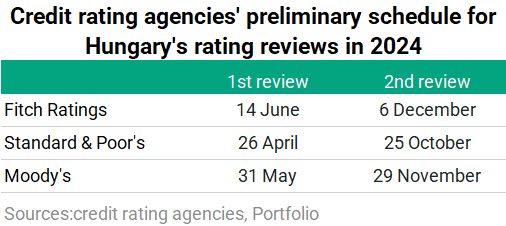
The next rating review by Moody's is due in a month, to be followed by a rating review by Fitch Ratings in mid-June.
Overview
- S&P expects high interest costs, sluggish value-added tax revenues, and off-budget activities will pressure Hungary's fiscal position in 2024.
- However, from 2025, they project consolidation efforts--aided by economic recovery, lower interest costs, and energy bills--will contain fiscal deficits at around 4% of GDP or lower, allowing the authorities to broadly stabilize government debt in the medium term.
- They noted that inflation has reduced markedly over the past months and the current account was in surplus in 2023, which has allowed the Hungarian Central Bank (MNB) to continue to cut interest rates and normalize monetary policy.
The stable outlook reflects our expectation that Hungary's economic recovery, ongoing disinflation, and falling interest rates will aid the government's fiscal consolidation efforts in the medium term, allowing the government debt burden to stabilize as a share of GDP,
S&P said.
Downside scenario
The rating agency said it could lower the ratings if Hungary's fiscal performance proved much weaker than S&P currently expects, as a result of insufficient policy efforts; weaker economic recovery; or external pressures, for example, triggered by substantial cuts to EU funds or by energy supply shocks.
Upside scenario
S&P could raise the ratings if Hungary's fiscal position improved significantly, alongside a reduction in its external vulnerabilities.
S&P prognoses
The tables of S&P show its estimates for Hungary's key macroeconomic indicators. The rating agency projects 2.2% GDP growth for this year, against the cabinet's 2.5% goal, which should rise to 3.1% in 2025, drop to 2.9% in 2026 and further to 2.5% in 2027.
S&P expects a gradual improvement in Hungary's unemployment rate from this year's 3.8% to 3.5% by 2027.
They see the budget gap at 5.3% of GDP this year, well over the government's upwardly revised 4.5% target, and expect it to be down only at 4.2% in 2025 (versus the cabinet's goal of a 3.7% gap). The shortfall is seen coming in at 3.7% in 2026 and 3.3% in 2027. In other words, S&P's economists do not believe Hungary will reduce the deficit to under 3.0% of GDP - the level expected by the EU - over three years in the 2024-2026 period.
This is not surprising, and it is worth recalling the speech Viktor Orbán made at an event of the Hungarian Chamber of Commerce and Industry (HCCI or MKIK), in which he said that he still had to discuss with Finance Minister Mihály Varga how many years it would take for the Hungarian budget to return below the 3% level. He said EU rules give everyone four years.
S&P expects Hungary's primary balance (excluding the interest balance) to be negative in 2024 (-0.3% of GDP) and in 2025 too (-0.4%).
The most prominent estimates are for Hungary's debt-to-GDP ratio, with S&P expecting it to rise from 73.5% in 2023 to 75.6% this year, remain unchanged in 2025, rise further to 75.7% in 2026 and fall to 75% only in 2027.
Annual average inflation is seen dropping from 17.0% in 2023 to 4.4% this year, 3.8% in 2025 and 3.5% in 2026 (also in 2027).
Rationale
S&P said the affirmation of the credit ratings reflects its assessment that
Hungary's fiscal slippage this year will be temporary and that public finances will improve from 2025 without threatening economic stability.
They base this view on:
- Their assessment that Hungary's outsized interest bill in 2023 and 2024 is temporary and will reduce meaningfully in 2025 from the repricing of the central government inflation-linked retail bonds in late 2024 and early 2025.
- Their expectation that the government will announce a credible consolidation agenda in the second half of 2024, which outlines steps that stabilize its fiscal trajectory, under the policy anchor of a looming excessive deficit procedure.
- The fiscal year 2024 will be burdened by one-off expenditures not repeated in 2025, such as the acquisition of an 80% stake in Budapest Airport.
S&P also considers the near-term fiscal risks are counterbalanced by constructive developments, such as the disbursements of EU funds and a strong pipeline of foreign direct investment (FDI)-funded projects--both of these, they believe, have the potential to lift Hungary's medium-term growth potential.
This year's economic output is expected to be bolstered by rebounding domestic demand, "progressively picking up over the second half of the year as interest rates reduce sharply and real wage growth gathers pace."
S&P has also warned, however that "Hungary's recovery faces headwinds from an accentuated weakness in external demand, in particular from Germany, despite price growth falling below expectations at the start of the year."
The rating agency noted the "sizable investments" that have gone into Hungary's EV and associated battery production facilities, which will provide scope for enhanced growth dynamics over 2025-2027, with real growth averaging 2.8%. It added that a reported EUR 13 billion of FDI was pledged in this sector in 2023.
They also believe that Hungary's reducing inflation rate and the strong rebalancing of its external accounts in 2023, together with our expectation of recurring current account surpluses in 2024-2025, will help the MNB to proceed with its monetary policy easing agenda, albeit cautiously, over 2024-2025.
S&P mentioned a legal procedure the European Parliament's legal committee has initiated against the European Commission for unlocking the €10.2 billion in EU funds for Hungary in December 2023, arguing that it was provided as a quid-pro-quo for Hungary's tacit acquiescence to a large EU package to Ukraine.
"Nevertheless, we consider a reintroduced suspension of approved EU funds, or a clawback of disbursed funds, to be unlikely. In any case, the associated legal process is expected to be lengthy," the rating agency added.
It has also criticised the government for its "frequent use of state-of-emergency measures, which have been extended on different grounds since 2020." This, it added,
reinforces our view that checks and balances between different public institutions remain limited, and this makes policy responses less predictable.
Ministry's react
The Ministry of National Economy issued a statement following the announcement of the rating agency's decision.
According to its assessment, "confidence in Hungary is unbroken: Standard and Poor's has reaffirmed Hungary's debt rating and continues to rate the country as an investment grade country".
The Hungarian economy is on a solid footing, as reflected in today's report from Standard and Poor's, which continues to recommend Hungary for investment with a stable outlook. Confidence in Hungary is strong, with all major credit rating agencies, including Standard and Poor's, Moody's and Fitch Ratings, also rating Hungarian sovereign debt as investment grade, the ministry said.
"Hungary is perceived favourably in international financial markets, with strong investor and market confidence underpinned by successful bond auctions and continued inflows of foreign working capital.
"The largest German car manufacturers, among others, are investing in Hungary, and the Chinese electric car manufacturer BYD will be the first in the EU to start manufacturing electric cars in Hungary.
"The popularity of Hungarian government bonds remains unbroken both in the international market and among the Hungarian population, as evidenced by the fact that the stock of retail government bonds closed at a new record high of more than HUF 10,760 billion at the end of March."
The ministry added that the country's financing situation is stable and secure, the government is committed to reducing the budget deficit and public debt, the twin deficits have been eliminated and the external trade balance is improving steadily.
Finance Minister Mihály Varga assessed the good news in a Facebook video published on Friday evening.
He stressed that Hungary remains in investment grade at Standard and Poor's. The minister stressed that the analysis showed that Hungary remains an attractive investment destination, that the unemployment rate could continue to improve and that the current account surplus could be maintained. They also praise the stability of the Hungarian banking system, the favourable structure of public debt and its secure financing, the Finance Minister said.
S&P has been keeping a close eye on Hungary even after January 2023 rating action
Standard & Poor’s lowered the long- and short-term foreign and local currency sovereign credit ratings on Hungary to 'BBB-/A-3' from 'BBB/A-2' in January 2023. It has been one notch above junk grade ever since. Hungary is one notch higher at the other two rating agencies, Fitch and Moody's, i.e. two notches above the investment grade.
After the downgrade in January last year, S&P has issued two opinions on Hungary's debt rating in 2023, affirming the rating and its stable outlook in July and December.
In recent months, S&P has been actively following developments in the Hungarian economy and economic policy, and has not remained silent on the more important issues. Most recently, analysts warned that Hungarian government debt could rise this year.
Cover photo: Scott Eells/Bloomberg via Getty Images





