It's official, Romanians live better than Hungarians


The Romanian economy has grown faster than the Hungarian economy in recent years. Romanians consumed more than Hungarians. And now we know why: wages were higher in Romania than in Hungary already last year. According to Eurostat data just released, 2023 was the first year in which Hungary's eastern neighbour's wages were higher in Purchasing Power Parity (PPS) terms than Hungarian wages.

Poland has by far the highest earnings in the region, and while earnings are rising in all countries, Romania has seen the fastest growth. Over the last ten years, the gap between Romanian (orange line) and Hungarian (green line) wages has narrowed almost steadily, eventually disappearing completely.
Net wage at purchasing power parity
It is most difficult to compare wages in different countries. The first difficulty is caused by the different currencies, or more precisely the fluctuations in exchange rates. The second problem is different prices. The third problem is the gross wage vs. net wage issue. Eurostat's annual net wage data at purchasing power parity address all three problems. So, in the end, it is not a currency but a so-called PPS value that is needed to account for price level differences. Eurostat provides estimates for a range of household types, including single-earner, multiple-earner, childless and households with children. The weakness of the indicator is that the price level may not be a perfect estimate. So far, this suspicion has only been confirmed for Slovakia, but it is regularly suggested that price estimation is one of the weak links in wage convergence. Therefore, it is better to look at longer-term trends.
It is worth looking at the impact of offspring on wages, i.e. how the subsidy system in each country affects net earnings. If there are two earners in a household with two children, the picture is now broadly the same as for a one-person household.
In Hungary, the child tax credit may have had a significant effect for a while, raising net wages substantially, and this kept a visible gap between the incomes of Romanian and Hungarian families.
Since the tax allowance has not increased for many years (10,000 HUF for one child and 40,000 HUF for two), while wages have risen, the allowance for children has been eroded, so it has less and less impact on net wages.

Romanian wage convergence was more dynamic for households without children, and overtaking Hungary was also slightly more dynamic.

Previous data showed that in the last few years Romania's GDP per capita has been close to Hungary's, and last year it exceeded it. In terms of consumption, the Romanian lead looks more stable, and although the data are still uncertain, the advance seen in wages is less and less cause for doubt.
The interesting thing about the above data is that Bulgaria is also progressing at an increasing pace, so it would not be surprising to see Bulgarian consumption reach the Hungarian level in a year or two.
The 2023 consumption data were released by Eurostat, the statistical office of the European Union, last night, the article on which can be found here.
If we look at the relationship between wages and consumption, we can say that Hungary is well below the trend line. That is, at the wage level we are currently at, consumption could be higher. And the Romanian wage level (which is not much higher than the Hungarian) is slightly above trend.
This phenomenon can be explained by a number of factors, perhaps the most important of which is that Hungarian policy makers focus on ensuring that investment takes up as large a slice of the economy as possible, while other countries run with much lower accumulation dynamics. In other words, at current income levels, the economic policies of the other countries in the region tend to focus on consumption rather than investment.
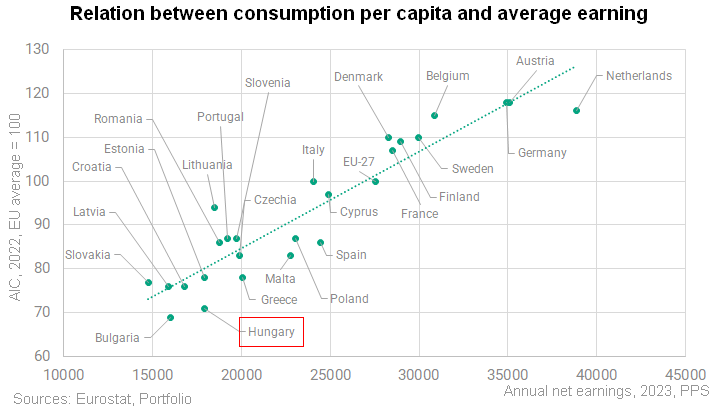
All in all, it seems that Hungary has not moved away from high-wage countries, and in terms of per capita consumption it is only ahead of Bulgaria.
Hungary continues to compete with low wage levels - against a depreciating forint exchange rate - leading to relatively slower economic convergence than investment in human capital (better training, more graduates). The total hourly wage bill of less than €13 (including taxes and contributions) is one of the lowest in the EU, which remains an attraction for companies that focus on cheap labour rather than high skills and high added value.

Based on the above, Hungary is clearly not keeping pace with the region, and its relative position is deteriorating. According to a recent report by the central bank, the country's relative development and relative productivity have also deteriorated overall in recent years compared to the countries of the region.
"As a result of imbalances and competitiveness weaknesses, the Hungarian economy has been more vulnerable to external shocks than other countries in the region," the MNB said, warning that Hungary's performance in key areas of the new decade (knowledge capital, digitalisation, green energy) is below the regional average. Major changes are therefore needed for a rapid convergence.
Cover photo: Getty Images





