Four fallacies of Hungarian economic policy


The Hungarian economy showed a disappointing performance in recent years. During the coronavirus crisis the country failed to "overtake on the bend", the energy crisis 'gifted' Hungary the highest inflation in Europe and a prolonged recession, the budget balance was severely upset and the country was a hair's breadth away from an exchange rate crisis. The government's short-term economic targets (GDP growth, budget deficit) have been consistently missed, and Hungary is slipping further and further down the EU development rankings.
Meanwhile, the main economic policy visions are getting ever closer to ground level. No one is talking about catching up with Austria by 2040 anymore, and it now seems as if we are no longer aiming to be among the five most liveable countries in the EU by 2030. In fact, by 2030 we are not even aiming to be at the EU average, but 'only' 90% of it in GDP per capita. Which is still hard to imagine in six years (from the current 76.4%).
The government has now laid down its competitiveness programme, and the vision is that there will be no new growth model, but we are proud to commit to business as usual. The programme includes new targets and recycles old objectives. These, and some of the messages that have been repeated slogan-like, show, in my opinion, that economic policy is driven by misconceptions and is focused in completely the wrong direction. Below we examine some of these.
1. Let's (not) give industry a 30% weight in the Hungarian economy!
In the 2010s, there was already a similar ambition in economic policy, under the heading of reindustrialisation, to achieve a 30% share of industry in GDP by 2020. Since then we have moved further away from that:
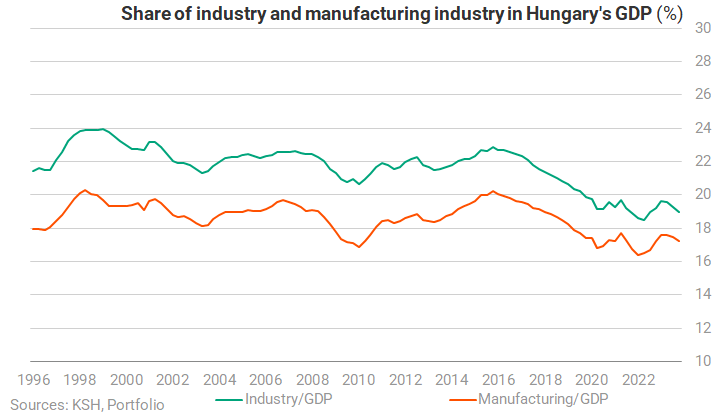
Now that this goal has been brought up again, we must stress again that it makes no sense. We have argued against re-industrialisation in several previous articles, and the arguments have not changed much since then. In fact, they have perhaps made the rationale for boosting the industry even more questionable. Instead of repeating our earlier fundamental and numerical arguments, we offer a much simpler one for consideration.
Growth in the Hungarian economy, based on the expansion of domestic resources, has largely come to an end. The labour reserve has virtually run dry, but even the possibilities of raising capital at very low cost have become more remote. We have two options.
- The first is to try to make our existing resources work on higher and higher added value activities. This would partly imply restructuring, but more importantly it means using the knowledge we accumulate in our economic activities to create more of our own value.
- The second is that, by sticking to the extensive model, we acquire production resources, labour and working capital from abroad.
Let's first look at the first option and try to integrate the industrialisation plan into it! So the basis for growth would be a shift towards higher value-added activities. These are mainly in the technology-based and skilled labour-intensive service sectors. And this is not industry. The value added of the industry's core sectors (vehicles, electronics, electrical equipment) averages around 15%. For the economy as a whole, it is 40%, in pharmaceuticals 50% and in information technology 65%.

In other words, if the question is in what direction we should try to channel existing resources, we should certainly not be thinking in terms of industrialisation, especially on a scale that represents 30% of GDP. (Now we shall not go into the huge increase in production volume needed to get from low value-added activities to 30% of GDP, and the environmental burden that this would entail.)
The other option is to carry out these low-value-added activities on the country's territory with the help of external resources, i.e. to put industrialisation at the service of an extensive growth model. We have written several times that in this case the GDP effect will be much smaller than the export effect and the national income (GNI) effect even smaller.
Let's do a simple calculation based on the example of battery capacities. Assume that the weight of battery production in 2030 exports equals the weight of vehicle production. This means that the share rises from 6% last year to 18%. (Exports in 2030 were calculated by projecting the export growth of the last seven years to the next seven years.)
The increase in export earnings of around €33 billion (based on a 15% value added ratio) will generate €5 billion of GDP. In case this seems like too big a drop, look at the graph below, which shows how the average value added of the electrical equipment sector has declined in recent years as the weight of battery production has increased:

The value added is shared between the domestic and foreign workers, the foreign capital owners and the state. Based on this, it does not seem far-fetched to assume that 60% of GDP will become GNI. A very crude calculation suggests that this level of battery factory expansion will not increase national income by even 2% - over a seven-year period.
Of course, this extremely rigid calculation can be relaxed. The mobilisation of the remaining labour reserve and the strengthening of domestic supplier activity may improve the income effect of reindustrialisation, but we can hardly expect a force that would bring the value added substantially closer to that of knowledge-intensive areas. This is also demonstrated by the experience of the last 20 years in the automotive industry, where no Hungarian-owned Tier 1 supplier has yet been found.
It is worth recalling the words of Gábor Orbán. The CEO of Richter said in an interview with Portfolio: "It's no longer enough if a host of graduate research scientists, who are considered as high added value, work for a company. If they are engaged in activities that end up adding to the intellectual capital of the parent company, the centre, then asymmetries in the division of labour will persist. The key is to bring the value created abroad back to the domestic hub. The domestic economy can only move up a level if we solve this task, this puzzle."
This idea helps us to understand the difference between the Hungarian industry and the German industry, which is regularly cited as an example of re-industrialisation. When it comes to developing, it makes a huge difference whether we compete in global value chains with our own intellectual capital, knowledge and patents, or import them from abroad.
Overall, therefore, it is not at all clear why people's well-being would increase in any meaningful way, i.e. how the brutal increase in the weight of industry would serve further convergence. So it is not clear why the state should spend thousands of billions of forints on this in the form of subsidies, tailor-made investments (energy, other physical infrastructure). Surely there would be a much better return on investment in the economy.
No country at the level of development of the Hungarian economy has got ahead by pouring taxpayers' money into low value-added assembly activities based on (foreign) wage labour.
2. Let's (not) have a 30% investment rate!
The target of using 30% of GDP for investment has been approached once, in 2022. At the beginning of this article, we briefly highlighted how (un)successful the last four years have been in economic policy, which in itself suggests that this may not be a significant success factor for the country.
As we have written about in more detail, we have paid dearly, quite literally, for the skyrocketing investment rate: much of the rise has been explained by the fact that huge orders have caused capacity constraints in the market for capital goods (and labour), making them so expensive that even less investment has cost more.

However, there is of course nothing wrong with a country having a high share of resources devoted to investment. If there are many profitable projects and a business environment that encourages their implementation, this promises higher future economic performance and greater prosperity. However, the conditions for this need to be created, which have clearly not been the case in the recent past:
- A higher investment rate has not led to faster growth. Other countries in the region have easily managed to expand at a higher pace with lower investment intensity.
- Accordingly, household incomes have not only failed to grow faster over time, they have clearly started to lag behind in relative terms. Average earnings in euro are the third lowest in the EU, and Hungary is ranked penultimate in per capita private consumption in purchasing power parity terms. This does not seem to make the investment worthwhile.
- One of the main problems is that much of the investment is poured literally into concrete by the state, meaning that the structure does not meet the needs of the technological transition. Experts of the MNB have already warned about this. They recently pointed out that construction investment as a share of GDP is the highest in the EU, while the share of investment in "smart investments" and intangible assets is low. Although the competitiveness programme addresses in general terms the need to improve competitiveness through quality investment, its specific target is "to achieve an investment rate of 30% of GDP, of which business investment should account for 20 percentage points." In other words, a significant part of the increment would stem from public infrastructure developments with dubious returns, priced, er..., generously. In other words: expensive concrete.
- An investment rate of 30% is arithmetically alarming, as much less of the income generated in a given year can be spent on household consumption. And, as mentioned above, the promise of higher future growth and income in return is uncertain to say the least. This could lead to Hungarian household consumption levels being the lowest in the EU on a sustained basis.
In other words, it makes no sense to justify a commitment to investment with preposterous quantitative targets. A country can grow nicely with an investment rate of 22-25% if those developments are smart, and you can go down a wrong path even with a 30% rate. Moreover, an investment rate that high increases the risk of an overheated investment market and the risk of poor, low-return (or even failed) investments.
3. Let's (not) aim for a zero profit balance!
It is an old topos of government policy that the profits of foreign companies operating in our country are a kind of modern exploitation, because they are taken out of country. Therefore, the goal is for us to have so much working capital (FDI) abroad ("invest abroad") that the resulting repatriated profits pull the profit balance back to break-even. According to Márton Nagy, Minister of National Economy, this requires a €6 billion improvement in the profit balance.
Undoubtedly, rich countries are typically net investors (abroad), and their national income is boosted by profits earned outside their borders. In view of this, it may seem painful that some of the profits generated in Hungary leave the country and much less is transferred home from abroad. According to preliminary data, foreigners earned about €12.2 billion from FDI here in 2023, while we earned €4.4 billion this way. It is worth noting that foreigners reinvested about half of the profits, so the real capital outflow is much lower.
The objective does raise questions, though. First, if "exploitation" hurts so much, why do we expect more (Eastern) working capital? And if we think it is beneficial for us (as Prime Minister Viktor Orbán says), why is this phenomenon so painful? In general, it can be said that significant imports of working capital are beneficial up to a certain level of development, then as the need (and knowledge) to engage in higher value-added activities in world trade through our own efforts increases, the need for foreign-owned capital and the associated knowledge imports becomes less and less.
In other words, the process of turning into a capital exporter from a capital importer is a natural phenomenon that comes with development. It is thus a consequence rather than a cause of national success.
The graph below shows the evolution of the net investment position in some countries of the region (not only FDI, but any other form of capital), which suggests that we are not the only ones that have not yet reached "net zero".

It is worth noting that we are still far behind in terms of working capital exports compared to the stock of FDI operating domestically, so "zeroing out" is not expected in the next few years.

Another question is: if there are so many investment opportunities in the country that the investment rate could climb to 30% (see previous point in this article), why would so many people seek investment opportunities abroad? This can be coveted by companies that realise Hungary is too small a market for them.
- Either because the domestic market is saturated,
- or at least the expected return is no longer as high as in an external market,
- or the internal resources (e.g. labour) of an already export-oriented firm are not sufficient for further expansion.
This can be done by so-called 'national champions', which the government is very committed to creating - but so far not very successfully.
State aid is not beyond the pale, but on the one hand it does not promise much success if the company is not competitive by international standards, and on the other hand it is unnecessary to sell it in voluntaristic packaging such as the goal of zeroing the profit balance.
4. A word about the excellent economic structure
Hungarian economic policy makers tend to highlight two indicators that show the very healthy structure of the economy. The first is the Economic Complexity Index (ECI), which was very popular in the world a few years ago, and Hungary scores very well on it.
This is how the MNB has presented the index in the past (pdf): "They look both at the state's trade links and the prevalence of products produced in the economy. By combining the two, the ECI can show the economic strength of a country derived from its export diversity and product quality."
In other words, if a country produces a wide range of products (some of them rare) and enters world trade, it is a complex economy. Although the central bank also indicates that the ECI is not an income indicator, it still concludes that the index "shows the expected catching-up rate based on the gap between economic complexity and per capita income, as a country converges in the long run to the income group that is also in sync with its productive knowledge base."
In this interpretation, economic complexity is the factor that can make a country successful. (Exactly how high a ranking is sometimes varies retrospectively, but whether we accept the 8th, 11th or 14th spot, it is a good result in any case.)
However, if we look at the evolution of the indicator over time, we may be uncertain about the predictive power of this type of indicator.
Economic Complexity Index (ECI)

In the ECI list, we can see high rankings even with relatively low development and vice versa, and more importantly, the direction of change does not necessarily reflect high predictive power (one need only look at the United States or the Netherlands, but one could also mention Australia or Qatar.)
In our view, the indicator of economic complexity is indeed an interesting indicator, but it captures only one (important) dimension of economic success, and a high ranking is no guarantee of rapid convergence. From our point of view, its most important shortcoming is that it cannot examine the extent of domestic knowledge and added value in the range of products offered by the country. There are approaches that try to make up for this, for example by measuring other dimensions of complexity. Thus, in addition to the complexity of commerce, such gauges also rank on the basis of patents and research publications. In these, Hungary is already outside the top 30, and probably because of the very shortcomings we have described above, and which are also the shortcomings of the other structural indicator. This second indicator is the share of high-tech products in industrial exports.
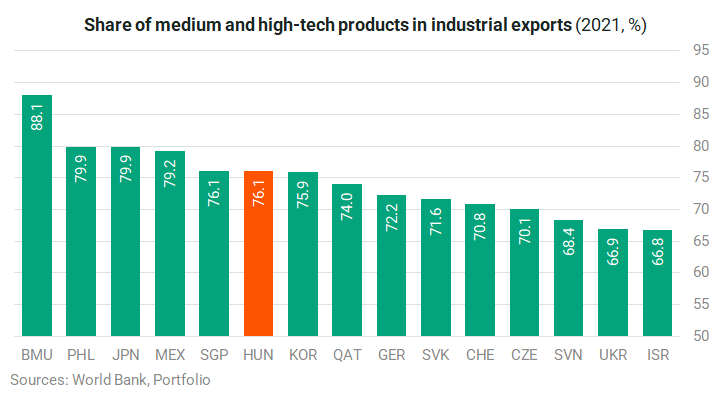
The graph shows how Hungary's high ranking, which puts its ahead of even Germany, looks like a paltry success when Bermuda, the Philippines and Mexico are ahead of us. This indicator also fails to capture a very important aspect of progress, the success of the shift from assembly to knowledge-based, high domestic value-added exports. If, for example, domestic battery exports explode in the coming years, this indicator will rise even if Hungary's average domestic value added of exports diminishes.
According to the OECD's Trade in Value Added (TiVA) database, in 2020, the value added generated abroad accounted for 46% of Hungarian exports. The share was 38% in the Czech Republic and 29% in Poland.
This suggests that a country on the borderline between an efficiency-driven and an innovation-driven economy, globally developed but (still) lagging behind the most developed countries (and even slightly less developed, judging by the data), can do well on both indicators. These indicators are designed to demonstrate virtues that are often necessary but not sufficient conditions for joining the group of the most advanced economies.
It is okay to be happy with these indicators. But it is easy to become an inconsequential chest-beating if we do not realise that these results are essentially the result of the production plants of foreign multinationals operating in Hungary, and that efforts to ameliorate this situation have so far yielded modest results.
Overall, neither industrialisation focusing on volume nor investment poured into concrete can guarantee successful catch-up with high-income, innovation-driven economies. Hungary's growth model and the quantified targets derived from it do not serve to make value added more dynamic. A new mindset is required.
Cover photo: Getty Images





