Hungarian gov't pleased with fuel price cuts, will not intervene for now


Fuel traders have adapted to the government's request, complied with it and brought their prices closer to those in the region, said Nagy.
He pointed out that the average price of 95-litre petrol was HUF 34 per litre lower than the peak seen in April (actually it will be come Friday), a drop of more than 5%, while the average price of diesel was (again, will be) HUF 54 forints lower than the peak seen in February, a drop of more than 8%.
Before the government starts another chest-thumping, se should note that price comparisons should not be made between current and peak prices this year. Economy Minister Márton Nagy warned fuel traders on 25 April they had two weeks to bring their prices closer to the regional average. Since then the price of petrol has been reduced by HUF 23 and the price of diesel by HUF 21.
Portfolio was the first to point out that the new benchmark created by the Central Statistical Office (KSH) at the cabinet's request, i.e. a regional average price, for a potential government intervention did not use the best possible methodology, as it included prices in the wider region - Czechia, Poland, Bulgaria - where Hungarian motorists would not go to fill up their tanks. We suggested the use of the average of neighbouring countries and so did industry experts. For once, the government paid heed to said recommendations and decided to use the average price for the neighbouring countries (bar Ukraine) as the benchmark for its price comparison.
Nagy said the KSH will remove Bulgaria, Czechia and Poland from its calculation.
The government concluded at its meeting today that with the current reductions we have reached the average price in neighbouring countries,
he told a press conference today.
There is order, but it must be maintained. The government still expects traders to maintain it. Every two weeks the government will take a look at these prices. Coordination and cooperation has been sufficient, Márton Nagy said at the event, meaning that no new measures or steps, such as the price freeze, have been announced.
Traders can absorb these cuts in profit margins,
he opined.
Before the announcement, two scenarios seemed likely: the current announcement (that there would be no substantial change in the government's behaviour) and a flexible price regulation. The latter would have been essentially ineffective, as Hungarian prices have slumped to the level of the average price in neighbouring countries considered as reference prices. So there is no surprise, and traders can breathe a sigh of relief, at least that they are not being hit with a hard, inflexible price control. True, the price of this was a 'voluntary' reduction in their margins. Voluntary = "You cut your prices or we'll cut them for ya!"
The KSH will publish its price comparison on Friday, using European Commission data to be released on Thursday. We're a bit faster than that.
According to the EC's Weekly Oil Bulletin, the average petrol price for Hungary's neighbouring countries (including Hungary) was HUF 629 per litre as of 6 May, which was HUF 3 or 0.5% lower than in Hungary. Hungary's average diesel price of HUF 614 per litre was HUF 5.5 or 0.9% lower than the HUF 619 average.
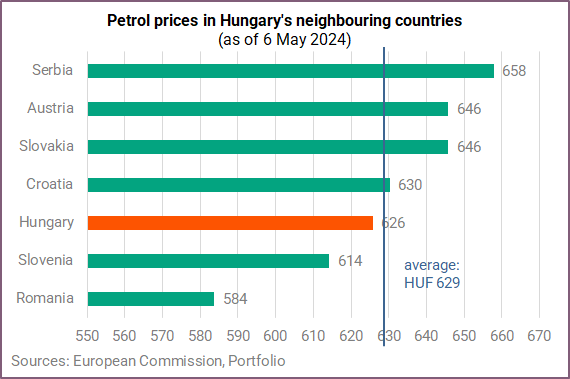
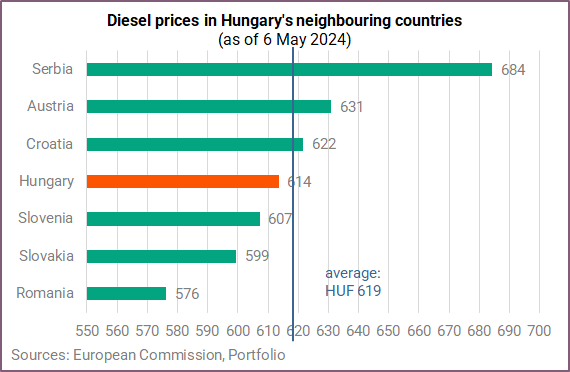
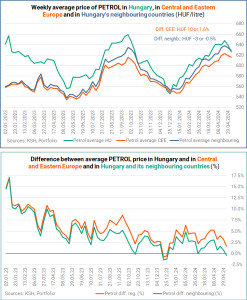
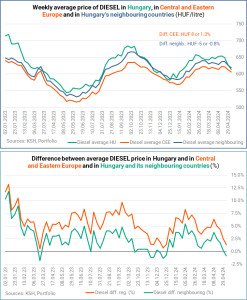
The graphs below clearly show the huge difference between the two methodologies. When compared to the average of the wider region (in which the KSH does not include Hungary, though), Hungary's average petrol price would still be HUF 10 or 1.6% higher, while the price of diesel would be HUF 8 or 1.3% higher. The averages of the neighbouring countries are already higher than domestic prices, as shown above too.
Cover photo: MTI Photo/Zoltán Máthé





