Disinflation is over for a while in Hungary


The stalling of the decline in inflation can be attributed to several factors. Firstly, the period of large repricing ended in the first quarter of last year, with April no longer seeing the kind of price hikes that could have been easily undershot this year (the 12-month price index would have fallen in that case).
Secondly, the rise in fuel prices brought a fresh momentum in price dynamics. Thirdly, the retrospective pricing behaviour of several large players in the services sector (e.g. telecoms and the financial sector) means that another round of price increases is rippling through the economy after the inflation shock has already subsided.

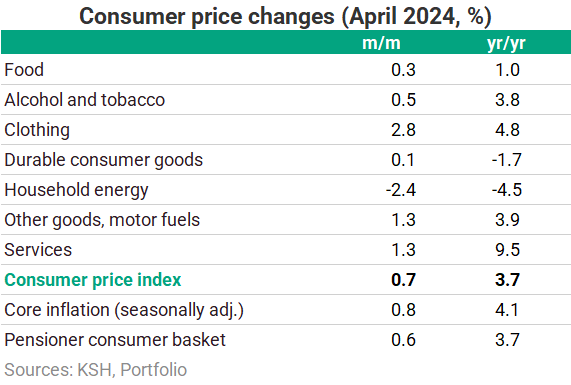
Looking at the detailed data, the inflation picture is rather mixed. Price pressures remain subdued in many areas, but there are some warning signs. For example, month-on-month core inflation is still 0.8%, which does not at all indicate that price developments in line with price stability (the 3% inflation target) are taking place in the country.
This is also underpinned by the fact that the April inflation turnaround occurred despite the fact that the "virtual" fall in gas prices even put a brake on inflation. Also uncomfortable is the fact that the services sector has increased its prices by a further 1.3% in a month. The big hike in telephone and internet companies in March carried over to April to some extent, with cinemas also raising their prices and the KSH statistics also show significant increases in the obscurely named "other services" group.
The much better news is that food prices remain broadly stable (although the 0.3% m/m increase is perhaps slightly higher than expected), and the import price impact of the March-April forint depreciation is still not visible for consumer durables.
The short-base core inflation indicator also reflects the much stronger repricing behaviour in the first third of the year compared to the price stability situation. According to our calculations, the price developments of the last three months are more consistent with an inflation environment of 5.5%.
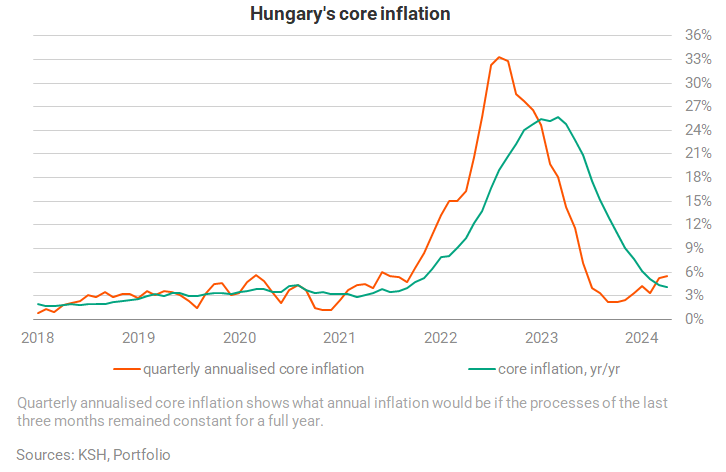
In the coming months, we can expect the already intense repricing activity at the beginning of the year to subside. However, this does not mean that the inflation rate will start to fall again. Indeed, last year - especially in the second half of the year - inflation almost disappeared from the economy as a result of the recession and the fall in energy prices. And low bases are slowly pushing the 12-month indices higher month by month.
The headline index is expected to be above 4% soon and could reach 5% by the end of the year. This seems logical, as while the situation in most parts of the economy is indeed close to price stability, the sharp hikes in services prices will have a upward impact on the inflation rate throughout the year.
Today's data will certainly not prompt the National Bank of Hungary (MNB) to reconsider its monetary policy stance. The base rate, which was cut below 7% in June, can no longer be considered extremely high in terms of the real interest rate (calculated in either a forward-looking or a backward-looking approach), given the inflation rate creeping back to 4-5%. It is not surprising, therefore, that the central bank has sent a strong signal several times recently that interest rate policy will be much more subdued in the second half of the year, with only a few small rate cuts.
This is to be expected, not least because the MNB has repeatedly indicated the mix in which it sees the 3% inflation target being achieved next year. If the pricing of services is so inconsistent with price stability, then low inflation should be imported. And the key to low imported inflation is a strong forint, which requires an appropriate interest rate premium for investors.
Detailed figures
Over a month, food prices rose by 0.3% on average, including seasonal food (potatoes, fresh vegetables, fresh domestic and exotic fruit) by 1.5%, chocolate and cocoa by 1.3%, restaurant meals by 1.1%, eggs by 1.3%, bologna and other sausages by 0.9%, milk by 0.8%, dry pasta and sugar by 0.7%-0.7%.
The biggest increase was in clothing, up 2.8% (a typical seasonal phenomenon, the effect of the spring collections hitting stores). Services rose by 1.3%, including domestic holidays by 2.2%, home repairs and maintenance by 0.9% and rents by 0.8%. The price of household energy fell by 2.4%, including 4.5% for piped gas. The latter, in addition to the fixed official prices, is calculated by the KSH on the basis of household consumption: if it sees a larger proportion of households escaping the seven-fold price band, it reports a fall in the average residential price. The price of vehicle fuel has risen by 3.5%.
Looking back over a year, food prices rose by 1.0%, with the most important increases for sugar (30.4%), snacks (9.6%), chocolate and cocoa (9.2%), pork (9.2%), restaurant meals (8.4%) and non-alcoholic beverages (5.8%). Within this product group, the prices of eggs fell by 20.3%, flour by 19.7%, dry pasta by 12.5%, cheese by 9.6%, milk by 9.3%, bread by 9.0% and poultry meat by 6.5%.
Service prices went up by 9.5%, including rent +14.0%, housing repair and maintenance +10.7%, vehicle repair and maintenance +10.1%, tolls, vehicle rental and parking +9.8%, sports and museum admissions +8.2%, holiday services +5.4%, while travel to work and school cost 21.7% less.
Prices of alcoholic beverages and tobacco rose by 3.8%, including tobacco by 4.3%. Prices of medicine and pharmaceutical products increased by 7.3%, washing and cleaning products by 3.8% and personal care articles by 2.1%. Household energy was 4.5% cheaper, including -9.2% for piped gas and -2.9% for electricity. The price of durable consumer goods fell by 1.7%, of which used cars dropped by 9.8%, kitchen and other furniture by 4.5%, heating and cooking equipment by 3.5%, new cars by 2.7% and household furniture by 2.3%. The price of motor fuels was up by 6.6% yr/yr.
Cover photo: Getty Images





