Commission sees Hungary overshooting new budget deficit target, public debt rising in 2024


From recession to gradual recovery
After contracting by 0.9% in 2023, Hungary's GDP is forecast to grow by 2.4% in 2024 and 3.5% in 2025. Consumption is set to be lifted by strong real income growth, supported by the resilient labour market and above-inflation hikes of pensions and minimum wages in 2024.
Investment is set to be held back in 2024 by fiscal consolidation efforts and an overcapacity of commercial real estate. It is projected to rebound in 2025, driven by rising capacity utilisation, large FDI-financed projects, and government support schemes for the purchase and renovation of dwellings.
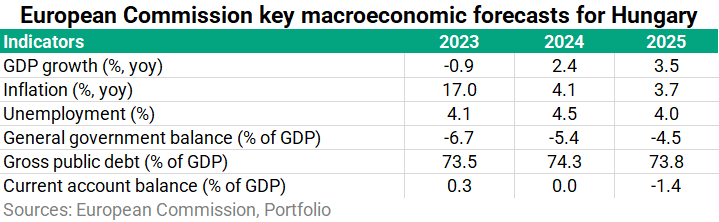
Exports are set to be bolstered by the recovery of global demand and the ongoing FDI projects. However, rising domestic demand is expected to boost imports and revert the current account balance from a small surplus in 2023 to a deficit of 1.4% of GDP by 2025.
Real wages set to grow fast
In the face of declining output in 2023, companies mainly reduced working hours instead of laying off employees, but the unemployment rate still rose to 4.6% in 2024-Q1. The labour market remained tight overall, although this was somewhat eased by rising participation and an inflow of foreign workers. As the economic recovery gathers speed, working hours and eventually employment are set to rise, reducing the unemployment rate to 4.0% by 2025.
Against a background of rising labour demand, real wages are projected to rise dynamically in 2024 and 2025. Nominal wage growth is set to ease in 2025, once the impact of the 15% minimum wage hike in December 2023 wears off.
Inflation to slowly decrease further
HICP inflation fell from its peak of 25.9% in 2023-Q1 to 3.6% in 2024-Q1, as the impact of earlier energy and food price increases faded, and consumer demand dropped. However, HICP excluding energy, food, alcohol and tobacco remained elevated at 6.1% in 2024-Q1.
High wage growth, stronger consumer demand, and backward-looking price setting in certain sectors, are maintaining inflationary pressures in 2024.
These are expected to ease only gradually in 2025. Excise duty hikes and a higher retail tax also contribute to inflation in 2024. Overall, HICP inflation is projected to ease from 17.0% in 2023 to 4.1% in 2024 and 3.7% in 2025.
The economic outlook is surrounded by significant uncertainty. Fiscal consolidation efforts could weigh on GDP growth but they might also result in higher inflation.
At the same time, a faster-than-expected rebound of private consumption or further large minimum wage increases could raise both GDP growth and inflation.
Budget deficit set to remain elevated
The budget deficit rose to 6.7% of GDP in 2023, up from 6.2% in 2022. The large budget slippage can be attributed to the underperformance of revenue, reflecting weaker-than-expected economic performance, and to expenditure overruns, in particular on interest, pensions and public wages.
In 2024, the deficit is forecast to decrease to 5.4% of GDP, driven by the recovering economy and by lower projected subsidies to utility companies to cover their losses from regulated energy prices.
The government's deficit target for this year is 4.5% of GDP.
The net budgetary cost of measures to mitigate the impact of high energy prices, including the windfall profit taxes collected from the energy sector, is estimated to fall from 1.6% of GDP in 2023 to 0.9% in 2024 and 0.4% in 2025. Labour tax revenue is set to grow rapidly on the back of robust wage growth.
At the same time, property income is projected to fall in 2024 in line with lower interest rates and lower projected dividends of state-owned enterprises. Primary current expenditure is expected to grow slightly below nominal GDP, while interest expenditure is forecast to increase. Capital expenditure is projected to remain subdued in line with some announced postponements in nationally financed public investments.
In 2025, the deficit is projected to narrow to 4.5% of GDP based on unchanged policies, supported by the further improving macroeconomic outlook. The planned phasing out of the sectoral and windfall profit taxes in 2025 is estimated to lower revenue by 0.5 pps. of GDP. Expenditure growth is set to be contained in 2025, as subsidies will continue to decline and the interest expenditure is forecast to decrease due to lower coupons on inflation-linked bonds.
The debt-to-GDP ratio fell slightly to 73.5% in 2023. The strong debt-decreasing impact of high inflation was offset by the high interest expenditure, negative primary balance and borrowing by the national development bank to finance its lending schemes.
Debt is projected to rise to 74.3% of GDP in 2024, driven by lower nominal GDP growth and a high budget deficit, before falling again to 73.8% in 2025.
Cover photo: EU





