Hungary remains close to the very top of EU inflation ranking


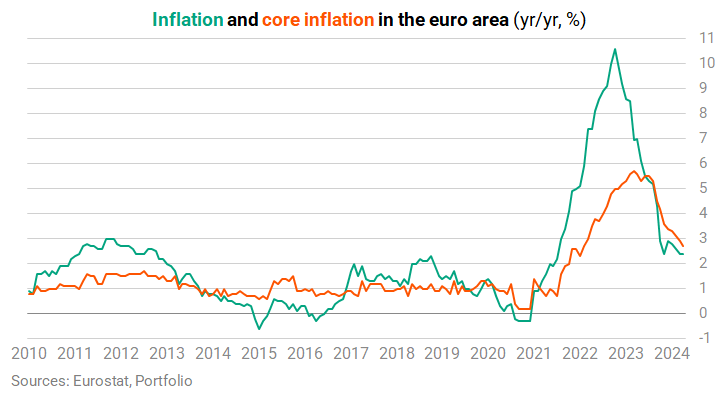
The euro area annual inflation rate was 2.4% in April 2024, stable compared to March 2024 and in line with the preliminary estimate. A year earlier, the rate was 7.0%. Eurozone inflation is falling rapidly, creating an opportunity for the European Central Bank to start cutting interest rates in June from historic high of 4%.
In April 2024, the highest contribution to the annual euro area inflation rate came from services (+1.64 percentage points, pp), followed by food, alcohol & tobacco (+0.55 pp), non-energy industrial goods (+0.23 pp) and energy (-0.04 pp).
In the EU, the annual inflation was 2.6% in April 2024, stable compared to March 2024. A year earlier, the rate was 8.1%.
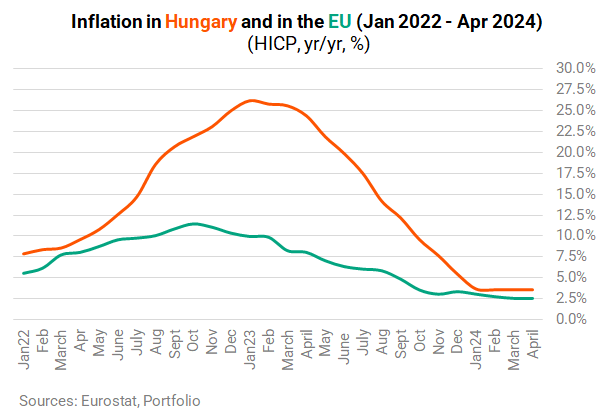
Hungary's HICP was the highest in the EU between August 2022 (19.0%) and October 2023 (9.6%). Since then, especially since January this year, it has been well behind the worst performers.
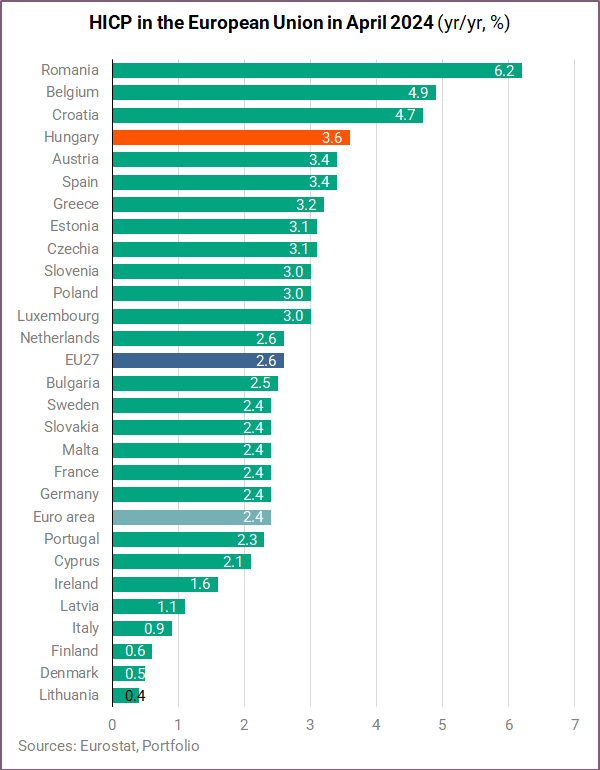
The 3.6% HICP calculated by Eurostat is a tad lower than the Hungarian Central Statistical Office's (KSH) 3.7% yr/yr CPI calculated for April. This is well below the 6.2% inflation recorded in Romania that has been on top of the HICP rankings for the fourth consecutive month. The latter figure, however, still marks a drop from 6.7% in March.
The lowest annual rates were registered in Lithuania (0.4%), Denmark (0.5%) and Finland (0.6%). The highest annual rates were recorded in Romania (6.2%), Belgium (4.9%) and Croatia (4.7%).
Compared with March 2024, annual inflation fell in fifteen Member States, remained stable in four and rose in eight.
Analysts expect Hungarian inflation to rise slightly to above 5% by the end of the year, but in the coming years it could be close to the 3% target the central bank wants to see.
Regional comparison
HICP - All items
You will find two types of charts below. The upper ones compare inflation in Hungary and in the EU between January 2022 and April 2024. The lower ones put Hungary on a regional map so to speak, but on a shorter period: between August 2022 (when consumer prices really started to take off in Hungary) and April 2024.
In the CEE region, Hungary had the highest HICP until November last year, when Czechia took over (8.0% vs. Hungary's 7.7%). In April, Hungary's annual inflation rate was the fourth highest among the eight EU members states selected, with lower rates found in Austria (3.4%), Czechia (3.1%), Slovenia (3.0%), Poland (3.0%), and Slovakia (2.4%) in the region.

Food, non-alcoholic beverages
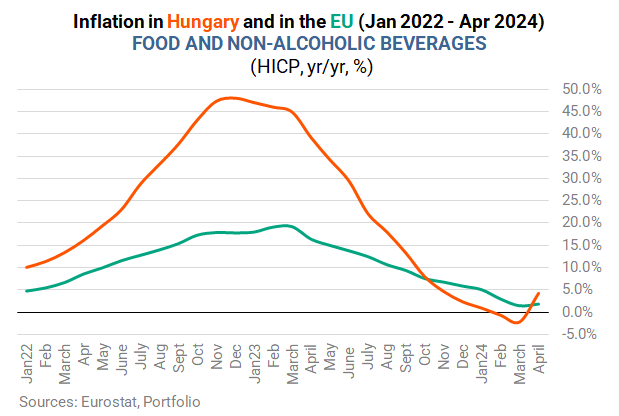
The turnaround in the region came about in October 2023, when Hungary's food inflation (8.0%) was no longer the highest in CEE, with Poland (9.2%), Slovakia (9.0%), and Croatia (8.9%) reporting higher figures. Hungary's yr/yr index in April came in at 4.3%, which was the highest in the region again after a 2.1% fall in March. Food inflation in April last year was still at a whopping 39.1%, although a lot lower than the Dec22 peak at 47.9%.

Alcoholic beverages, tobacco
Hungary's HICP in this product group was still well over the EU average in January, but dipped under it in February and remained lower in March (HU: 4.1%, EU: 5.4%) and in April too (HU: 3.5%, EU: 5.5%). The price increase in this product group peaked at 20.4% in April 2023.
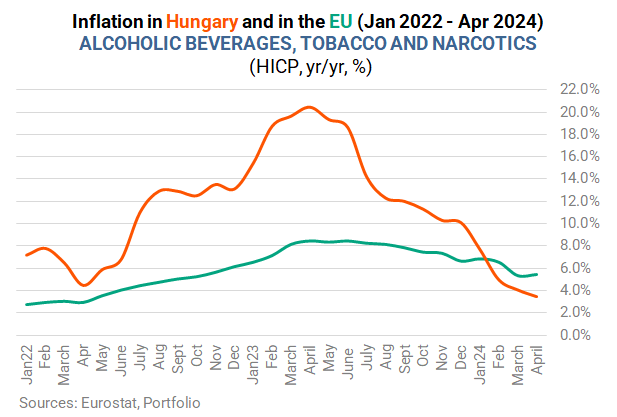
In a regional perspective, Hungary lost its top ranking only in January this year, and the April print (+3.5%) was already the second lowest behind Austria's 3.1%.

Transport
Following a 5.1% drop in January, a humble 0.5% fall in February, transport prices in Hungary rose 2.3% in March and 3.3% in April, while the EU average dropped to 1.7% from 2.0% in March. Note that the index was extremely high a year ago (+25.4% in Jan, +22.6% in Feb, +20.1% in March, and +19.6% in April 2023).
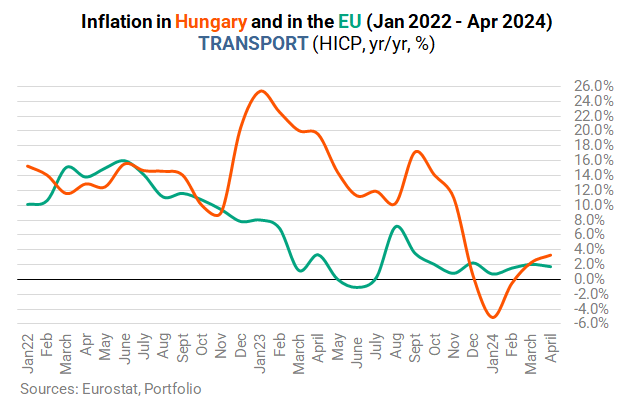
The yr/yr change in transport price was negative last month only in Poland (-0.8%) and Hungary's reading was not among the highest (e.g. 6.9% in Slovakia and 5.5% in Romania, 5.1% in Croatia).

Restaurants and hotels
Hungary's annual index in this category hit its lowest at 7.6% in April after peaking at 31.5% in March last year. The EU average also fell further to 5.2% from 5.6% in March.
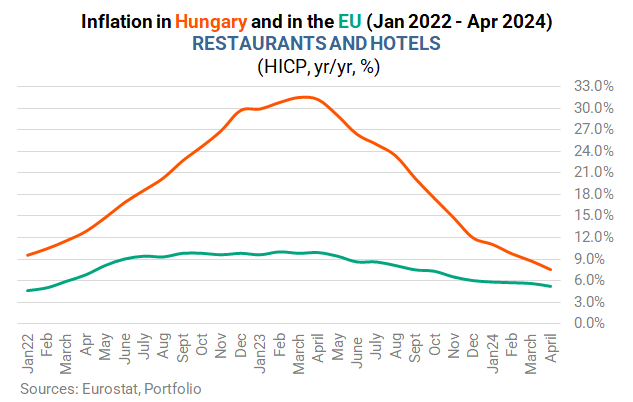
Hungary was on the 1st spot in November and on the 3rd in December in the CEE ranking, but snatched the 'silver medal' in January (11.1%) and again 'bronze' in February (9.8%) and March too (8.8%, behind Croatia and Romania (both 11.4%). The 7.6% April print was the fourth lowest in the region, with Romania (11.6%) and Croatia (11.2%) on top.

Recreation and culture
The gap between the annual change in prices in this category Hungarian and EU widened to nearly 13 percentage points last April, but it narrowed to only 2.3pps by April this year.
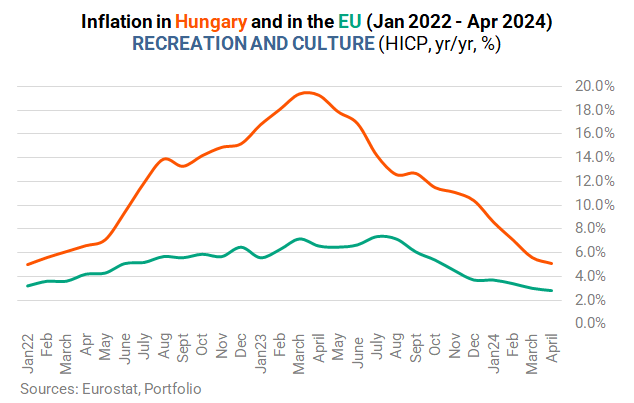
In this category, Hungary has not 'given up' its leading position in CEE until February when it finished 1.4ppts lower than Romania which has been the runner-up since September. Hungary finished 2nd also last month, and the gap widened to 2.3ppts (HU: 5.1%, RO: 8.4%).

Services
Services inflation peaked at 19.1% in Hungary in April 2023, more than three times as high as the EU average (6.1%). Since then the Hungarian figure has been constantly dropping. The April print shows further moderation both in the EU (to 4.4% from 4.1%) and in Hungary (to 8.8% from 9.4%).
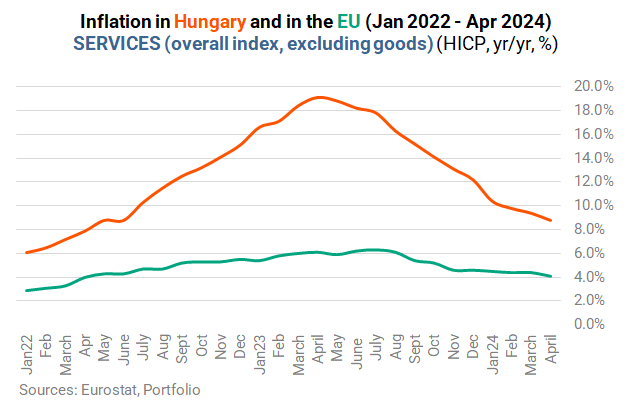
In regional terms, Hungary has just been dethroned by Romania where services inflation eased to 8.9% in April from 9.1% in March, while the Hungarian print came in at 8.8% after 9.4% in March.

Cover photo: Getty Images





