Hungary public debt at nearly two-year high


The central bank's Q1 2024 financial accounts statistics were released today, revealing three interesting macro developments.
1. Rebound in public debt
By the end of the first quarter, Hungary's public debt-to-GDP ratio had jumped to 75.9%. The ratio was last higher in the second quarter of 2022. Based on the latest data, it is quite likely that at the end of last year an old tradition of "managing" the public debt indicator at the end of the year returned.
The most interesting aspect of government debt is the level at the end of the year (partly because of the debt rule and partly because there are more one-off effects during the year that make it worth focusing on the year-on-year change), and when government debt does not really want to fall at the end of the year, the government uses its "room for manoeuvre" to temporarily adjust the figure a little by various small or large fiscal operations.
This was common practice in the first half of 2010 and could well be back now. For this year, too, it is difficult to calculate a declining debt ratio based on macroeconomic parameters, so similar tricks may be used now.

2. Budget deficit declined but remains high
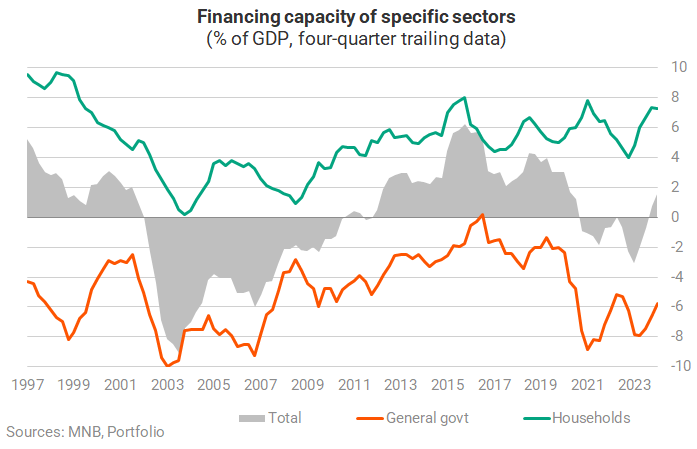
The general government deficit as a share of GDP was 6.5% in the first quarter, according to seasonally adjusted data. This is the highest of the past 12 months, but lower than at the beginning of last year, bringing the four-quarter rolling deficit to 5.7%.
Of course, this is still very high, and there are risks that this year's 4.5% of GDP deficit target will be missed, but there is a chance that the situation will automatically improve as the economy recovers. This would be necessary, because it is hard to imagine that the government would be willing to make substantial adjustments in the year before the 2026 election.

3. Households to the rescue of Hungary's external balance
Households' propensity to save remains very high, averaging 7.3% of GDP over the last year (net lending of households leading up to Q1 2024 totalled HUF 5,601 billion). This means that the combined financing position of government and households is positive at 1.6% of GDP. So together, these two sectors contribute to improving the external balance. The financing capacity was last this high four years ago.
In the medium term, an improvement in the external balance will require a correction in the general government balance, as the pick-up in economic growth will raise import demand for household consumption and corporate investment. In other words, if rapid growth is to be achieved in a sustainable way without deteriorating the external balance, public finances will need to be disciplined.
Cover photo: Getty Images





