Hungary has overtaken Slovakia in economic development - but are the figures accurate?


International comparisons of the performance of the Central and Eastern European economies have become particularly hot topics these days, mainly because of news reports about the relative decline of the Hungarian economy in the region.
In terms of the most popular development indicator, GDP per capita at purchasing power parity, Hungary was the regional leader after the change of regime and at the time of EU accession, and our lead over Romania and Poland was considered significant then, but it has now disappeared. It is a bit lost on the public, but it is worth stressing that this is not because Hungary has stalled, but because we have been catching up rapidly with the EU average in recent years, whereas many countries in the region have been growing even faster than us. The whole CEE region has shown significant convergence, except for one country whose catching-up has slowed down spectacularly according to official data:
Slovakia, which has fallen behind the EU average in recent years.
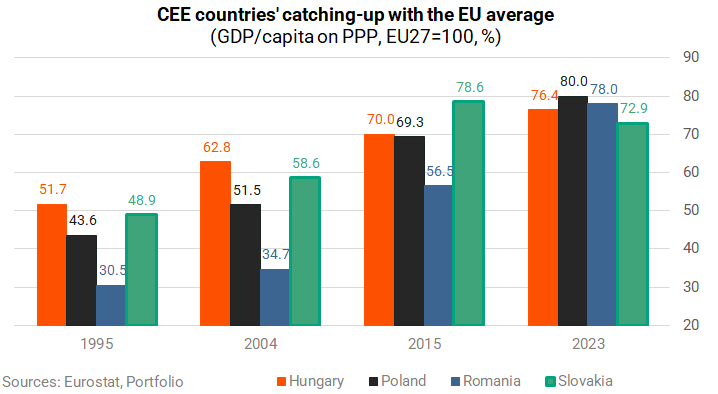
This leaves Hungary's northern neighbour alone in a narrow region on a downward trajectory, moving away from the EU average, while the rest of the world is catching up. Put more simply, it means that Slovakia, unlike the other countries (including Hungary), is becoming less developed within the bloc.
If this is the case, then the pessimism about the economic outlook in Slovak public discourse is well-founded, and the outlook is indeed dire. But the fact is that we have no idea how Slovakia is performing in terms of development, because the above figures simply beggar belief.
Something is clearly wrong with the Slovak numbers
As already described, the above comparison is based on GDP per capita measured at purchasing power parity (PPP). This is the development indicator most preferred by economists, as it shows how added value per capita, taking into account price differences, compares with the added value per capita of another country measured at PPP. Its advantage over the other popular development indicator, GDP per capita at current prices, is that it eliminates differences in price levels and exchange rates between countries.
As economist Gábor Oblath has pointed out on several occasions, GDP per capita calculated on PPP is suitable for comparing the relative development of countries at a given point in time, but not for time series analysis. However, Oblath concludes that if the GDP per capita level of one country measured at PPP has increased significantly between two points in time, then in some sense - which needs to be clarified - there has been an increase in the relative real level of the less developed country. However, the economist has repeatedly pointed out that Slovakia's perceived lag in PPP GDP per capita (at least in terms of size) hardly reflects reality. All things considered, the Slovak data may be suspicious even without serious research,
as there is no evidence for such a degree of Slovakian backwardness other than the much quoted indicator.
The first striking sign is that, while the GDP per capita indicator adjusted for price differences and exchange rate differentials has declined in Slovakia relative to the EU, Slovak real GDP growth (i.e. growth adjusted for the deflator, not PPP) has slightly exceeded the EU average GDP growth over the same period.
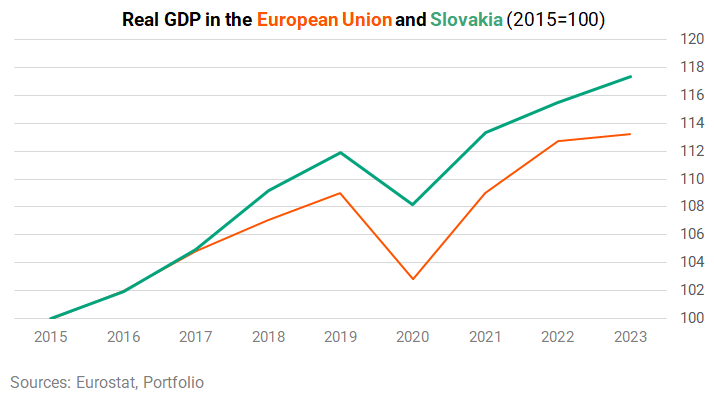
It is also noteworthy that nominal GDP per capita in euro terms has not fallen behind the EU average, and looking at the current price index, it appears that the catching-up with the EU average has continued - at a slow pace - but has stalled only in purchasing power parity terms. In the latter, the catching-up is largely due to the fall in the growth rate from 2015 to 2016.

In fact, if we look at the current price figures in time series (the nominal indicator is more appropriate than the PPP indicator), Slovakia is not lagging behind the region in that it still has the closest GDP per capita in euro terms to the EU average of the countries surveyed, with the highest added value per capita in euro terms. Slovakia's lead is narrowing, but there is no relative catching-up in this indicator.

Since the growth of nominal GDP per capita consists of two parts (volume and price growth), if there is a relative decline in the PPP index with a relative increase in the nominal index, the only way in theory that can happen is that the volume of output falls while the price rises relative to the rest of the world. In other words, if we accept the figures above, the situation would be that the average Slovakian resident produces less than the average EU citizen, but more expensively than years ago.
And this brings us to the crux of the matter: something is known to have gone wrong with the calculation of relative price levels in Slovakia.
At some point, someone got something wrong
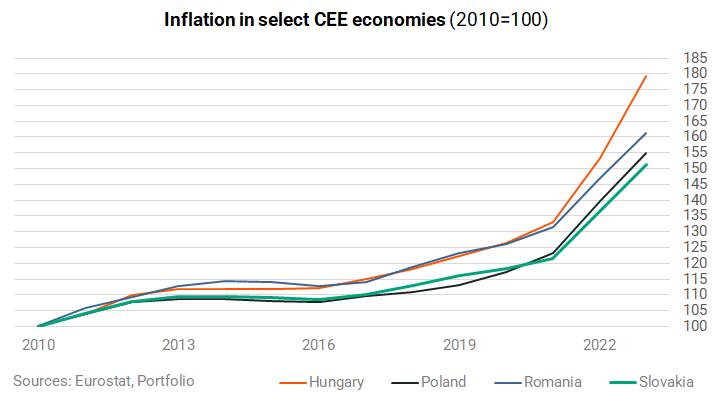
To make the surprising difference between nominal and PPP GDP per capita regional rankings real, price levels in Slovakia would have had to rise much faster than in the other countries. Looking at consumer prices, we do not see such a change: since 2010, Slovakia has had the lowest repricing of all the countries surveyed. Although consumer prices do not directly translate into changes in purchasing power parity, such a permanent disconnect is unrealistic. The fall in consumer inflation is also linked to the fact that the Slovak economy slowed down during this period (but still exceeded the EU average).
If we look at the Eurostat database, the problem becomes striking when we look at purchasing power parity. Most of all, it is housing that screams that something is wrong with the figures. Housing costs (including household energy) jumped from 46.2% in 2015 to 68.1% of the EU average in 2016. Meanwhile, the same costs fell more in Slovakia that year than in the EU. Assuming that the domestic price change was measured correctly by the Statistical Office Of The Slovak Republic (Štatistický úrad Slovenskej republiky),
there must have been something that happened when the relative price level was set that caused the Slovak price level to jump suddenly compared to the European average.
Since nominal output had to be corrected for higher prices from one year to the next, the result was that GDP per capita at purchasing power parity fell from one year to the next. Higher prices have therefore resulted in Slovakia producing less per capita GDP in real terms than before, compared to the EU average. It was then, after the change in methodology, that Hungary overtook Slovakia in the most important development indicator.

If one looks at the Hungarian figures, there is no such change in this period. While in 2015 the differences in relative price levels between Slovakia and Hungary were roughly in line with the difference in development between the two countries at that time (the well-known and often proven Balassa-Samuelson effect shows that the price level of the more developed country is higher than that of the less developed one), by 2016 the Slovak price level had become out of line with the Hungarian one.

We have reported (and not only us) to the statistical office that there are problems with the data,
Mihály Horváth, Chief Economist of the National Bank of Slovakia (Národná banka Slovenska, NBS) and former Minister of Finance, told Portfolio.
The Slovak Statistical Office implemented a methodological change in 2019, which included a revision, and as this can only be done for three years backwards, there is a break between 2015 and 2016. It is therefore certain that one of the two methodologies for measuring price levels does not reflect reality. At this point, three things are possible:
- either the Slovak Statistical Office calculated the relative price level correctly before 2016, in which case Slovakia's relative development did not fall;
- or they measured it incorrectly until 2015, in which case the country was not as high as in the previous rankings;
- or they underestimated the relative price level before 2015 and overestimated it after 2016, incorrectly in both cases.
In our view, the first scenario is the most likely.
On the one hand, relative price levels between Hungary and Slovakia were closer until 2015, which is typical for countries with similar levels of development. In the second case, Slovakia is unrealistically expensive for its level of development, which is less understandable. The first scenario seems plausible even if we start from nominal development rankings: it is highly unrealistic that while Slovakia has the highest (and growing) GDP per capita in current prices relative to the EU average, it has the lowest (and falling) GDP per capita in PPP terms.
I find it hard to believe that housing prices in Slovakia are at 95% of the EU average, while the Czech average is only 72% and the Hungarian average is 47%,
Oblath told HVG after the data revision (the data has since been revised once more, but more on that later). The economist notes in the study cited above that "recent revisions to the country's PPP data are extremely hard to believe."
As Horváth succinctly explains, the Slovak Statistical Office, under pressure from Eurostat, switched from the user cost method to the stratification method for the calculation of rents in 2019 (for three years at a time). The former is a bottom-up summation of the various housing-related costs from different data sources, while the latter tends to follow market prices. There is a huge difference between the two. There has been no methodological change for housing. In the so-called imputed rent category (for owner-occupied housing), the intermediate consumption item (which mainly covers renovation and insurance costs) was not calculated before 2016.
It is clear that something went wrong in the count. Mihály Horváth told Portfolio that we do not have enough information to call what happened a mistake. "The problem could be that there is no standard methodology for estimating housing costs, for example, and different statistical offices have different ways of doing things. This ultimately makes it difficult to compare the figures internationally," he added. He notes that the Slovak housing costs, which are higher than those of the Czech Republic, could theoretically be the result of the Czechs miscalculating their own price levels.
So what is certain is that at some point someone got something wrong, and that some of the data on Slovak purchasing power parity before 2015 and after 2016 do not reflect reality. But whether Slovakia is measuring the data correctly or the other countries are, and if the miscalculation came from Slovakia, whether the figures before or after the methodological change should be accepted, is anybody's guess. And we have even fewer clues as to what exactly is causing confusion in the data. Horváth says it would be welcome if the data revision did not only cover three years backwards, because then there would be no break in the data. We would like to add that this would only be a real solution if we accept that the figures are accurate after the 2023 revision (i.e. the second), but there are questions about this too.
Portfolio has sent a request for detailed data to the Slovak Statistical Office, but have not yet received a reply. When we receive them, we will of course make them known.
Data Revision 2.0, or making the picture more complicated
Another fact confirms our assumption that the pre-2015 data series is a more accurate reflection of the Slovak price level and hence development: the statistical office has recently carried out another data revision, and the figures for 2019 - the first, probably wrong, revision - have been revised upwards by a sizeable amount. The figures are now slightly closer to those before 2016, but there is still a large gap.

For example, before the second revision, Slovakia stood at 68.3% of EU development in 2022, after the revision it jumped to 71%. The review shows a similar picture for 2021 and 2020: Slovakia has suddenly become a more developed country than before. There was no revision between 2016 and 2019, as the revision can only cover the three years before: there is a strong suspicion that the revision would have resulted in a higher relative development in the period 2016-2019 if the revision could be extended to this period (it is questionable whether there would be a break between 2015 and 2016, as this would show how well the 2023 revision went). Revisions of data occur in all countries, but such a significant deviation is very rare.
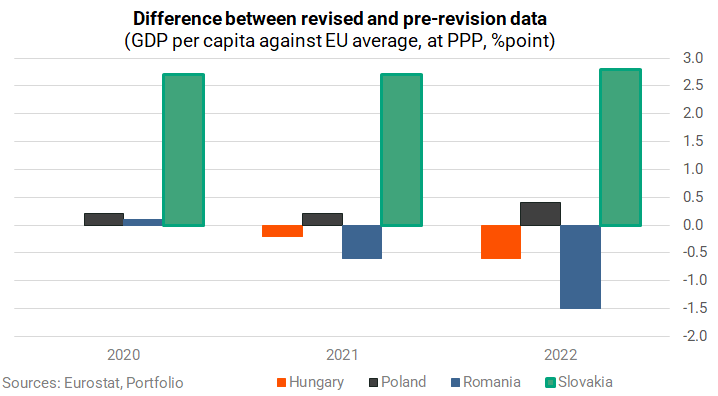
The fact that the Slovak Statistical Office has revised upwards the figures for the last three years (more precisely, the price level has been revised downwards, which automatically leads to an increase in the price-adjusted GDP per capita) confirms that they did something wrong in 2019, the year of the first revision.) So, our impression is that the second revision may have brought us a little closer to the truth, but given that real growth in the period under review was above the EU average, the GDP per capita indicator on PPP after the second revision still looks too low, so
overall we are still not sure exactly how developed Slovakia is.
We cannot therefore give a precise answer to the question posed in the title. According to the most important development indicator (GDP per capita at PPP), Hungary is more developed than Slovakia - but this indicator is useless for Slovakia. If we look at nominal GDP per capita, Slovakia is still ahead of Hungary, but its lead is diminishing, except that this indicator does not tell us anything about relative price levels, which is necessary for a satisfactory comparison of development.

Even if there are no obvious inaccuracies in the calculation, international comparisons based on purchasing power parity should be viewed with some reservations. Taking into account the views of the Slovak central bank's economists and the trend before 2015, it is hardly wrong to think that
Hungary and Slovakia are actually very similar in terms of development,
so there is little point in discussing which country is 1-2 percentage points ahead of the other. We also think this because since 2015, when Slovakia was a bit ahead of Hungary, real GDP has grown faster in Slovakia, so it is plausible that Slovakia has by now fallen a bit behind.
Horváth told Portfolio that convergence is monitored according to a number of alternative indicators, but each has its own weaknesses. "Among these, I would perhaps highlight the indicator that is calculated by simply taking the relative real GDP per capita growth rate from the 2015 PPP data (assuming that 2015 was still "well" calculated and that there has been no significant relative price level movement since then that would not be sufficiently captured by real GDP developments)."
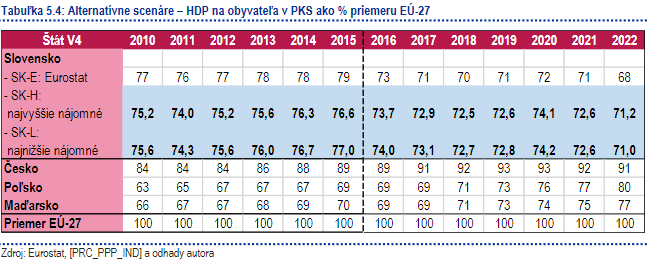
The economist cautions that it is difficult to comment on the absolute level, but one estimate is that Slovakia's living standards have been underestimated by roughly 2% since 2016, if we substitute other countries' housing statistics for the years after 2016, according to official Slovak housing data.
However, this does not really answer the question asked, and would not substantially change the story of recent years,
Horváth adds.
There can be little doubt that Slovakia's growth has slowed significantly in recent years. Even if, based on the trends in GDP per capita at PPP up to 2015 and the real growth surplus relative to the EU average, we can casually say that Slovakia is around 80-82% of the EU average (which, in Horváth's words, would be a very optimistic estimate), Slovakia cannot be proud of its performance in recent years. The outlook in this case is far less gloomy than the official figures suggest, but it is not good.
Something is indeed amiss in Slovakia
Let's forget for a moment the vague purchasing power parity and other development indicators and look at a much clearer indicator of economic performance. In terms of annual average real GDP growth, Slovakia's performance in the 2000s was stellar, earning it the label of the tiger of the Tatras for good reason, inspired by the growth miracle of the Asian tigers. Compared with 1995, Slovakia's cumulative growth is the second highest of the four countries studied (and Hungary's the lowest, as it had the highest base). If we take 2005 as the base year, Slovak growth is only third in the ranking, and clearly last from 2010 onwards. There is no question, therefore, that in recent years the country has underperformed relative to the region by a wide margin, regardless of whether its relative development has declined, stagnated, or increased compared to the EU average.

Slowing growth is natural as development increases. According to convergence theory, every economy has a level of development that can be reached, and the further away from it, the faster it can grow, but as it approaches the maximum level of development, a significant slowdown occurs. Although we have explained above that we do not know exactly how developed Slovakia is,
we can say with certainty that it is not so developed as to justify the current low potential growth.
It is either that the achievable convergence is inherently low and Slovakia is then permanently stuck in the catching-up phase, or that for some reason the catching-up to their current level of development is stuck. But what is certain is that the growth that Slovakia has been experiencing recently cannot be described as healthy and requires immediate intervention by economic policy makers.
Here we can return again to the question posed in the title: although we cannot answer now whether Hungary has indeed overtaken Slovakia, we can say with a high degree of certainty that, if it has not yet done so, Hungary will certainly overtake them in a few years if current trends continue.
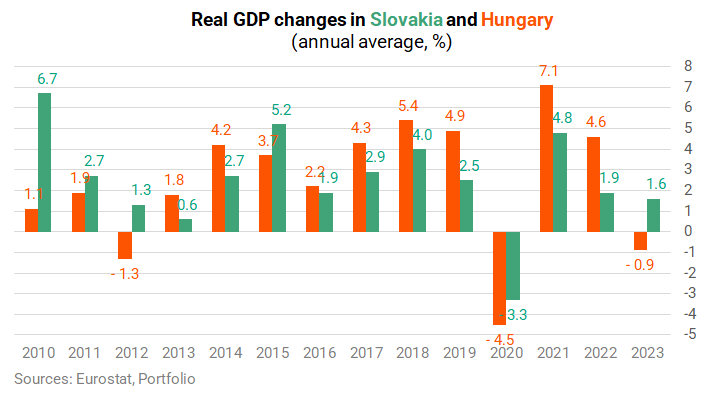
"The message is clear. Slovakia's catching-up process has slowed down in recent years at the very least, and has most likely come to a complete halt. One could write a lot about the reasons for this, and list a plethora of structural indicators. The problem is therefore domestic," writes Horváth.
In conclusion, it is worth pointing out that in analysing Slovakia's relative development,
the figures of international comparisons should not be taken to the nearest centimetre, especially when they are based on a complex indicator.
What they are very well suited for is to identify the long-term shifts in the differences in development seen between countries. For example, there can be no doubt that Romania has shown a huge catching-up and has roughly reached the level of development of Hungary (more precisely, its economic performance in terms of GDP over a year), just as there is no doubt that Slovakia has not been able to maintain the development advantage it gained in the 2000s within the narrow region.
Cover photo: Getty Images





