Severe labour shortage in Hungary - Why is the problem so massive?


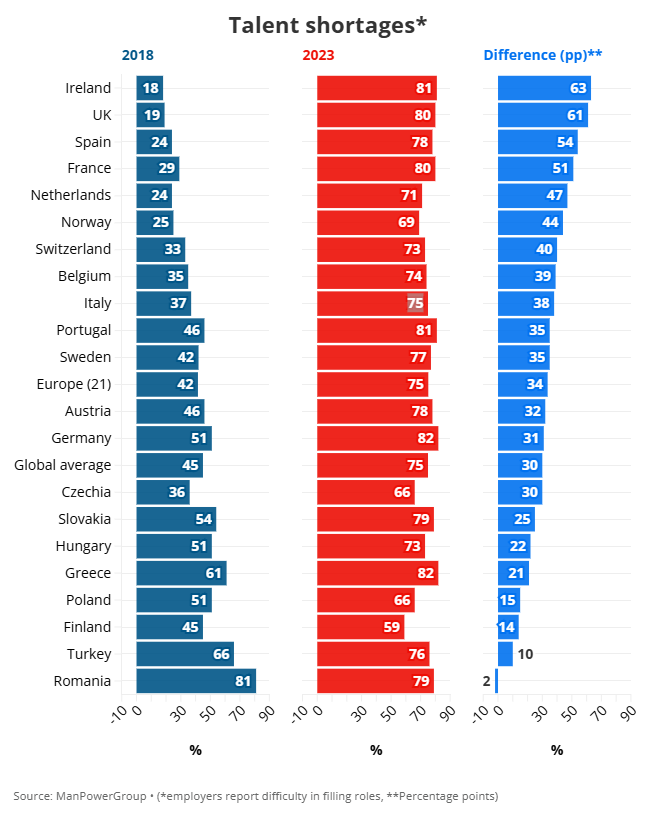
Some 75% of employers in 21 European countries could not find workers equipped with the right skills in 2023. This was up 33 percentage points compared to 2018. And there's no sign of demand for skilled workers slowing any time soon, Euronews reported on the latest findings of ManpowerGroup, a global workforce solutions company.
Of the 21 European countries surveyed, Germany has the highest proportion (82%) of firms that have difficulty finding skilled workers to fill vacancies. The lowest proportion of firms complained about this phenomenon in Finland (59%) and 73% in Hungary.
In 2018, the average was only 42% in these countries, varying from 18% in Ireland to 81% in Romania. Except for Romania (81% in 2018 vs. 79% in 2023), the share of employers who could not find the skills they needed increased substantially between 2018 and 2023.
This rise was more than 50 percentage points in Ireland, the UK, Spain and France. For example, it reached from 18% to 81% in Ireland, and from 19% to 80% in the UK.
The increase was also more than the European average in the Netherlands (47 pp), Norway (44 pp), Switzerland (40 pp), Belgium (39 pp) and Italy (38 pp).
Many countries worse off than Hungary
In Hungary, the proportion of firms that had difficulty finding suitably qualified workers to fill their vacancies was "only" 51% in 2018, compared to 73% last year.
The growth rate of the domestic rate was thus below the average of 21 European countries. However, the full picture is that in 2018, with a domestic rate of 51%, Hungary had the fifth highest proportion of firms (behind Germany and Poland) that had problems filling vacancies with skilled workers.
By contrast, last year's 73% rate in Hungary meant that 16 of the 20 other European countries surveyed had a higher or similar proportion of companies with problems on this issue.
“Figures in our annual Talent Shortage survey increased dramatically, as the need for skilled workers is becoming more and more acute,
Mara Stefan, VP of Global Insights at ManpowerGroup, told Euronews Business.
“In Europe, we see falling unemployment, meaning there are not enough skilled workers to fill existing or new jobs. To exacerbate this, Europe has an ageing population, with a global decline in birthrates further contributing to the skills and talent gaps we see today”, she underlined.
“This partly explains why Germany’s talent figure shortages are steeper than Finland. In 2023, Germany’s unemployment rate was 3.0%, whilst Finland’s was at 7.0%, resulting in a smaller pool for finding skilled labour,” Mara Stefan added.
One of the main problems for companies
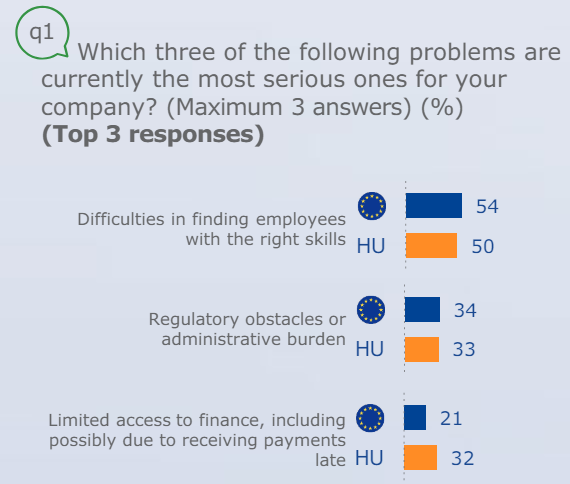
According to the Eurobarometer "SMEs and skills shortages" survey conducted at the end of last year, skills shortages are the top-ranking problem for SMEs, even more so for 'large' SMEs.
the survey showed that more than half (54%) of Small and medium-sized enterprises in the eu mentioned labour shortage, i.e. finding employees with the right skills, one of their top 3 problems. exactly half of hungarian respondents were of the same view.
At the two extremes of EU member states are Latvia and Belgium, with only around a third (35%) of firms in the Baltic state listing skills shortages as one of their top three problems, compared to two-thirds (68%) of businesses in Belgium.
After skills shortages, regulatory problems and administrative burdens were cited by EU businesses as the main problems.
Shortage of technicians is great
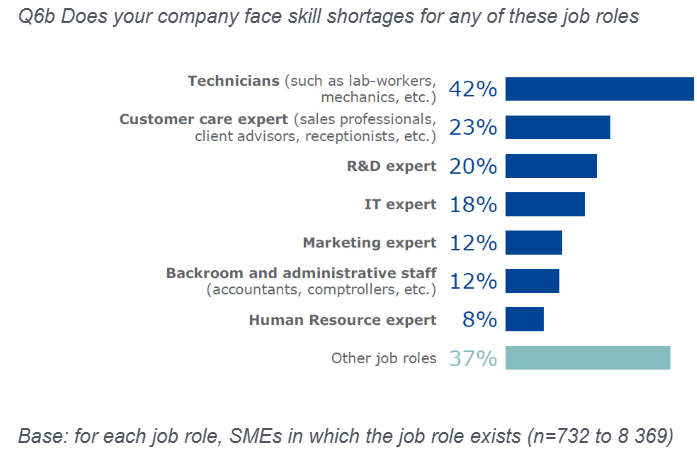
Respondents in this survey were also presented with seven job roles and they were asked for each of these whether the job role exists in their SME and whether their SME faces any skills shortages for this job role.
33% employ technicians (such as lob-workers, mechanics, etc.).
42% in these SMEs with technicians report that they face skills shortages for this job role – this is, by far, the most-identified job role with skills shortages.
In 39% of SMEs, there are customer care experts (sales professionals, client advisors, receptionists, etc.). In these SMEs with customer care experts, 23% of respondents answer that there is a skills shortage for this job role.
Although backroom and administrative staff (accountants, comptrollers, etc.) are job roles most likely to be present in SMEs (52%), respondents are less likely to reply that their SME faces a skills shortage for this role (12%).
On average, 20% SMEs with an R&D expert reply that they face a skills shortage for this job role; a similar proportion is also observed for IT experts (18%). The corresponding figure us 12% for marketing experts and 8% for human resource experts.
The data also show that Hungarian SMEs have the most difficulty finding staff for technician jobs, with 22% of firms experiencing such difficulties.

Few applications for vacancies
According to the Eurobarometer survey, 56% of respondents answer that their SME's skills shortage is caused by there being few or no applicants. This answer was given by 60% of Hungarian respondents, with higher rates only in five Member States.
Another main reason why SMEs had difficulties finding and hiring staff was, according to 54% of respondents, that applicants do not have the right qualifications, skills or experience. In Hungary, this rate was a lot higher at 66%, with a larger share of SMEs in only two countries (Estonia and Slovakia) reporting this to be an even greater problem than in Hungary.
Cover photo: Getty Images





